Most compact city apartments suffer from a severe layout identity crisis. You have a few erratic feet of empty floor space between a balcony door and an interior passageway, and suddenly you are trying to wedge an entire corporate command center into a hallway. It rarely works. Heavy desks block foot traffic. Plastic chairs destroy the aesthetic harmony of original plaster molding. If you want a functional writing nook that honors historic architecture rather than fighting it, the approach has to shift from pure utilitarian office supply to understated interior restraint.
Embracing Haussmann Proportions
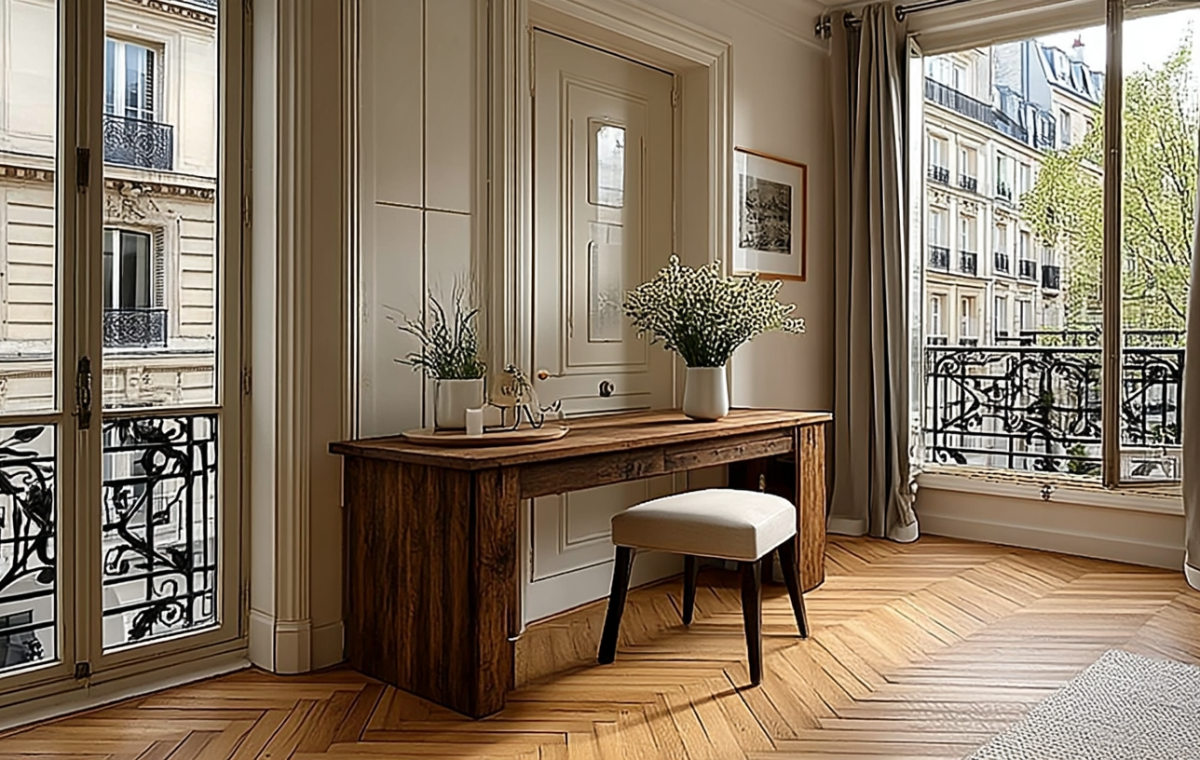
Look at the floor beneath your feet before buying a single piece of furniture. Traditional herringbone hardwood floors demand furniture with legs that breathe. A chunky, floor-skimming executive desk will visually suffocate the grain and make the room feel cramped. Slimmer wooden writing desks allow the chevron pattern to flow uninterrupted underneath, creating an immediate sense of expanded square footage. Natural timber also softens the stark verticality of tall French doors and white paneled walls.
- Choose low-profile seating that tucks completely under the writing surface.
- Keep desktop clutter to a bare minimum with a single ceramic vase or tray.
- Let natural daylight take center stage instead of relying on heavy desk lamps during daytime hours.
Balancing Light and Function
Working right next to a pair of wrought-iron balcony doors sounds romantic until afternoon glare blinds your laptop screen and drafts chill your ankles. Positioning a console table or desk flat against an interior partition wall provides a stable, grounded anchor. You keep the peripheral view of the bustling street outside without sacrificing workspace ergonomics. Notice how a simple upholstered vanity stool functions comfortably here without dominating the floor plan. It is lightweight, easy to slide away, and adds a soft textural contrast against rich wood and polished hardware.
Of course, real-world upkeep applies here. Polished hardwood requires constant dusting, and open windows let in urban soot that quickly settles on delicate fabric upholstery. It is a trade-off. You accept minor maintenance in exchange for an inspiring, light-filled daily routine.
How do you balance the need for a practical home office with the desire to preserve your living space architectural character?
Editorial Silo • Recommended Architecture Studies
- The Engineering of Ease: How to Make Contemporary Furniture for High-Performance Urban Living”, description: “Modern living demands a departure from static design; to make contemporary furniture today is to engineer kinetic, multifunctional solutions. This guide introduces the ‘2:1 Rule’ of spatial density—balancing two parts low-profile furniture with one part uninterrupted breathing room. We analyze the ergonomics of ‘cognitive stability,’ integrating hidden power hubs, wireless charging surfaces, and modular footprints that allow a single piece to pivot between a high-focus workspace and a serene sanctuary. — Archival Design Case Study
- Grand Closet home office aesthetic styling trends — Archival Design Case Study
Curated Lookbooks & Architectural Studies
- Timeless Mantel Decor Ideas for Your Living Room Fireplace
- Practical Small Entryway Ideas That Actually Work
- Classic Hallway Design: Balancing Style and Entryway Function
- Designing Around a French Marble Fireplace
- The Geometry of the Void: Architectural Blueprints for Precision Powder Rooms Under Stairs
- The Tactile Aesthetic of Joan Didion Apartment Big Price Cut: Materials, Moods & Lighting Kelvin
Curated Visual Lookbook
Design Gallery & Spatial Studies
A visual curation of architectural arrangements, lighting concepts, and material palettes featured in this space.