The Anatomy of a Quiet Display
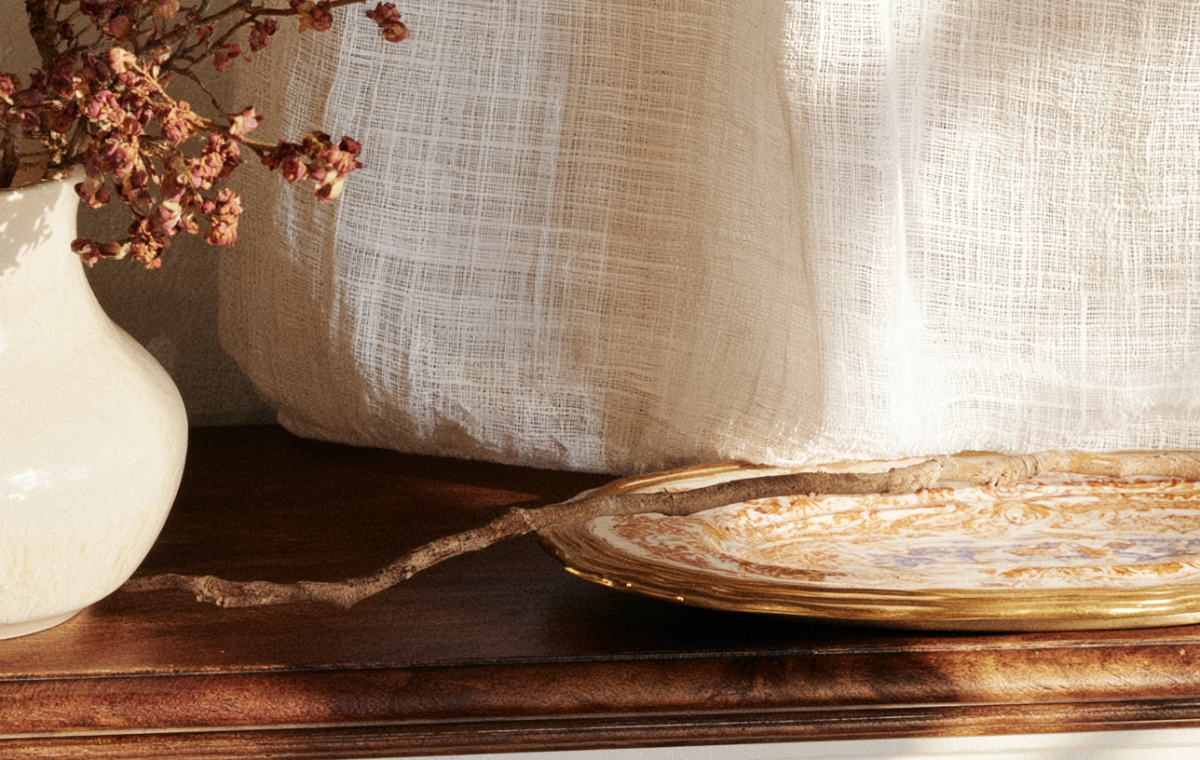
Styling a wooden console or mantle often fails when we try too hard. Too many trinkets clutter the eye. Instead, look at how a single branch, a heavy gold-rimmed ceramic dish, and a weathered jug create instant gravity. Real warmth comes from restraint. It requires a willingness to leave empty space around your objects so each piece breathes.
Balancing Textures and Tones
Weight matters in vignette styling. Notice the heavy wooden surface paired against the fragile, textured weave of a linen curtain in the background. If everything in your display shares the same smooth finish, the eye grows tired. Mix rough-hewn dry twigs with polished metal accents or cracked earthenware. This tension keeps flat surfaces dynamic throughout changing daylight.
- Use dried botanicals for zero-maintenance seasonal height.
- Layer flat decorative trays beneath upright objects to anchor the arrangement.
- Allow natural light to graze across textured fabrics to cast soft shadows.
Of course, upkeep demands a careful touch. Dried stems shed easily when bumped, and antique platters require gentle dusting rather than harsh chemical cleaning. Yet these small maintenance habits are a minor trade-off for rooms that feel genuinely collected over years rather than bought in a single afternoon.
Where to Start Your Arrangement
Begin by clearing the entire surface completely. Wipe down the wood. Place your tallest or heaviest item first—such as a large vase or a stacked pile of art books—off-center to establish an asymmetrical anchor. Fill the remaining visual weight with a lower, horizontal element like a decorative dish or a winding branch that leads the eye across the timber grain.
How do you usually decide when a shelf display is finished, or do you find yourself constantly tweaking arrangements week after week?
Editorial Silo • Recommended Architecture Studies
- The Architect’s Blueprint: Living Room Ideas For Small Rooms & Engineering Spatial Volume and Flow in Compact Living Rooms — Archival Design Case Study
- Large living room design rules for functional flow — Archival Design Case Study
Curated Lookbooks & Architectural Studies
- Small Entryway Organization: Fix Your Hallway Clutter
- Boucle Dining Chairs: Texture, Comfort, and Real-Life Upkeep
- Charming Wooden Vanity Setup Ideas for Classic Bedrooms
- The Tactile Aesthetic of Green Couch Living Room Design: Materials, Moods & Lighting Kelvin
- The Social Spine: L Shaped Kitchen Floor Plans & Why L-Shaped Kitchen Floor Plans are the Anchor of Modern Open-Concept Living
- The Engineering of Ease: How to Make Contemporary Furniture for High-Performance Urban Living”, description: “Modern living demands a departure from static design; to make contemporary furniture today is to engineer kinetic, multifunctional solutions. This guide introduces the ‘2:1 Rule’ of spatial density—balancing two parts low-profile furniture with one part uninterrupted breathing room. We analyze the ergonomics of ‘cognitive stability,’ integrating hidden power hubs, wireless charging surfaces, and modular footprints that allow a single piece to pivot between a high-focus workspace and a serene sanctuary.
Curated Visual Lookbook
Design Gallery & Spatial Studies
A visual curation of architectural arrangements, lighting concepts, and material palettes featured in this space.