The Weight of Dark Cabinetry
Dark kitchen cabinets demand respect. They alter the temperature of a room immediately. Instead of reflecting every beam of midday sunshine, deep espresso and charcoal finishes absorb light, anchoring the space with quiet authority. If you have ever felt that all-white kitchens lean too sterile or clinical, turning toward heavier hues offers a direct antidote. It is a bold architectural move that requires careful balancing, yet the payoff is a cooking zone that feels permanent, grounded, and deeply personal.
Balancing Light and Shadow
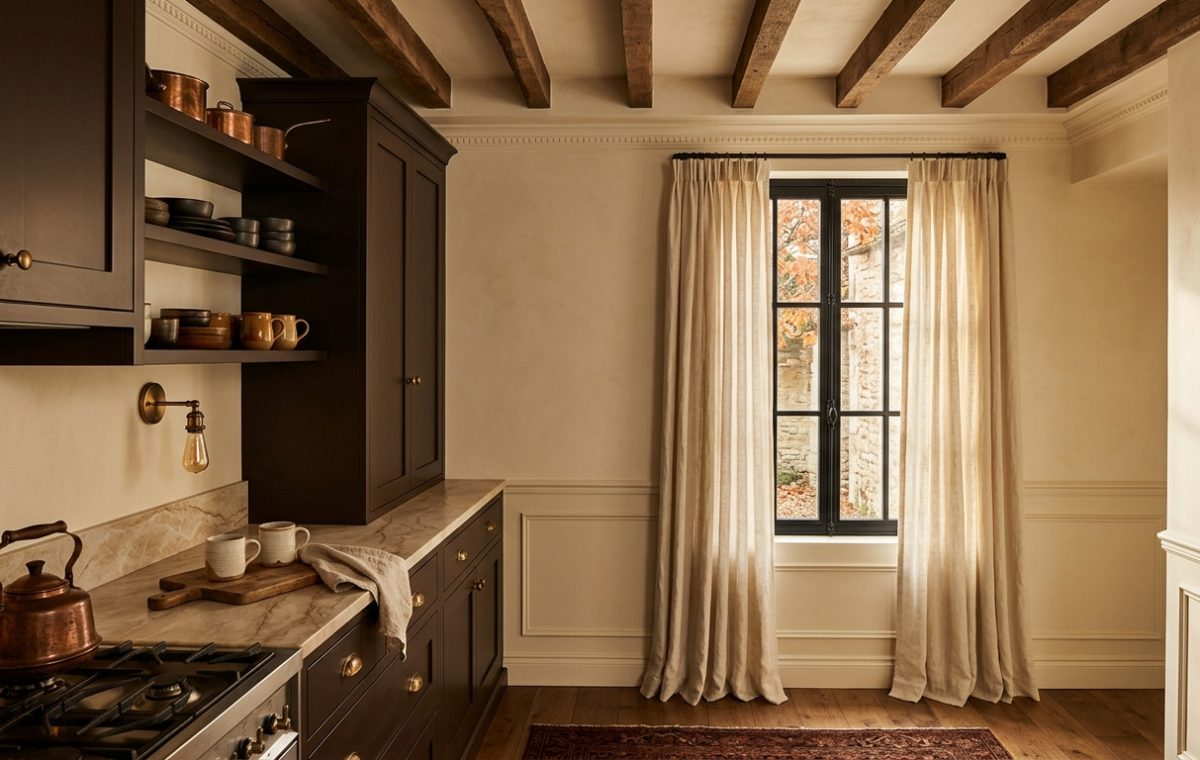
You cannot drop heavy millwork into a cave and expect comfort. The secret lies in deliberate contrast. Notice how the dark upper and lower storage blocks in this room interact with the pale, warm plaster walls and the sweeping, unlined cream linen curtains framing the window. Natural daylight pours through the glass panes, softening the perimeter. If your ceiling features raw wooden beams, you already possess a natural bridge between dark cabinetry and bright, airy textiles. Brass sconces and gleaming copper cookware add metallic friction, bouncing tiny pinpricks of amber light across the matte painted surfaces.
Practical Realities of Deep Finishes
- Maintenance: Dark surfaces show dust and water spots faster than bleached oak. Keep a soft microfiber cloth handy.
- Lighting Strategy: Plan for layered illumination. Under-cabinet task lights are non-negotiable here.
- Hardware Selection: Unlacquered brass and antique bronze warm up charcoal tones instantly.
There is also the matter of spatial perception. Small kitchens can feel smaller with dark woodwork, but they often gain a jewel-box intimacy instead of looking cramped. It all hinges on ceiling height and window placement. When natural light is abundant, dark tones stop feeling oppressive and start feeling architectural.
Curating Your Own Space
Building a moody kitchen isn’t about following a rigid formula. It is about editing out the unnecessary white noise until only textures remain—the cold click of a cast-iron skillet, the soft drape of linen, the rough grain of an old cutting board. How do you plan to balance moody tones in your own cooking space without losing that essential morning brightness?
Editorial Silo • Recommended Architecture Studies
- Ergonomic Mastery: Functional & Space-Saving Hacks for Kitchen Tile Ideas Floor — Archival Design Case Study
- The Golden Ratio of Designing Kitchen Island: A Masterclass in Spatial Flow and Architectural Symmetry — Archival Design Case Study
Curated Lookbooks & Architectural Studies
- Hallway Console Table Decor Ideas for a Sophisticated Entry
- Architectural Illumination: Bright Bedroom Color Ideas & Scaling Bedroom Volume with High-Reflectance Color Systems
- The Functional Gourd: Turning Your Halloween Decor into Sustainable Home Accents
- The Micro-Mudroom: Wall Mounted Coat Rack Plans & Ergonomic Mastery and Multi-Tiered Spatial Efficiency
- Mastering Corner Reading Nook Styling in Small Spaces
- The Tactile Aesthetic of Inexpensive Apartment Decorating Ideas: Materials, Moods & Lighting Kelvin
Curated Visual Lookbook
Design Gallery & Spatial Studies
A visual curation of architectural arrangements, lighting concepts, and material palettes featured in this space.