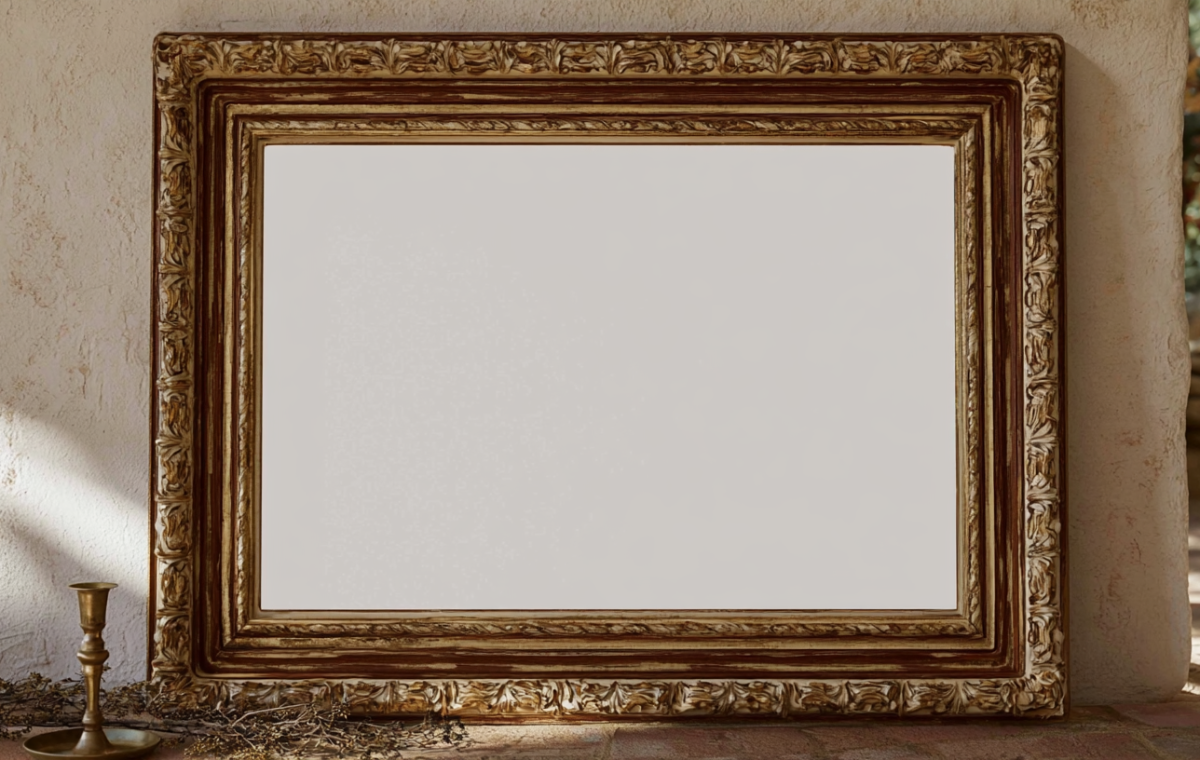
Mass-produced decor has its place, but it rarely tells a story. When you bring an antique picture frame into a room, you are instantly anchoring the space with history. That heavy wooden moulding, worn down by decades of handling, carries a weight that a pristine store-bought box store piece simply cannot replicate. Real patina takes time.
The secret lies in leaving the frame empty or pairing it with muted, tonal artwork that does not compete with the ornate borders. Notice how the carved wood and aged metallic finish command attention against a textured plaster background. It creates a focal point without shouting. Too often, people rush to fill every square inch of negative space with glass prints and saturated photography, losing the raw breathing room that allows a special piece to truly shine.
Sourcing and Inspecting Vintage Mouldings
Hunting for quality vintage frames requires patience. Skip the pristine showroom floors and head straight to estate sales, dusty antique malls, or local flea markets. Look closely at the corners. Separation in miter joints happens easily over time, but solid wood can always be re-glued and clamped back into shape. Plaster or composition ornamentation, however, can crumble past the point of easy restoration.
- Inspect the back panels for woodworm damage or dry rot.
- Check if the original gilding or paint is flaking off aggressively.
- Measure your intended display wall twice before committing to oversized frames.
Weight is another factor most decorators overlook. An authentic, heavily carved wooden frame paired with thick glass can pull right out of weak drywall if it is not hung using proper heavy-duty anchors or stud-mounted hardware. Take the extra five minutes to install rated fasteners. Nothing ruins an afternoon faster than a crashing thud from the hallway.
Balancing Scale and Wall Texture
An ornate piece looks best when balanced by simple surroundings. If your frame features deep relief work, intricate acanthus leaves, or dark burnished bronze tones, let the underlying wall remain understated. Lime-wash, soft Venetian plaster, or simple matte linen paint provides the perfect tactile backdrop. Minimal styling nearby, like a slender brass taper candle holder or a handful of dried botanicals, keeps the arrangement grounded rather than museum-stuffy.
How do you plan to incorporate vintage wall accents into your current room layout?
Editorial Silo • Recommended Architecture Studies
- The Architect’s Blueprint: Living Room Ideas For Small Rooms & Engineering Spatial Volume and Flow in Compact Living Rooms — Archival Design Case Study
- Large living room design rules for functional flow — Archival Design Case Study
Curated Lookbooks & Architectural Studies
- Linen Kitchen Towels: Why Pure Flax Beats Cotton Every Time
- Front Entryway Mat Ideas to Elevate Your Doorstep Style
- Welcoming Painting A Large Room: Pro Efficiency Tips
- French Country Dining Room Ideas for Small Parisian Spaces
- Small Apartment Balcony Ideas: Ergonomic Mastery and the Best Patio Heaters
- Marble Kitchen Countertops: Real Talk on Upkeep and Style
Curated Visual Lookbook
Design Gallery & Spatial Studies
A visual curation of architectural arrangements, lighting concepts, and material palettes featured in this space.