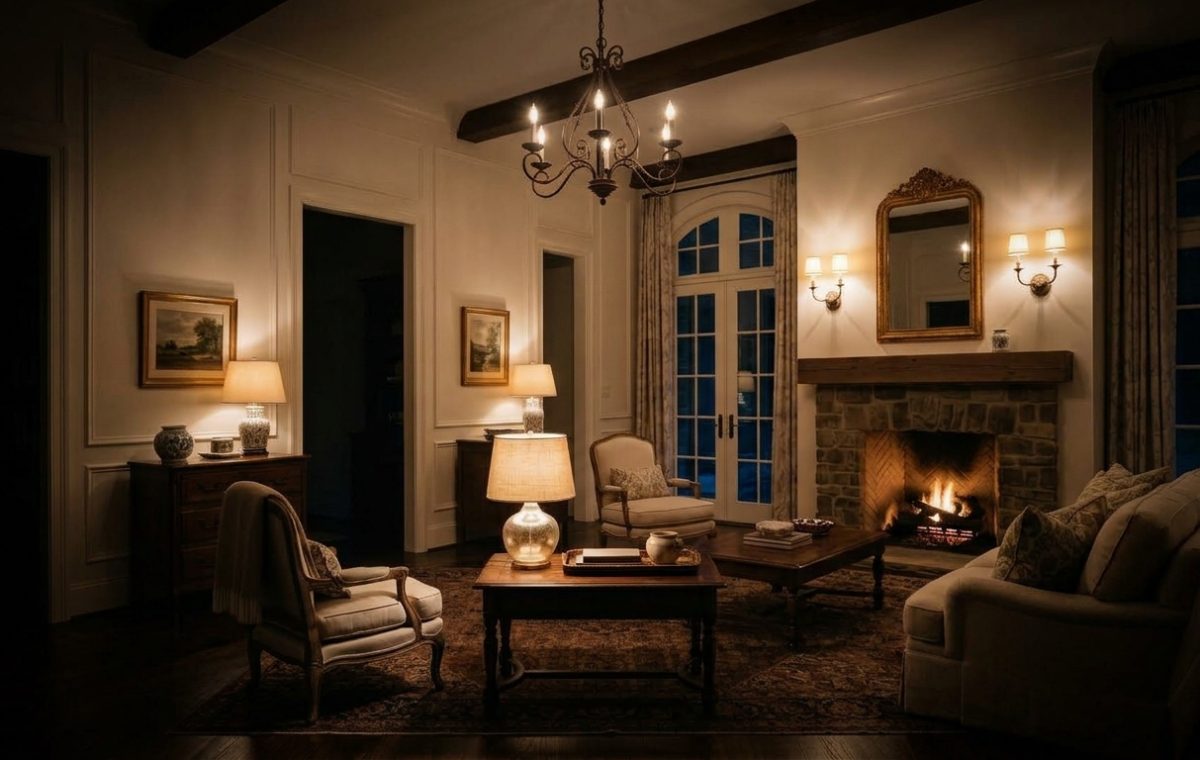
Bright white walls have dominated interior design for over a decade. Yet, clean minimalism often feels cold once the sun goes down. A stark room rarely invites you to linger with a heavy book or a glass of wine. Instead, shifting toward deep, enveloping tones creates a sanctuary that feels safe from the outside world. Rich architectural molding paired with dark beams completely changes how a space holds light.
The Psychology of Low-Light Interiors
Overhead illumination is usually the enemy of genuine coziness. When every bulb glares from the ceiling, shadows vanish along with intimacy. By stripping away bright overhead glare and relying entirely on multi-tiered table lamps, wall sconces, and a roaring hearth, the room takes on an entirely different rhythm. Notice how the amber glow catches the polished wood surfaces and the carved stone fireplace. This is not about leaving rooms in darkness. It is about placing light precisely where human eyes naturally rest.
Layering Textures in Dark Spaces
Monochromatic dark rooms can easily fall flat if every surface absorbs light in the exact same way. Texture acts as the substitute for bright color. Heavy upholstered sofas in muted linen contrast against rugged stone mantels. A worn Persian rug softens dark wood flooring while anchoring the central seating zone. You need tactile variety. Smooth brass mirror frames, chunky woven throws, and distressed leather accents keep the eye moving across the space without needing vibrant hues to command attention.
- Use low-wattage warm bulbs to mimic candle flame color temperatures.
- Anchor heavy furniture arrangements with vintage woven rugs.
- Combine rough stonework with smooth polished timber.
- Position table lamps at varying heights for balanced depth.
Of course, maintaining this aesthetic requires a bit of practical compromise. Dust shows more readily on dark surfaces, and heavily shadowed corners demand clever cord management to keep lamps functioning without exposed wires ruining the illusion. Yet, the maintenance payoff is minor compared to the sheer emotional relief of walking into a room that exhales stress the second you cross the threshold. How are you balancing natural daylight with intimate evening illumination in your own home?
Editorial Silo • Recommended Architecture Studies
- The Architect’s Blueprint: Living Room Ideas For Small Rooms & Engineering Spatial Volume and Flow in Compact Living Rooms — Archival Design Case Study
- Large living room design rules for functional flow — Archival Design Case Study
Curated Lookbooks & Architectural Studies
- Vintage Tabletop Decor Ideas for Historic Home Charm
- Cool Conference Rooms with the Amazing Table Chair Desigs and Wall Decor
- Sustainable design house: Fresh Layout strategies
- Maximum Utility, Minimum Footprint: The Elite Guide to Amazon Labor Day Ergonomics for Narrow Balconies
- The Architecture of the 15-Square-Foot Pantry: Engineering Vertical Depth and Sightline Symmetry
- Entryway Console Table Ideas for Small, Polished Foyers
Curated Visual Lookbook
Design Gallery & Spatial Studies
A visual curation of architectural arrangements, lighting concepts, and material palettes featured in this space.