Finding Space Where None Exists
Square footage is expensive. Most of us waste awkward corners on empty air or heavy storage units that suffocate the room. Carving out a functional small home office nook does not require an entire spare bedroom. It demands a repurposed wall, ruthless prioritization, and a refusal to treat tight spaces as dead zones.
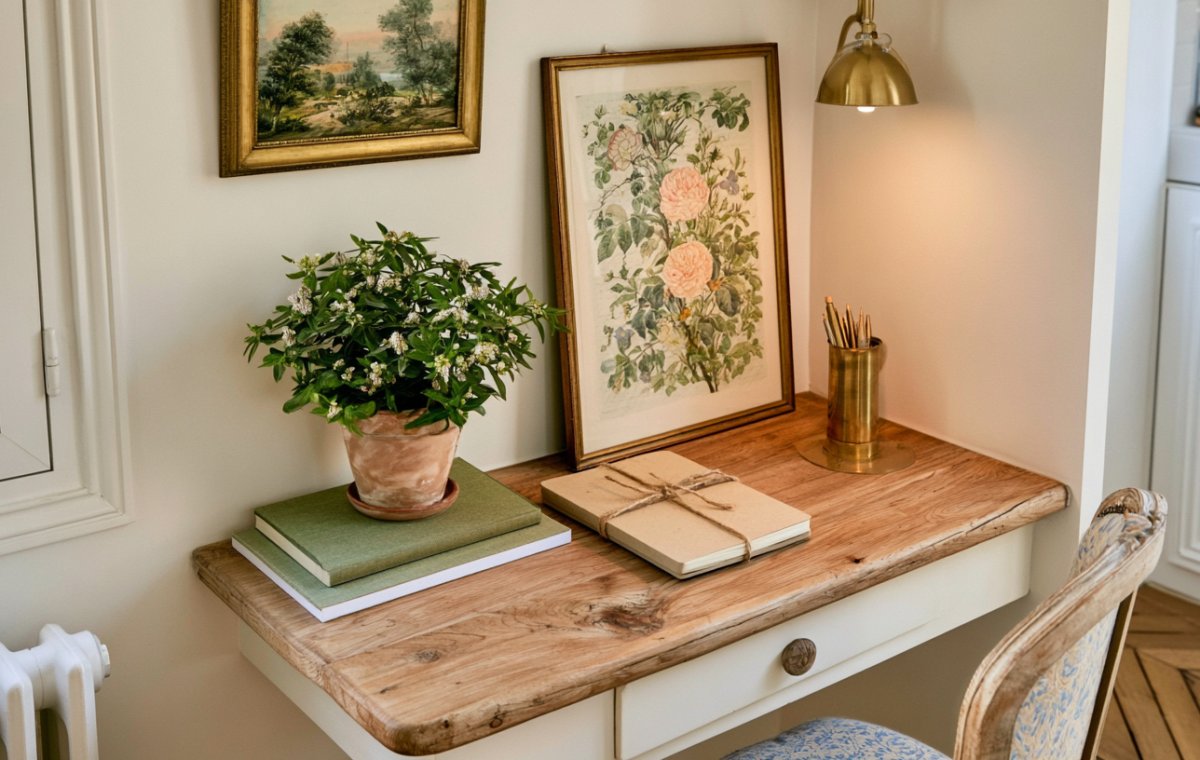
A narrow wooden desk anchors the entire setup without dominating the floor plan. Natural wood grain adds warmth that laminate and glass simply cannot touch. That organic texture changes how a room feels. It grounds your daily tasks in something tangible. Pair that with a comfortable upholstered chair, and your makeshift workstation suddenly looks like a deliberate design choice rather than an afterthought.
Lighting and Layering for Visual Comfort
Overhead lighting ruins concentration. Harsh bulbs flatten a room and induce headaches by mid-afternoon. Task lighting changes the dynamic entirely. A simple adjustable brass lamp mounted nearby casts a focused, amber glow right where your pen meets paper. It creates a distinct zone. When the lamp is on, it is time to work. When it is off, the corner fades back into the living space.
Walls need personality. Sticking a computer against bare drywall turns your nook into a punishment zone. Layer in framed vintage botanical prints. Break up the monotony of flat paint with classic illustrations. Botanical art brings a touch of the outdoors inside, keeping your workspace feeling alive rather than clinical.
- Choose slim-profile furniture that respects your walking paths.
- Keep writing instruments contained in a sleek metal holder.
- Layer books horizontally beneath a small potted plant to add height variation.
The Reality of Maintenance
Let us be honest. Open wooden surfaces collect dust. Potted plants drop the occasional leaf onto your paperwork. A minimalist setup looks stunning in photographs, but real life happens. Clutter creeps in. Stacking a couple of bound notebooks tied with twine keeps rough drafts out of sight while maintaining that coveted rustic aesthetic.
If you have an unused corridor or a blank stretch of wall under a window, stop ignoring it. Outfit it with a slender surface, good illumination, and a few pieces of art that inspire you. How are you currently utilizing those awkward, forgotten zones in your home?
Editorial Silo • Recommended Architecture Studies
- The Engineering of Ease: How to Make Contemporary Furniture for High-Performance Urban Living”, description: “Modern living demands a departure from static design; to make contemporary furniture today is to engineer kinetic, multifunctional solutions. This guide introduces the ‘2:1 Rule’ of spatial density—balancing two parts low-profile furniture with one part uninterrupted breathing room. We analyze the ergonomics of ‘cognitive stability,’ integrating hidden power hubs, wireless charging surfaces, and modular footprints that allow a single piece to pivot between a high-focus workspace and a serene sanctuary. — Archival Design Case Study
- Grand Closet home office aesthetic styling trends — Archival Design Case Study
Curated Lookbooks & Architectural Studies
- How to Style a Round Mirror Wall Decor Piece Like a Pro
- The Architectural Blueprint: Structural Precision in Bachelor Bedroom Furniture Layouts
- Hallway Runner Rug Ideas to Transform Long Corridors
- Powder Room Tile Ideas: Designing a Compact Half Bath Right
- Styling Hardwood Flooring with Area Rugs: A Practical Guide
- Effortless Table Setting Ideas for Cozy Dining Spaces
Curated Visual Lookbook
Design Gallery & Spatial Studies
A visual curation of architectural arrangements, lighting concepts, and material palettes featured in this space.