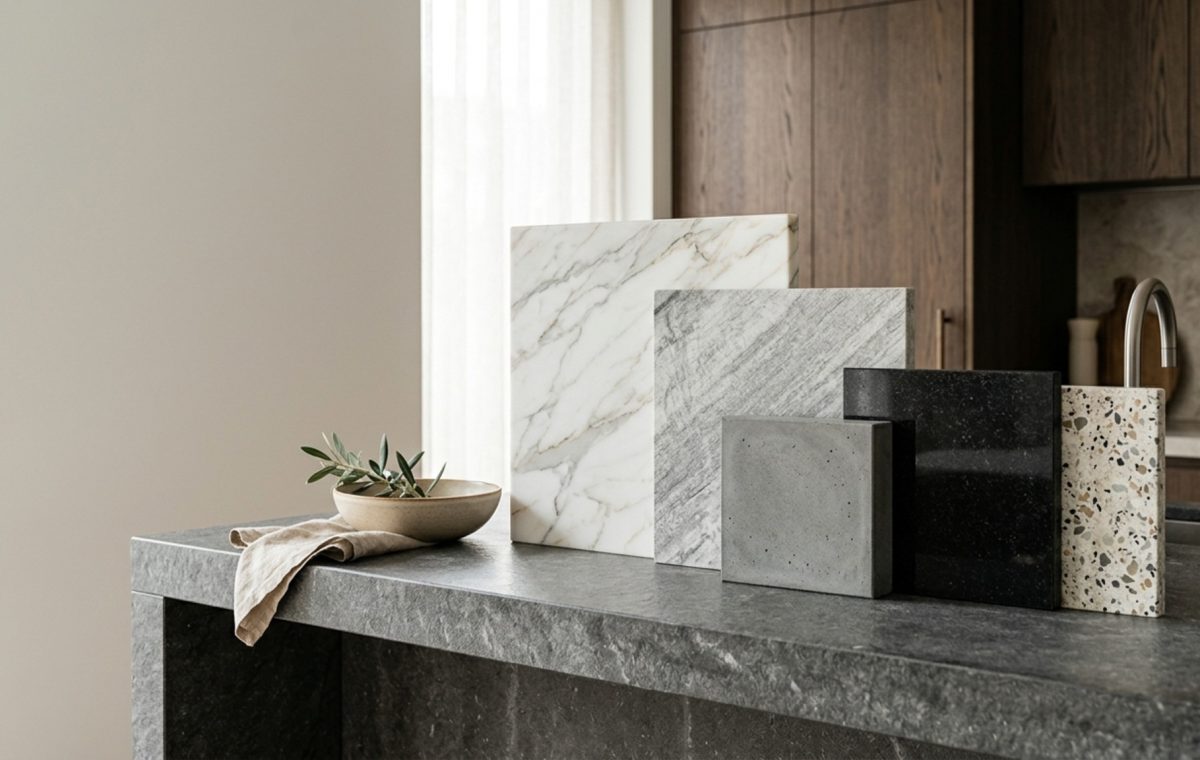
Morning light filters through the floor-to-ceiling steel-casement windows, casting elongated shadows across a three-centimeter honed marble island that feels more like a sculpture than a workspace. When evaluating countertops material options, the decision shifts from mere color selection to a profound exploration of architectural volume and structural integrity. A countertop is not just a surface for prep; it is a horizontal plane that anchors the kitchen, dictating the spatial cadence of the entire home.
In high-end residential architecture, we view the slab as a load-bearing element. The choice between a standard 2cm thickness with a built-up mitered edge and a solid 3cm monolithic slab significantly alters the visual weight of the cabinetry below. A 3cm slab of Taj Mahal Quartzite, for instance, exerts immense pressure on the sub-structure, requiring reinforced carcasses that can handle upwards of 20 pounds per square foot. This structural dialogue between the horizontal stone and the vertical cabinetry determines whether the kitchen feels grounded and permanent or light and ephemeral.

1. The Monolithic Presence: Assessing Countertops Material Options for Structural Impact
Choosing a slab is an exercise in scale. We often see homeowners gravitate toward the aesthetic of a material without considering its architectural gravity. A thick, mitered edge can make a kitchen feel imposing, while a thin, eased edge promotes a sense of airy minimalism. The spatial flow of a kitchen depends on these sightline alignments. When a countertop extends into a breakfast bar, the overhang must be calculated not just for legroom (a minimum of 12 to 15 inches), but for the material’s tensile strength.
Natural stone, particularly denser granites and quartzites, offers a tactile grounding that synthetic materials struggle to replicate. The cold touch of a stone surface in a room filled with warm oak cabinetry creates a sensory contrast that defines luxury. However, the architectural impact is most felt at the edges. A waterfall detail—where the stone continues vertically to the floor—transforms a functional island into a geometric monolith. This design choice requires precision engineering; the vein-matching at the mitered joint must be flawless to maintain the illusion of a single, continuous block of stone.
Modern Waterfall Edge Profiles: Scaling the Vertical Plane
Integrating modern waterfall edge profiles into a layout demands a rigorous understanding of floor levelness and cabinetry precision. Because the stone drops to the floor, any deviation in the subfloor is amplified. We often specify a recessed toe-kick at the base of the waterfall to create a slight shadow line, making the heavy stone appear as if it is hovering just millimeters above the floor. This technique, frequently seen in projects by designers like Joseph Dirand, utilizes negative space to alleviate the inherent bulk of the material.

2. Quartz vs Granite Durability Comparison: Engineering the Modern Kitchen
The debate between natural and engineered surfaces often centers on the quartz vs granite durability comparison. From an architectural perspective, quartz offers a level of consistency that allows for more predictable structural planning. Because it is a composite, it lacks the natural fissures and stress points found in granite or marble, making it an excellent candidate for long, unsupported spans. However, granite remains the gold standard for those seeking a material that can withstand the literal heat of a professional-grade kitchen.
Granite is an igneous rock formed under extreme pressure, which translates to a surface that is nearly impossible to scratch and exceptionally heat-resistant. In contrast, the resins used in engineered quartz can discolor or even melt if a pot taken directly from a 450-degree oven is placed on its surface. When designing for clients who prioritize a high-performance culinary environment, we often lean toward darker, honed granites like Nero Mist or Absolute Black, which provide a matte, architectural finish without the maintenance of marble.
3. Low Maintenance Kitchen Surfaces: The Beauty of High-Performance Composites
For many contemporary households, the priority is a surface that remains pristine with minimal intervention. Low maintenance kitchen surfaces like sintered stone (Neolith or Dekton) have revolutionized the industry. These materials are manufactured using extreme heat and pressure to mimic the metamorphic process of natural stone, resulting in a slab that is non-porous and UV-resistant. This makes them ideal for indoor-outdoor kitchens where the countertop transitions through a glass wall to an exterior patio.
Sintered stone allows for incredibly thin profiles—as slim as 12mm—which creates a sharp, blade-like edge that fits perfectly into a Bauhaus-inspired kitchen. This thinness reduces the load on the cabinetry while maintaining a high level of impact resistance. From a styling perspective, these surfaces offer a
Editorial Silo • Recommended Architecture Studies
- Playful Where Should I Buy A Mattress Layout Ideas — Archival Design Case Study
- Soft How Do You Become A Designer: Ergonomic Living Rules — Archival Design Case Study
Curated Visual Lookbook
Design Gallery & Spatial Studies
A visual curation of architectural arrangements, lighting concepts, and material palettes featured in this space.