Finding Focus in Tight Quarters
Most productivity guides push massive standing desks and sprawling dual-monitor command centers. Real life rarely cooperates. If your available footprint measures barely a few square feet, forcing oversized furniture into the room creates immediate frustration. Instead, working with cramped dimensions requires treating every inch as intentional. A wedge of natural light matters far more than square footage.
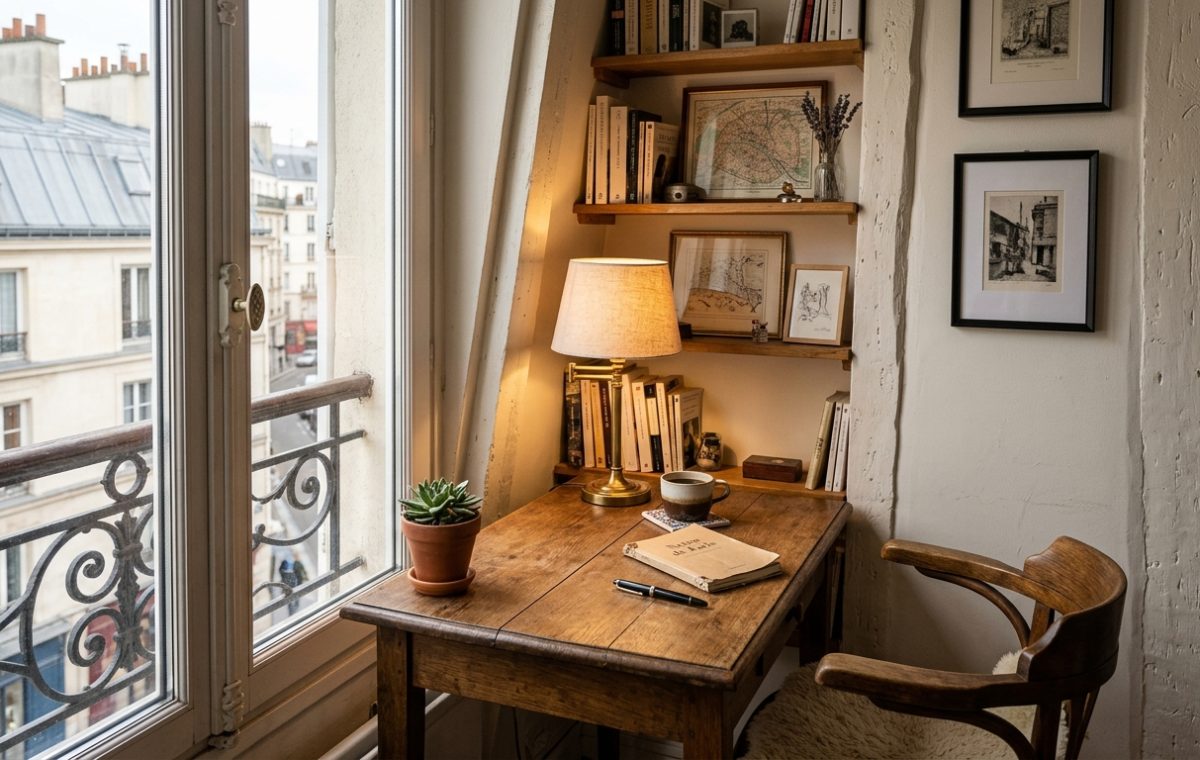
Look at how a simple antique wooden table hugs an awkward architectural slant. Paired with a functional brass lamp and stacks of well-read books, the setup feels grounded rather than squeezed. You do not need a dedicated corporate suite to get things done. You need a surface that invites you to sit down, a pen that actually writes, and a cup of coffee resting within arm’s reach.
The Psychology of a Window-Facing Desk
Placing your workspace directly against a window changes the entire rhythm of the workday. Staring at blank drywall kills motivation fast. When your eyes can wander past windowpanes onto slate rooftops and historic streetscapes, cognitive fatigue drops. Natural daylight floods the writing surface, reducing the need for harsh overhead bulbs until the sun dips entirely below the horizon.
- Position a low-profile potted succulent like an echeveria on the corner to bring organic texture indoors without eating up writing space.
- Mount open wooden shelves directly into awkward wall angles to store reference books and framed prints vertically.
- Choose a comfortable wooden armchair with a sheepskin throw rather than a bulky ergonomic rolling chair that ruins the room’s aesthetic.
Of course, tight window seats come with compromises. Street noise drifts through single-pane glass, and temperature fluctuations near exterior walls can test your comfort tolerance during peak winter months. Dust accumulates quickly on open shelving, meaning routine maintenance is part of the package.
Curating Your Everyday Essentials
Clutter creeps into small areas instantly. When your desktop is compact, every object must earn its keep. A ceramic mug, a classic fountain pen, and a bound notebook are all you need to start drafting ideas. Keep digital distractions locked away in another room and let analog tools dictate your morning workflow.
How does your current workspace handle the transition from morning coffee to deep afternoon focus?
Editorial Silo • Recommended Architecture Studies
- The Engineering of Ease: How to Make Contemporary Furniture for High-Performance Urban Living”, description: “Modern living demands a departure from static design; to make contemporary furniture today is to engineer kinetic, multifunctional solutions. This guide introduces the ‘2:1 Rule’ of spatial density—balancing two parts low-profile furniture with one part uninterrupted breathing room. We analyze the ergonomics of ‘cognitive stability,’ integrating hidden power hubs, wireless charging surfaces, and modular footprints that allow a single piece to pivot between a high-focus workspace and a serene sanctuary. — Archival Design Case Study
- Grand Closet home office aesthetic styling trends — Archival Design Case Study
Curated Lookbooks & Architectural Studies
- Inexpensive House: The Architectural Blueprint & Spatial Flow Guide
- Herringbone Wood Flooring: Elevating Classic Hallways
- Brass Wall Sconce Lighting Ideas for Warm Transitional Interiors
- Master Vintage Shelf Styling with Timeless Antiques
- French Herringbone Wood Flooring Ideas for Historic Spaces
- How to Style a Marble Top Desk Like a Design Pro
Curated Visual Lookbook
Design Gallery & Spatial Studies
A visual curation of architectural arrangements, lighting concepts, and material palettes featured in this space.