Hard sunlight can ruin a room faster than bad furniture. When glaring rays hit dark wood floors, the contrast feels clinical rather than inviting. That is where lightweight window dressings earn their keep. Hanging loose-weave textiles changes the geometry of a room, taking aggressive beams and softening them into a hazy, ambient glow that flatters everything it touches.
The Mechanics of Diffused Light
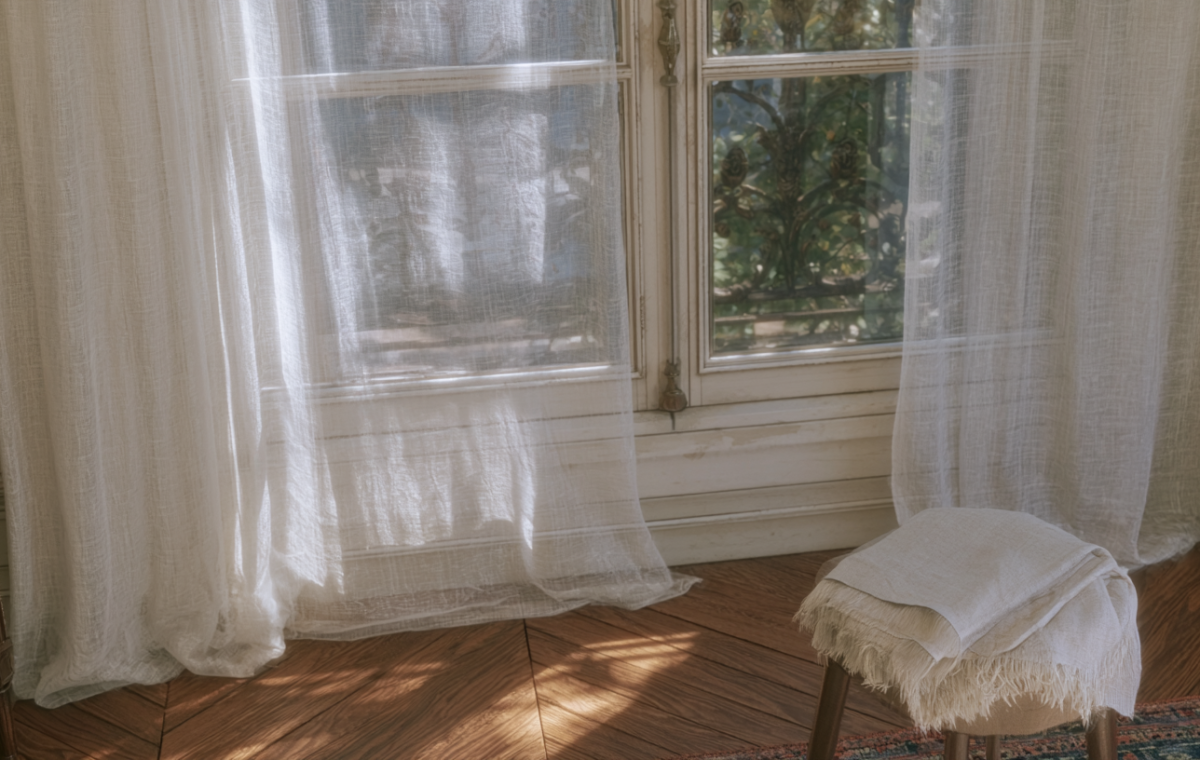
Most people buy window fabrics purely for privacy, ignoring how they behave at high noon. Heavy synthetics block everything out like a cave, while cheap polyesters trap heat and look shiny under direct rays. Linen behaves differently. Its organic fibers hold microscopic irregularities that scatter photons in multiple directions. Notice how the bright midday illumination filters gently across the herringbone parquet floor in the scene above, casting faint, dancing shadows without scorching the wood surface.
Selecting Weight and Weave
Do not default to stark optic white when shopping for yardage. Raw flax, oatmeal tones, and unbleached cream hues carry underlying warmth that complements vintage architecture and aged moldings. A looser weave lets air circulate freely, causing the panels to sway whenever a draft slips through an open sash. That subtle motion introduces life into a static corner.
- Opt for unlined panels to maximize translucent effects.
- Check the linen weight; medium-heavy grades offer better privacy while retaining texture.
- Allow extra length so the hems pool slightly onto the floor for an effortless drape.
Layering Textures Close to the Glass
Windows should never feel like an afterthought bolted onto drywall. Pairing raw textiles with weathered timber frames and an understated footstool draped in a fringed textile creates a cohesive vignette. The trick lies in restraint. Keep hardware simple—think antiqued iron or raw brass rods that blend into the background rather than demanding attention.
Of course, high-maintenance fabrics come with trade-offs. Raw flax wrinkles easily and requires careful laundering to prevent shrinkage. Yet that relaxed imperfection is precisely the point. Crisp perfection feels sterile; lived-in textiles tell a better story.
How do you usually balance privacy and natural brightness in your main gathering spaces?
Editorial Silo • Recommended Architecture Studies
- The Architect’s Blueprint: Living Room Ideas For Small Rooms & Engineering Spatial Volume and Flow in Compact Living Rooms — Archival Design Case Study
- Large living room design rules for functional flow — Archival Design Case Study
Curated Lookbooks & Architectural Studies
- Atmospheric Transit: Curating High-Texture Materiality and Mood in Compact Entries
- How to Style a Brass Table Lamp for Timeless Interiors
- Mastering Warm Interior Styling: Cozy Spaces That Work
- The Invisible Gourmet: Structural Secrets of the Integrated Modern Style Kitchen
- French Country Living Room Decor: Timeless Rustic Ideas
- How to Style a Minimalist Wooden Stool in Any Room Corner
Curated Visual Lookbook
Design Gallery & Spatial Studies
A visual curation of architectural arrangements, lighting concepts, and material palettes featured in this space.