A morning routine changes entirely when your furniture has character. Too many modern bedrooms rely on flat-pack convenience. They lack the grounding weight of solid timber. A classic wooden vanity table breathes life back into sleeping quarters.
The Anatomy of a Functional Dressing Area
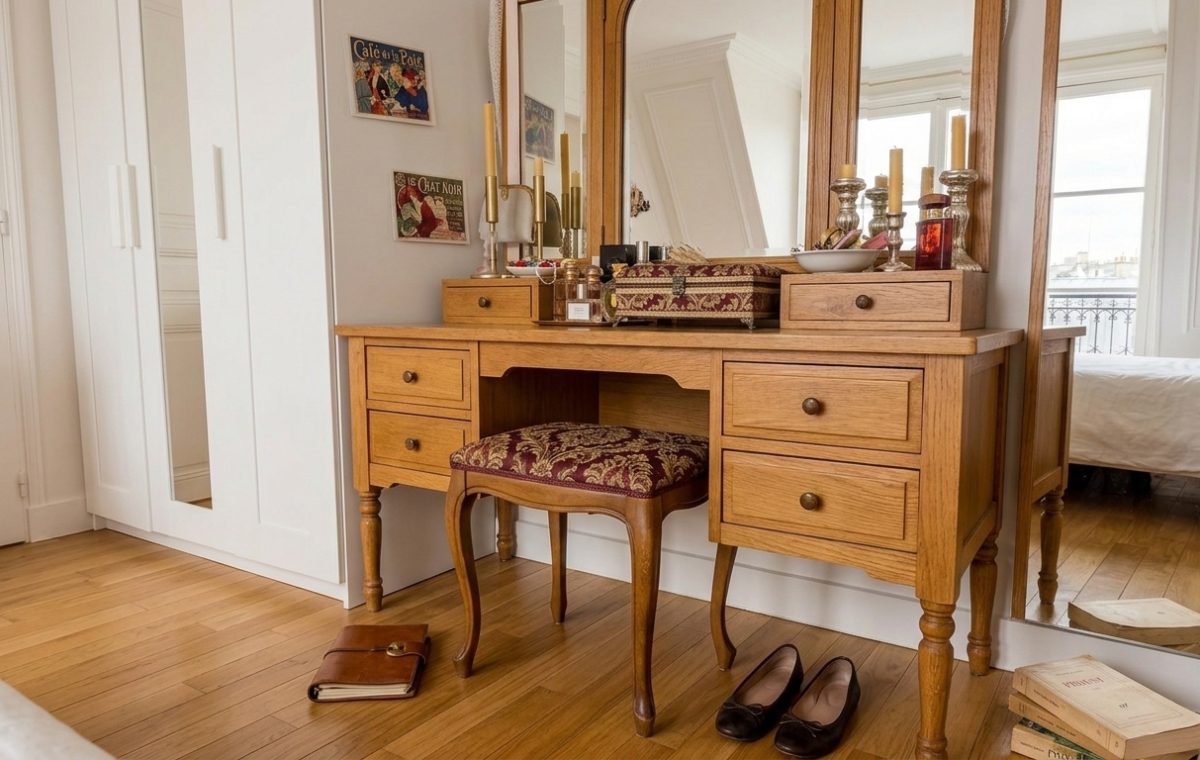
Look closely at how this setup works. It balances storage with open display. Drawers swallow everyday clutter. Surfaces hold curated vintage accents. The carved wooden stool with its patterned upholstery offers a tactile contrast to smooth floors.
Natural light pours across the room. It catches the glass perfume bottles and brass candlestick holders. Mirrors triple the sense of space. They bounce daylight around the corner toward the crisp white bed.
Avoiding Common Layout Mistakes
Clutter creeps in fast. A dressing table is not a catch-all tray for mail and loose change. Keep the surface intentional. Group items by height. Let wood grain breathe instead of covering every square inch.
- Use small ceramic trays to corral daily jewelry.
- Limit tabletop perfumes to three favorites.
- Keep books and notebooks tucked away or neatly stacked near the base.
Foot traffic matters too. Notice how the classic flats rest right below the chair. The layout invites you to sit, prep, and walk straight out the door. No awkward squeezing required.
How is your current morning station holding up against the daily rush?
Editorial Silo • Recommended Architecture Studies
- Fall Fireplace Mantel Decor: Warm Autumn Styling Ideas — Archival Design Case Study
- Autumn Centerpiece Ideas for a Cozy Seasonal Table — Archival Design Case Study
Curated Lookbooks & Architectural Studies
- Wooden Vanity Mirror Ideas for a Timeless Dressing Table
- Ergonomic Mastery: Functional & Space-Saving Hacks for Interior Design Project Ideas
- Designing Around a French Marble Fireplace
- Ergonomic Mastery: Functional & Space-Saving Hacks for Table Decorations For Christmas
- Ergonomic Mastery: Functional & Space-Saving Hacks for L Shaped Kitchen Designs
- The Engineering of Ease: How to Make Contemporary Furniture for High-Performance Urban Living”, description: “Modern living demands a departure from static design; to make contemporary furniture today is to engineer kinetic, multifunctional solutions. This guide introduces the ‘2:1 Rule’ of spatial density—balancing two parts low-profile furniture with one part uninterrupted breathing room. We analyze the ergonomics of ‘cognitive stability,’ integrating hidden power hubs, wireless charging surfaces, and modular footprints that allow a single piece to pivot between a high-focus workspace and a serene sanctuary.
Curated Visual Lookbook
Design Gallery & Spatial Studies
A visual curation of architectural arrangements, lighting concepts, and material palettes featured in this space.