Proportion Dictates Everything in a Narrow Corridor
Hallways are workhorses. They take the brunt of wet umbrellas, kicked shoes, and scuffed bags. Yet homeowners often treat them as afterthoughts, throwing up flat drywall paint and hoping for the best. Installing lower wall paneling fixes both aesthetics and durability in one move.
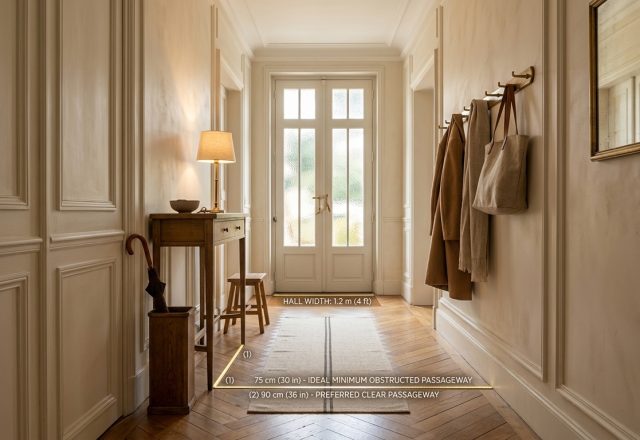
Notice the height of the chair rail in this corridor. It sits at approximately one-third of the total wall height. This is deliberate. Running moulding too high shrinks a tight hall, making it feel like a narrow trench. Keep it lower, around 36 to 40 inches from the floor, and the eye naturally tracks upward toward the ceiling.
The choice of raised picture frame moulding adds architectural relief without consuming usable square footage. When dealing with hallways barely three feet wide, you cannot afford bulky built-ins or deep trim profiles. A slim bead profile gives you the classic shadow line without clipping elbows as you pass.
Hardware Integration: Where Most Renovations Stumble
A bare wall with moulding is nice. A functional entryway is better. The challenge lies in mounting utilitarian items like a hallway coat rack without butchering the woodwork design.
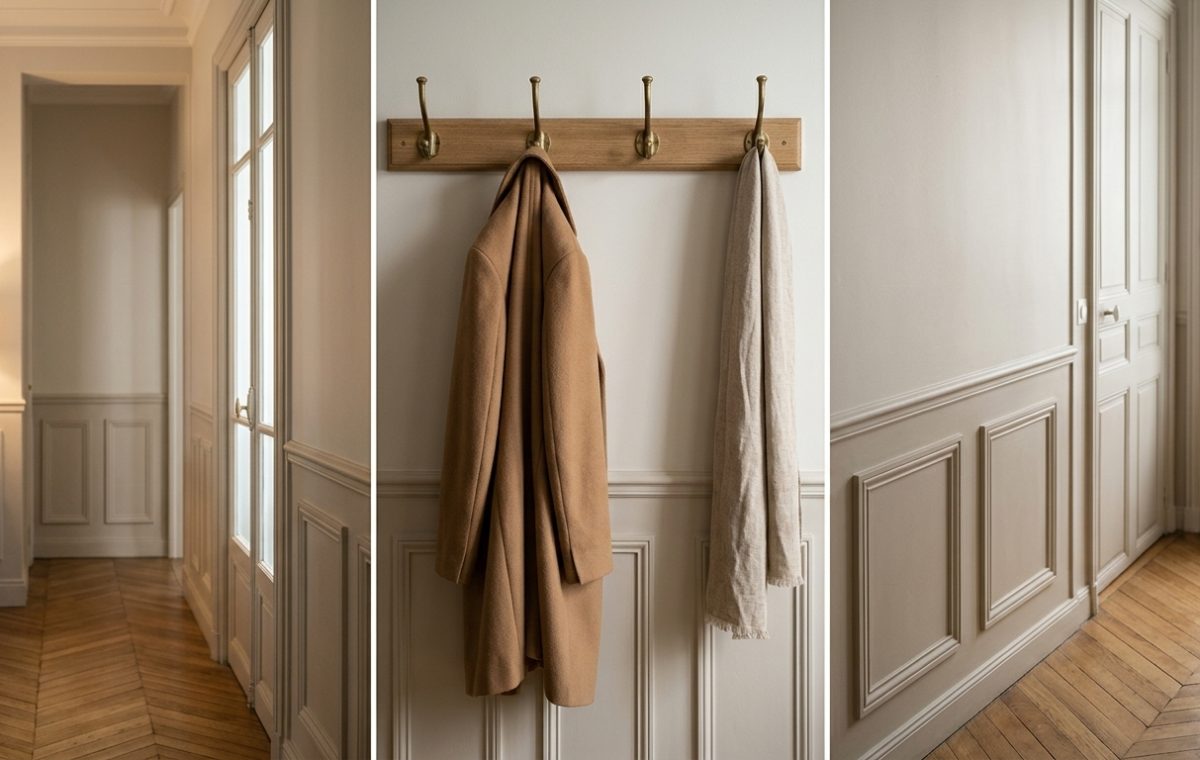
Notice how the coat rack here is mounted cleanly above the chair rail rather than floating awkwardly inside a panel box. Mounting hooks directly into drywall often leads to loosened anchors after a single winter of heavy outerwear. The solution demonstrated here is foolproof: mount an oak backing rail secured into studs, then seat your antique brass hooks into the hardwood.
Hardware should never look like an afterthought bolted onto decorative trim. Anchor the utility piece cleanly to the structural framing.
Brass works exceptionally well against warm stone or putty paint tones. It resists moisture from wet coats and develops a muted patina over time rather than showing paint chips like coated black iron hooks tend to do.
Selecting Tone and Finish for Daily High-Traffic Walls
High-traffic trim demands tough paint. While flat finishes look velvety in catalog photos, they are a disaster in an entryway. Fingerprints turn into permanent grease marks, and wet wool leaves telltale rings.
For neutral wall panelling, apply an eggshell or soft satin on the lower woodwork and keep the upper drywall in a matching chalky matte. Using the same warm mushroom or greige tone across both surfaces creates quiet continuity. It feels tailored, not busy.
- Lower moulding: Acrylic satin finish for scrubbability against shoe scuffs.
- Upper wall: Ultra-matte or dead-flat to absorb glare from overhead fixtures.
- Flooring boundary: Chevron wood flooring or herringbone oak provides warm movement that balances the rigid geometric panels above.
Chevron planks instantly lead the gaze forward, pulling guests through the home instead of letting them linger awkwardly at the threshold.
Do your own hallway walls currently suffer from dark scuffs at hip level, or have you already experimented with chair rails to protect them?
Editorial Lookbook & Photo Collection