Most productivity advice assumes you own a spare bedroom or a massive walnut partner desk. Real life rarely cooperates. A quiet corner by a bright window often beats an isolated office room anyway. You stare at drywall less. You catch natural light. But squeezing a functional station into a sliver of square footage takes discipline.
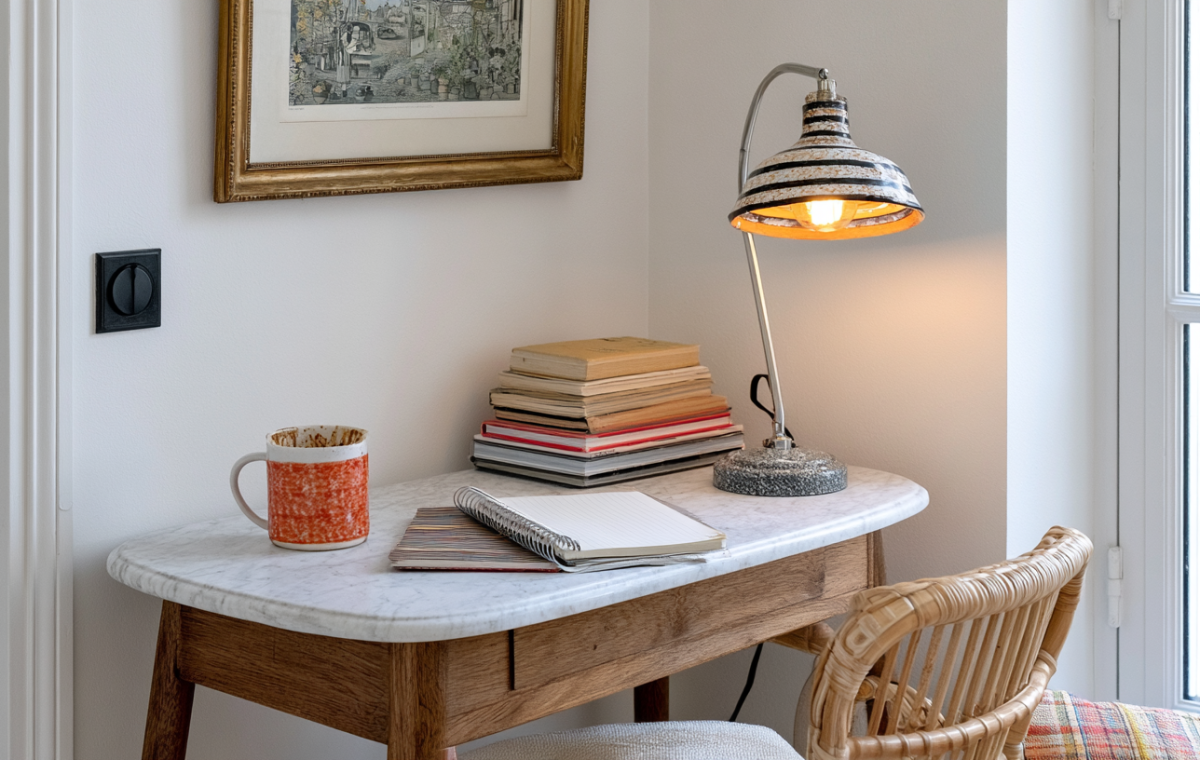
Look at how a simple marble-topped console transforms a dead zone. It has depth, but not too much. A desk that is too deep dominates a room and collects junk. A shallow surface forces prioritization. You keep what matters close: a favorite notebook, a stacked pile of reference texts, and an orange mug stained with the morning brew.
Lighting Makes or Breaks the Corner
Overhead lights create harsh shadows and eye strain by mid-afternoon. Task lighting fixes this instantly. A well-placed adjustable lamp with a patterned shade brings focused warmth right where the paper meets the pen. Notice how the bulb glows against the white wall. It feels intentional, not clinical. When the sun dips behind neighboring rooftops, that single lamp preserves your focus without lighting up the entire apartment.
Managing Visual Clutter
Tiny zones get messy fast. One stray mail envelope makes the whole area look abandoned. The trick lies in designated landing spots. A spiral-bound notebook left open signals active work, while a neat stack of books adds quiet weight and texture. Keep the surface clear of electronics unless they serve an immediate purpose. Sometimes analog tools win simply because they take up less visual bandwidth.
Comfort matters just as much as aesthetics. A rigid wooden chair will chase you back to the couch within forty minutes. A woven rattan seat with subtle padding offers breathability and natural texture. It bridges the gap between casual living room furniture and serious workspace utility. If your seating feels punishing, your attention span shrinks accordingly.
Setting up a compact workspace is an exercise in editing. Strip away the extra monitors, the cable nests, and the decorative knick-knacks that pull your focus. What is the one item you always reach for first when sitting down to write?
Editorial Silo • Recommended Architecture Studies
- Performance Modularity: Modular Shelf System & Engineering Seamless Living in the Modern Compact Home — Archival Design Case Study
- The Physics of the Curve: Structural Secrets of Earth-Sheltered Hobbit Home Designs — Archival Design Case Study
Curated Lookbooks & Architectural Studies
- The Alchemy of Atmosphere: Interior Design Ideas For Bathrooms & Curating Tactile Materiality and Chromatic Depth for the Modern Bath
- Fawn Galli New York Apartment: The Architectural Blueprint & Spatial Flow Guide
- How to Style a Round Mirror Wall Decor Piece Like a Pro
- Mantel Decor Ideas for an Antiqued Transitional Look
- Luxury Linen Textiles and How to Layer Bedding Like a Pro
- Artistic Kitchen countertop design ideas for spatial flow
Curated Visual Lookbook
Design Gallery & Spatial Studies
A visual curation of architectural arrangements, lighting concepts, and material palettes featured in this space.