The Cost of Mounting Hooks Too Close
Most mudrooms fail before anyone even takes off their shoes. The carpenter eyeballed the hardware. Hooks were drilled four inches apart to squeeze in six instead of four. By mid-November, the whole arrangement collapses under its own bulk. Heavy wool outerwear overlaps, scarves get tangled, and every time someone grabs a car coat, two neighboring jackets end up on the floor.
Hardware looks deceptively small on an empty wall. You stand in an empty hallway, holding a sleek brass hook, and think you can cluster them tightly. You cannot. Garments have volume.
The Magic 15 to 20 Centimeter Rule
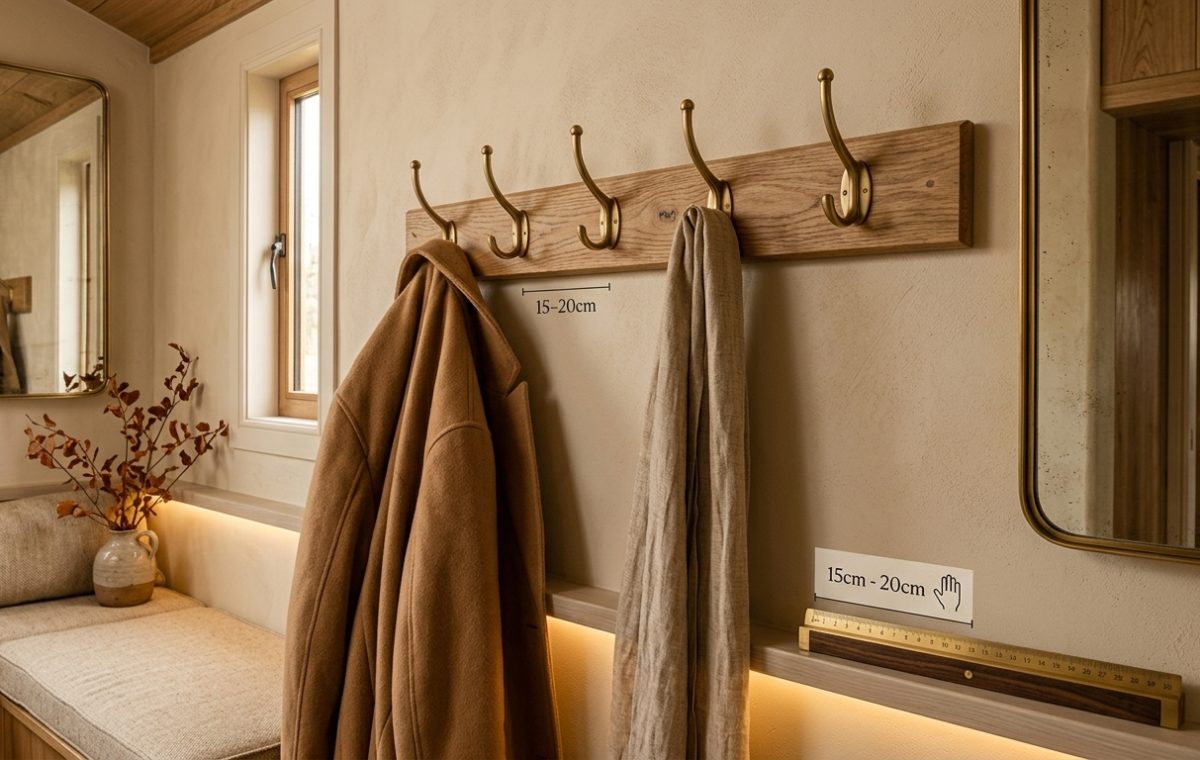
Give your hooks breathing room. Fifteen to twenty centimeters—roughly six to eight inches—is the sweet spot between spatial efficiency and real-world utility.
Why this specific gap? Because winter coats aren’t two-dimensional. A structured camel overcoat flairs out at least seven inches at the chest when hung by its nape loop. If your coat hook spacing drops below fifteen centimeters, adjacent coats will push against one another, creating friction that literally pops hanging loops off their pegs.
- Under 12 cm: Garments crowd, pockets catch on adjacent hardware, and jackets end up draped on chairs instead.
- 15 to 20 cm: Adequate clearance for thick shearling, oversized wool coats, and wide linen scarves without bunching.
- Over 25 cm: Wasted linear wall space unless you are designing an art gallery rather than an active family mudroom.
Solid Backing Versus Drywall Gambles
Notice the solid white oak rail in the photo. That timber is not merely a rustic styling trick. It solves the structural problem of wall studs. Studs in typical framing sit sixteen inches on center. If you want precise fifteen-to-twenty-centimeter coat hook spacing, you cannot screw directly into wall studs for every hook. It is mathematically impossible.
A timber backing board lets you secure deeply into studs behind the scenes, while arranging your actual hardware at whatever spacing your daily routine demands.
Skip the plastic drywall anchors. A wet parka, a laptop bag, and a heavy tote bag easily exceed twenty pounds. Over a single winter season, dynamic weight pulls hollow-wall anchors straight out of plaster. Mount a stout hardwood plank first. Fasten it securely into structural timber, then screw your brass hardware directly into the hardwood face.
Functional Layering
Pairing a well-spaced rail with low-profile bench seating changes how an entry functions. The ledge beneath the coat rail in the frame serves a subtle double duty: it catches items that inevitably slide off, while the warm LED under-glow guides shoes into their slots without overhead glare.
Before you commit drill to wall, pull your heaviest winter jacket out of the closet. Hang it over a hook held in your hand. How much breathing room does it actually demand in your daily rush?
Editorial Lookbook & Photo Collection