The Anatomy of a Well-Styled Shelf
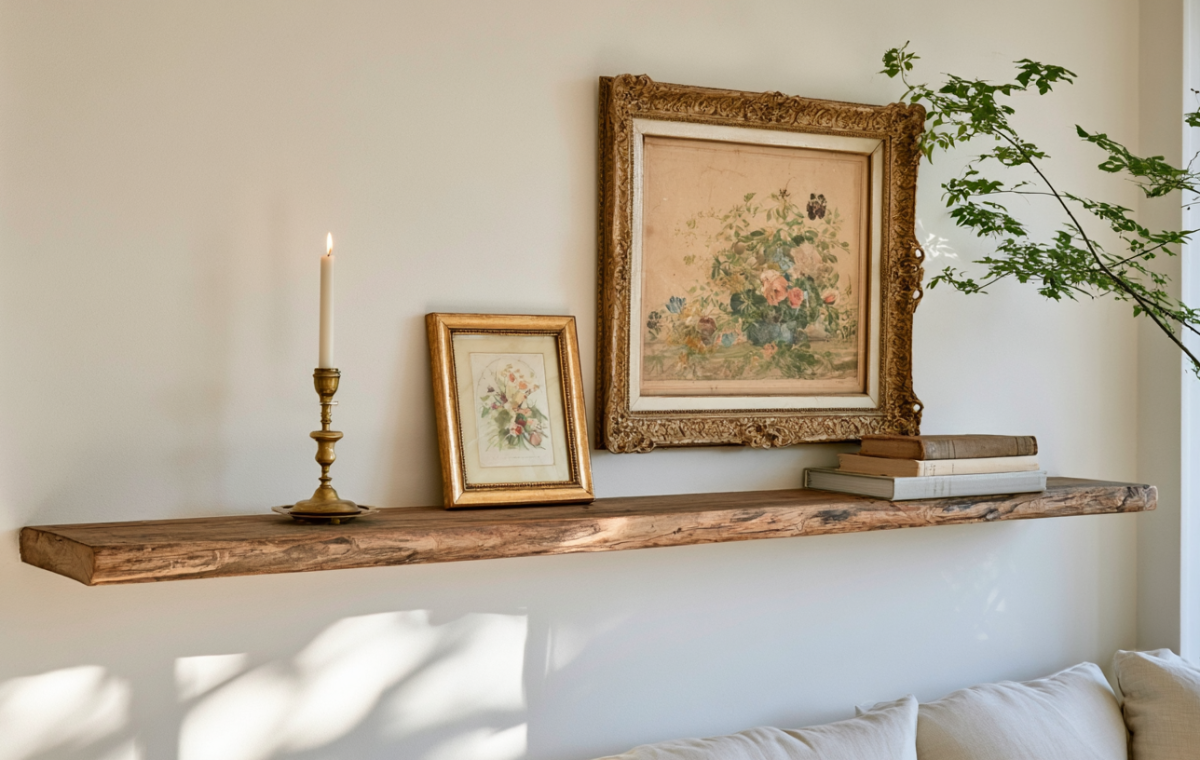
Most shelving attempts fail because people buy matching sets of plastic decor. They arrange identical candles in a neat row. It looks like a showroom floor. It lacks soul. Real spaces require friction. Take a thick piece of reclaimed timber mounted directly onto a stark white wall. Notice how the rough, live-edge wood contrasts with the smooth plaster. This is where good interior styling begins.
You need contrast. Smooth meets rough. Old meets new. A single heavy timber plank can anchor an entire room if you let the materials speak for themselves. Avoid overloading the surface. Negative space is your friend. Let the raw wood breathe.
Layering Art and Objects
Leaning artwork against a wall creates instant depth. Do not grab the power drill immediately. Prop up a large, ornate gilded frame with a faded botanical print, then tuck a smaller frame right in front of it. This overlapping technique tricks the eye into seeing more space. It feels relaxed, not forced.
Balance is tricky. Heavy items pull the eye in one direction. A tall, slender brass candlestick holder acts as a counterweight to a stack of vintage books and a trailing green branch on the opposite side. If you pile everything in the middle, the shelf will sag visually. Distribute your visual weight deliberately.
- Mix gold-toned brass with weathered paper and linen.
- Vary the heights of your objects to create an organic rhythm.
- Keep clutter minimal by editing out anything that does not serve the palette.
Practical Realities of Raw Wood
Reclaimed wood looks stunning, but it has quirks. It collects dust quickly in the natural grooves. Unsealed timber can also stain if you place a sweating glass or an oily candle directly on the surface. Keep a soft cloth nearby and consider a clear, matte sealant if you want protection without losing the rustic texture.
Lighting changes everything throughout the day. Direct afternoon sun will bleach out vintage watercolors over time. Pay attention to your window placement before hanging heirloom art permanently.
How do you usually balance old heirlooms with modern furniture in your living space?
Editorial Silo • Recommended Architecture Studies
- Performance Modularity: Modular Shelf System & Engineering Seamless Living in the Modern Compact Home — Archival Design Case Study
- The Physics of the Curve: Structural Secrets of Earth-Sheltered Hobbit Home Designs — Archival Design Case Study
Curated Lookbooks & Architectural Studies
- Classic Entryway Decor: How to Balance Utility and Warmth
- Styling a French Apartment Mirror in a Classic Parisian Interior
- Triangle Method Shelf Styling: The Architectural Blueprint & Spatial Flow Guide
- Invisible Architecture: Precision Color Zoning and Functional Paint Blocking for the High-Efficiency Multi-Use Home
- How to Style an Antique Gold Mirror for Timeless Interiors
- The Tactile Aesthetic of Best Patio Furniture Covers: Materials, Moods & Lighting Kelvin
Curated Visual Lookbook
Design Gallery & Spatial Studies
A visual curation of architectural arrangements, lighting concepts, and material palettes featured in this space.