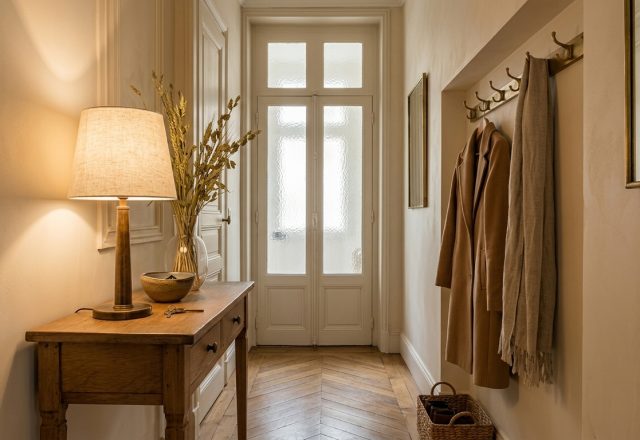
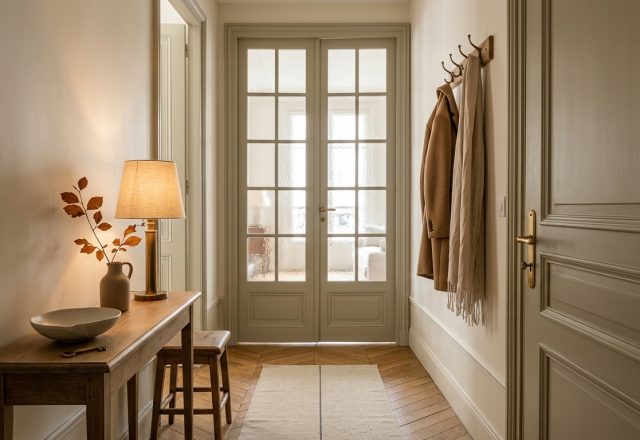
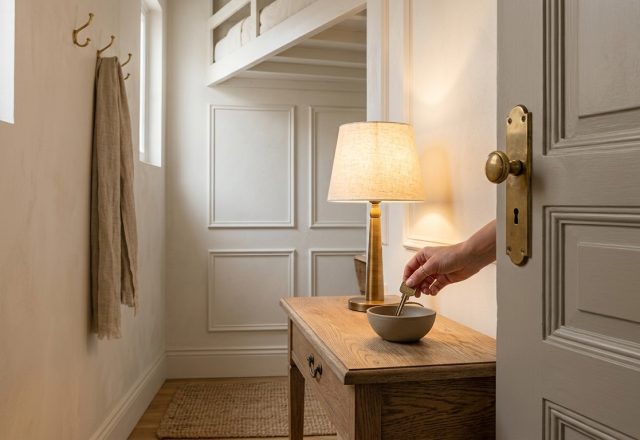
Lighting is the most neglected architectural tool in the modern home. Most people slap a flat, plastic LED panel on the ceiling and wonder why their living room feels like a dentist’s waiting room. Look at the way that single fabric-shaded lamp interacts with the wall molding. It doesn’t just illuminate the space; it defines the textures of the plaster and the brass hardware.
The Psychology of Eye-Level Glow
Wall sconce lighting works because it brings the light source down to where we actually live. Ceiling lights are functional, sure, but they create harsh downward shadows that highlight every wrinkle and dust bunny. A sconce provides a lateral glow. It’s soft. It’s forgiving. By using a fabric lampshade, you’re diffusing the bulb’s intensity, turning a point of light into a soft aura.
This isn’t just about vanity. It’s about wayfinding. In a hallway or entryway, you don’t need the sun. You need a guide.
That warm lighting atmosphere tells your brain you’ve transitioned from the chaotic outside world into a controlled, private sanctuary.
Working With Architectural Depth
Notice how the classic wall molding creates recessed panels. Without the side-lighting from the brass wall lamp, these details would disappear. Light is a sculptor. When it grazes across a raised surface, it creates shadows that give a flat wall three dimensions. If you have wainscoting or picture-frame molding, overhead lighting is your enemy—it flattens the very detail you paid a carpenter to install. Pairing this with a minimalist console table keeps the footprint small. You don’t need a massive chandelier to make a statement. Sometimes, a single well-placed fixture does more for the expensive feel of a home than a room full of designer furniture.
The Reality of Installation
Let’s be honest: the downside is the wiring. Unless you’re doing a renovation, cutting into drywall to hardwire a new sconce is a mess. It’s dusty and expensive. However, the puck light hack—using battery-operated bulbs—is a temporary fix that often looks cheap because the light temperature is usually a cold, bluish white. If you’re going to do it, do it right. Hire the sparky. Get the warm 2700K bulbs. The brass coat rack and the wooden stool in the frame suggest a space that is used daily. It’s a high-traffic zone. Yet, it feels quiet. That’s the power of light layering. You have the task light and the ambient light. How many corners of your house are currently dead zones because they’re shrouded in shadow or blasted by a 100-watt ceiling bulb? Sometimes the best design move isn’t buying more stuff, but simply changing how the stuff you already have is lit.
Editorial Lookbook & Photo Collection