The Tension Between Structural Intent and Seasonal Sentiment
Why do we spend the entire year obsessing over the clean lines of a mid-century modern hearth or the airy volume of a vaulted ceiling, only to obscure those very assets with a chaotic layer of tinsel and oversized greenery come December? This architectural friction often stems from a lack of scaling. Integrated ideas for decorating for christmas serve as a structural corrective, ensuring that festive additions act as a purposeful extension of your home’s existing geometry rather than a claustrophobic intrusion. When we approach holiday styling through the lens of architectural scaling, we move away from ‘filling space’ and toward ‘enhancing form.’ It is the difference between a room that feels cluttered and one that feels curated.
The primary challenge lies in the sheer mass of traditional decor. A standard 7.5-foot tree can consume nearly 40 square feet of visual volume once you account for its diameter and the necessary negative space surrounding it. In a room with standard 8-foot ceilings, this creates a ‘top-heavy’ effect that compresses the room’s height. Conversely, in a double-height Great Room, that same tree looks like a discarded toy. Professional scaling requires us to look at the room’s ‘vanishing point’ and ensure our festive focal points respect the primary circulation paths—maintaining that crucial 36-inch clearance for natural human movement.
Verticality and Volume: Luxury Christmas Tree Themes
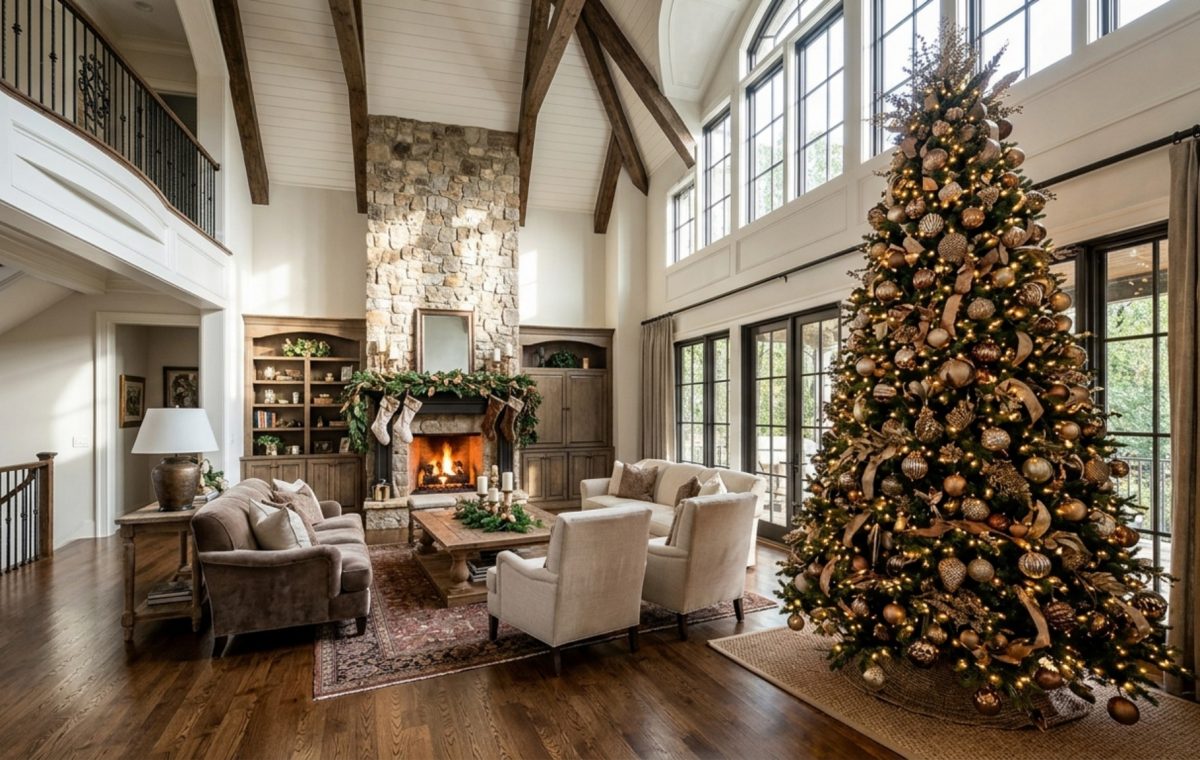
In homes with significant vertical reach, the tree should be viewed as an architectural column. A slim, pencil-profile tree in a high-ceilinged room fails to command the space, while a wide-diameter Frasier Fir can block sightlines to neighboring rooms. When exploring luxury christmas tree themes, consider the ‘Two-Thirds Rule.’ Your tree should ideally occupy two-thirds of the vertical wall height before the ceiling tapers or meets a molding. If you are working with a 12-foot ceiling, a 9-foot tree provides the necessary 3-foot ‘breathing room’ at the apex to prevent the space from feeling pinched.
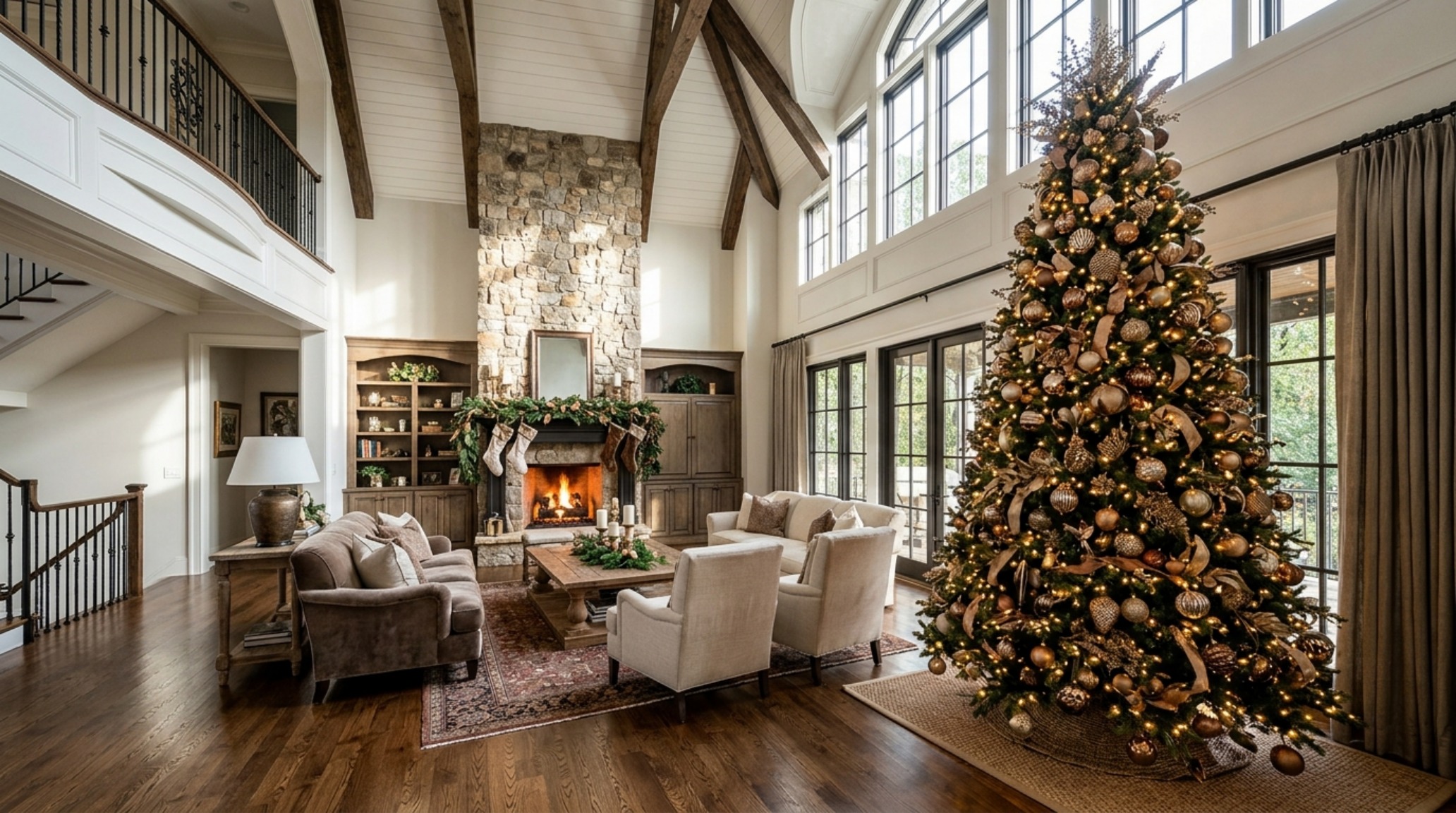
Texture also plays a role in architectural scaling. In a room finished with Benjamin Moore Swiss Coffee or Farrow & Ball Setting Plaster, the tree’s greenery provides a deep, organic contrast. Use monochromatic ornament palettes—think matte ochre, brushed bronze, and mercury glass—to maintain a sophisticated ‘quiet luxury’ aesthetic. By keeping the color story tight, you allow the tree’s silhouette to emphasize the room’s height rather than distracting from it with a kaleidoscope of competing hues.
Visual Narrative & Detail Studies: Minimalist Festive Interior Design
The mantel is perhaps the most architecturally significant horizontal line in any living space. It acts as a visual anchor, yet it is often the first victim of over-styling. To achieve a minimalist festive interior design, one must embrace the power of asymmetry and repetition. Rather than centering a heavy, uniform garland, try an asymmetrical ‘sweep’ that pools on one side of the hearth. This draws the eye across the architectural plane of the fireplace, emphasizing the width of the room.
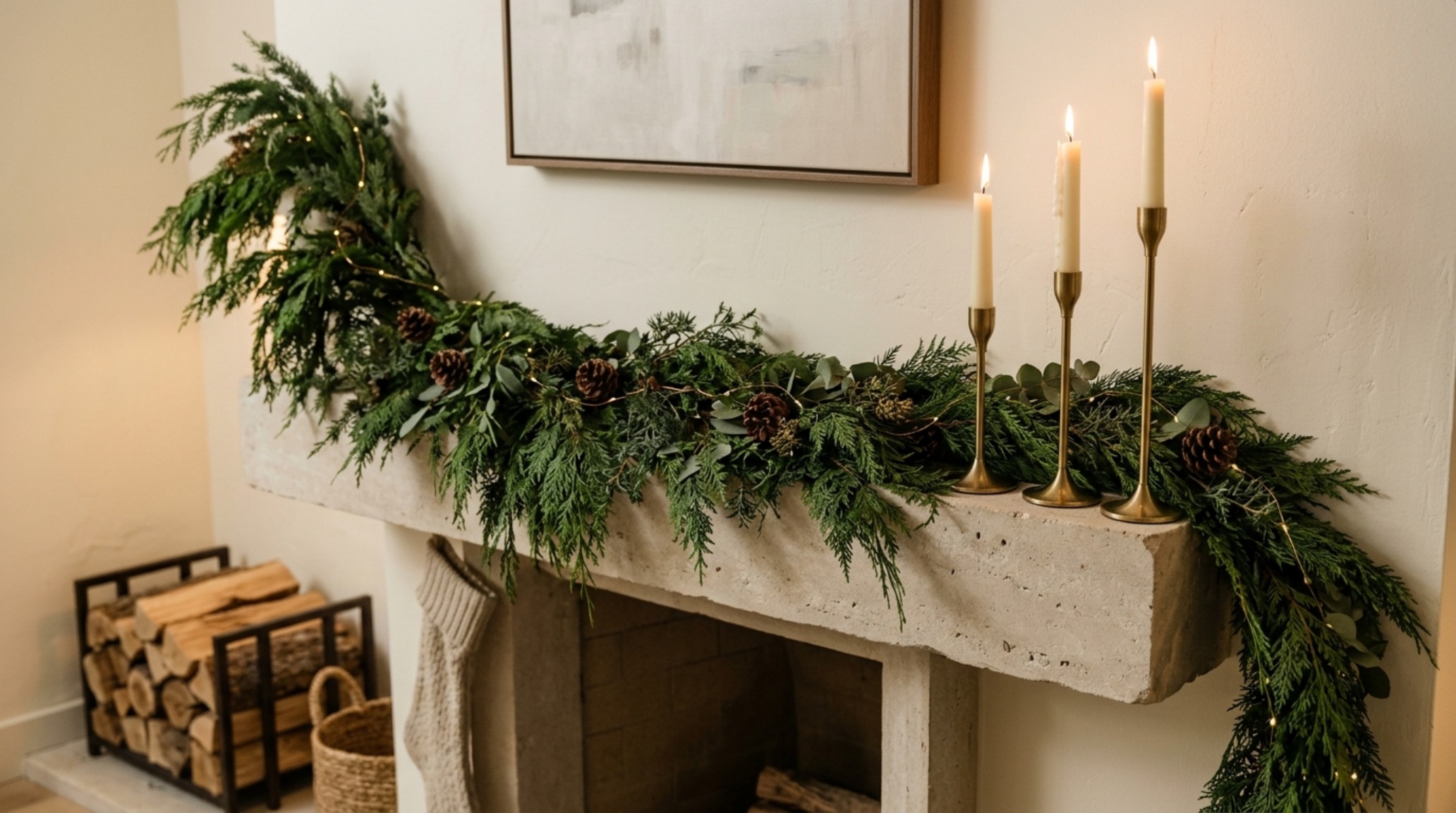
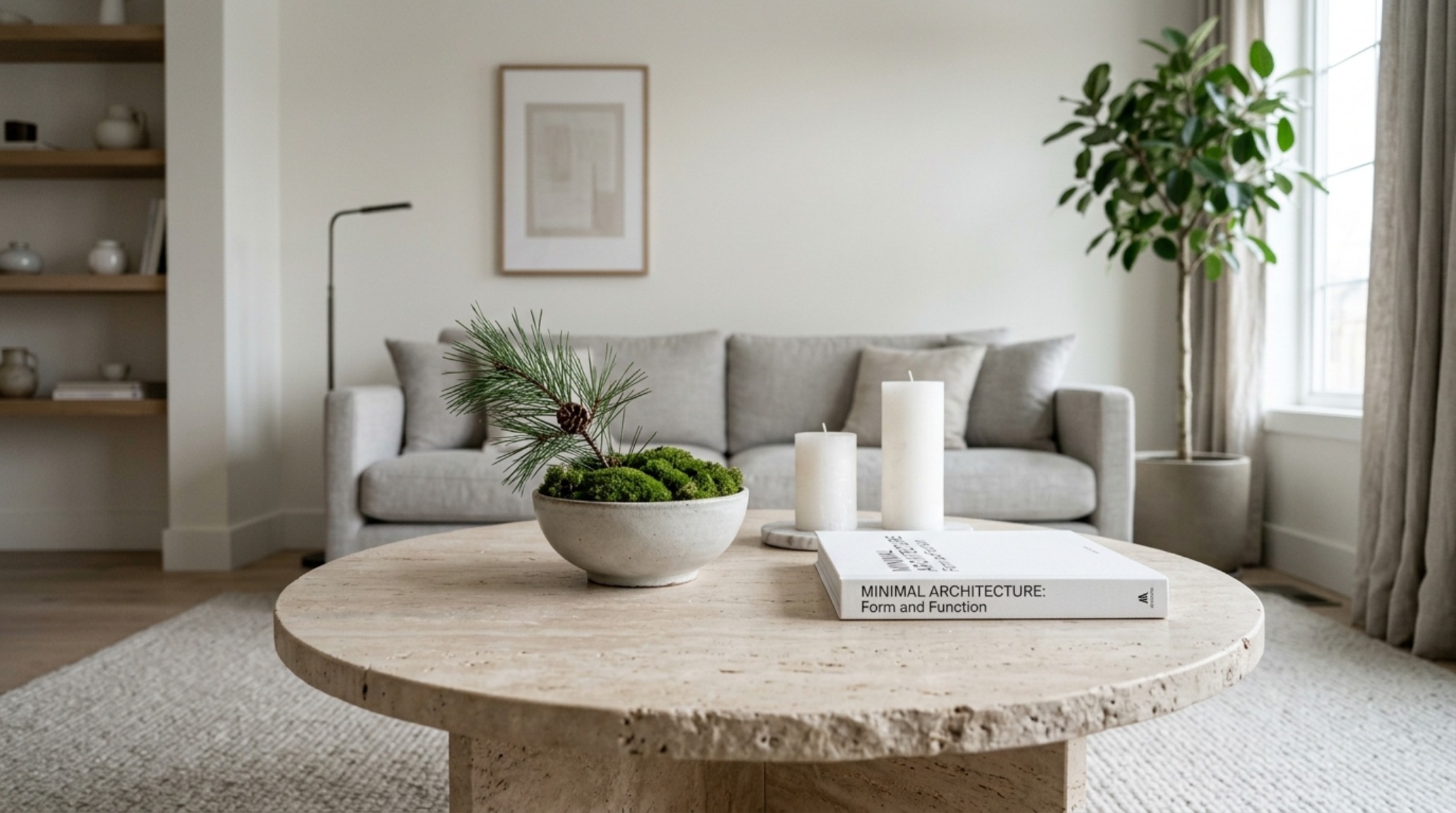
Maintain the 18-inch reach rule even during the holidays. If your coffee table is adorned with a sprawling evergreen centerpiece, ensure guests can still set down a drink without navigating a forest. Use low-profile vessels in honest materials—honed travertine or raw terracotta—to ground the arrangement. This tactile grounding ensures that the festive elements feel integrated into the furniture’s materiality rather than sitting awkwardly on top of it. Lighting here should be subtle; think 2700K warm white LEDs tucked deep into the greenery to create an inner glow that mimics the warmth of a dying ember.
Spatial Cadence: Entryway Transitions as Galleries
The transition from the exterior to the interior is an architectural ‘handshake.’ In modern homes, this space is often defined by hard surfaces—white oak flooring, glass panels, and steel hardware. Introducing quiet luxury christmas decor here requires a soft touch. A single, oversized velvet ribbon in a deep moss green tied to a minimalist staircase railing provides a rhythmic cadence that guides the eye upward. It respects the ‘spatial flow’ of the staircase without obstructing the handrail’s function.
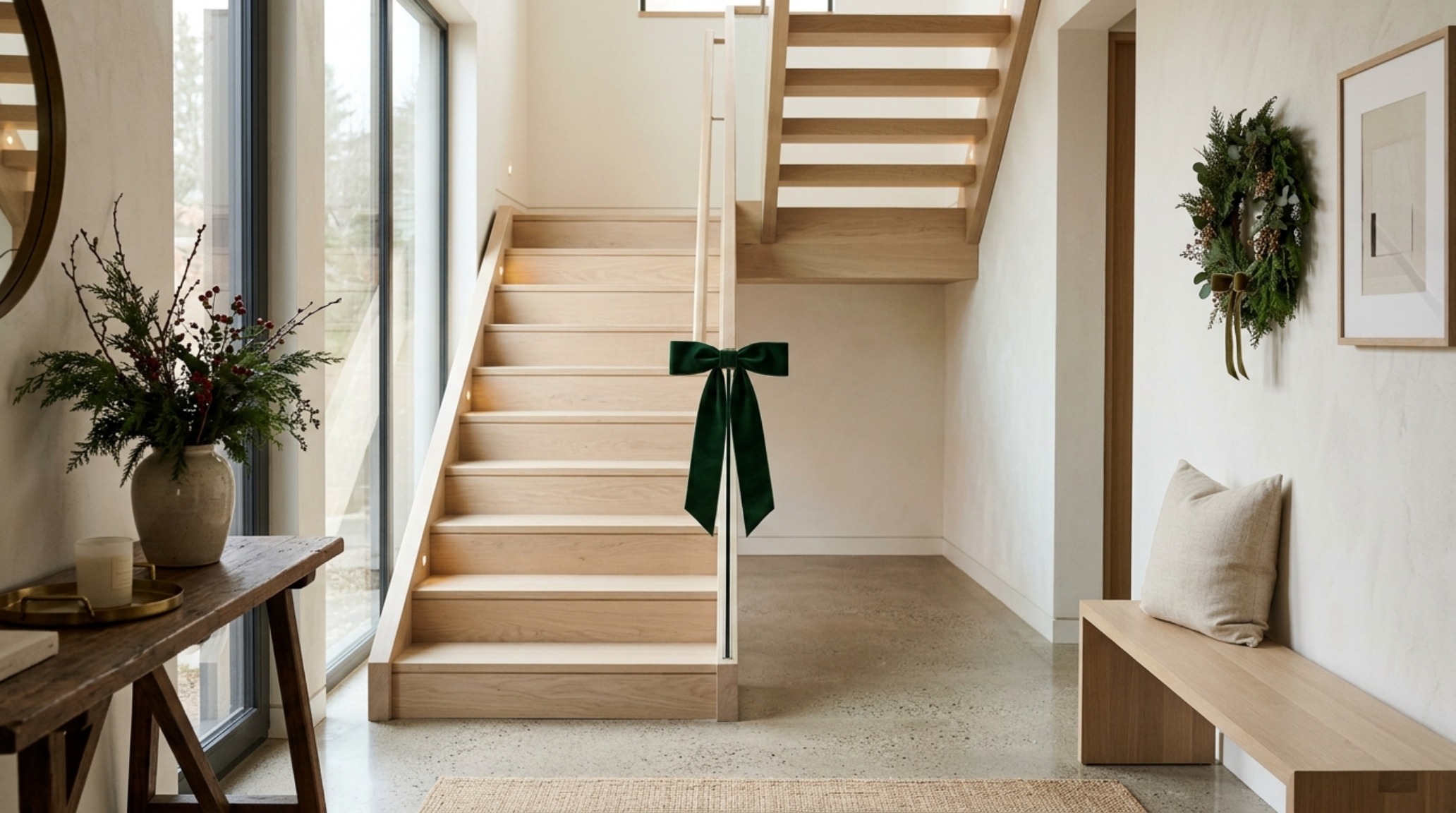
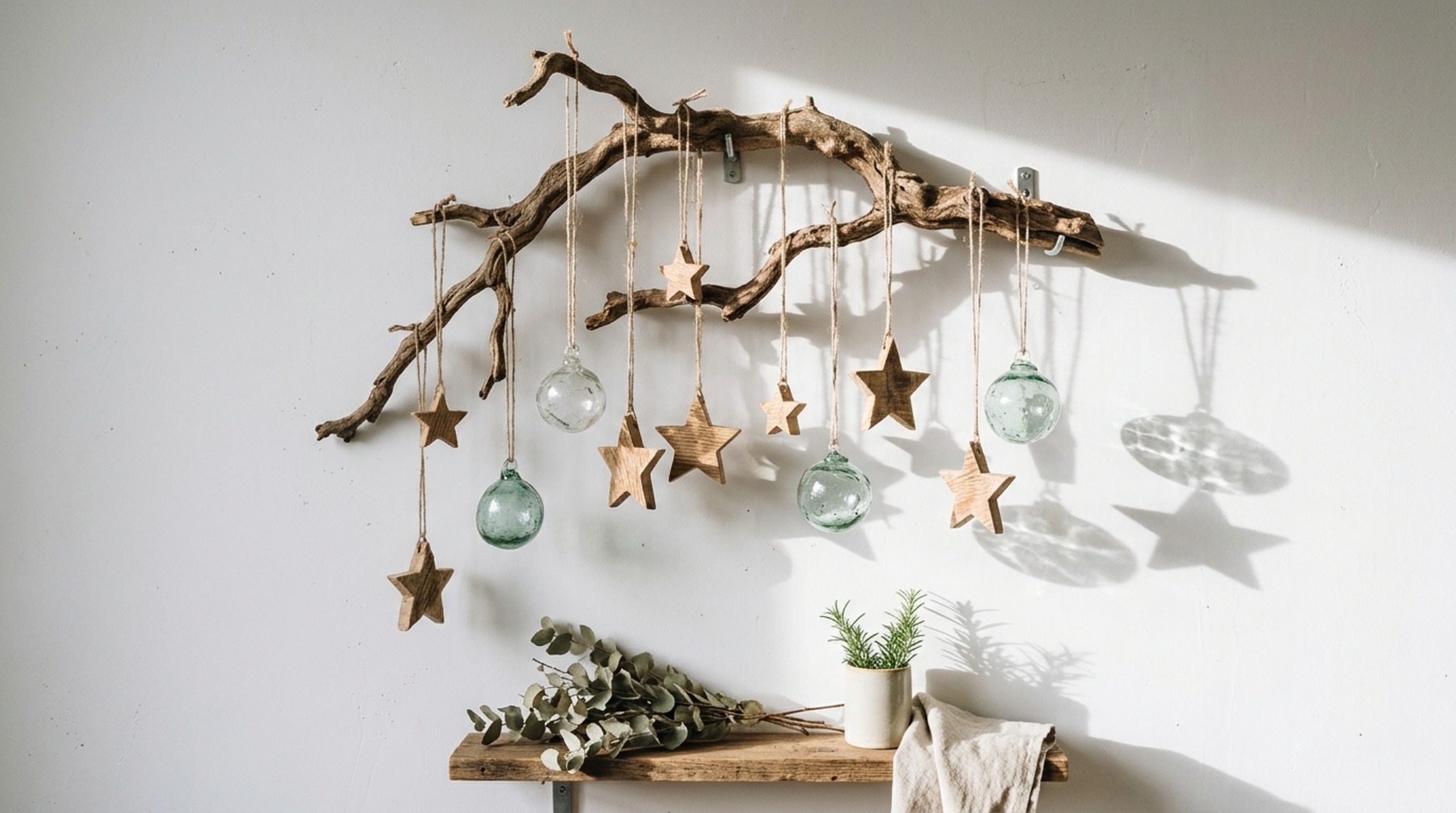
Consider the ‘Shadow Play’ of your entryway. When we position a single, well-lit branch of ilex berries against a neutral wall, the resulting shadow becomes an architectural feature in itself. This is where smart holiday lighting solutions come into play. By using high-CRI (Color Rendering Index) lighting, you ensure that the rich textures of your decor—the nap of the velvet, the grain of the wood, the glint of the glass—are rendered with absolute clarity. Avoid the ‘blue tint’ of cheap LEDs; 3000K is the absolute limit for task areas, while 2700K remains the gold standard for ambient holiday warmth.
Architectural Illuminance: Smart Holiday Lighting Solutions
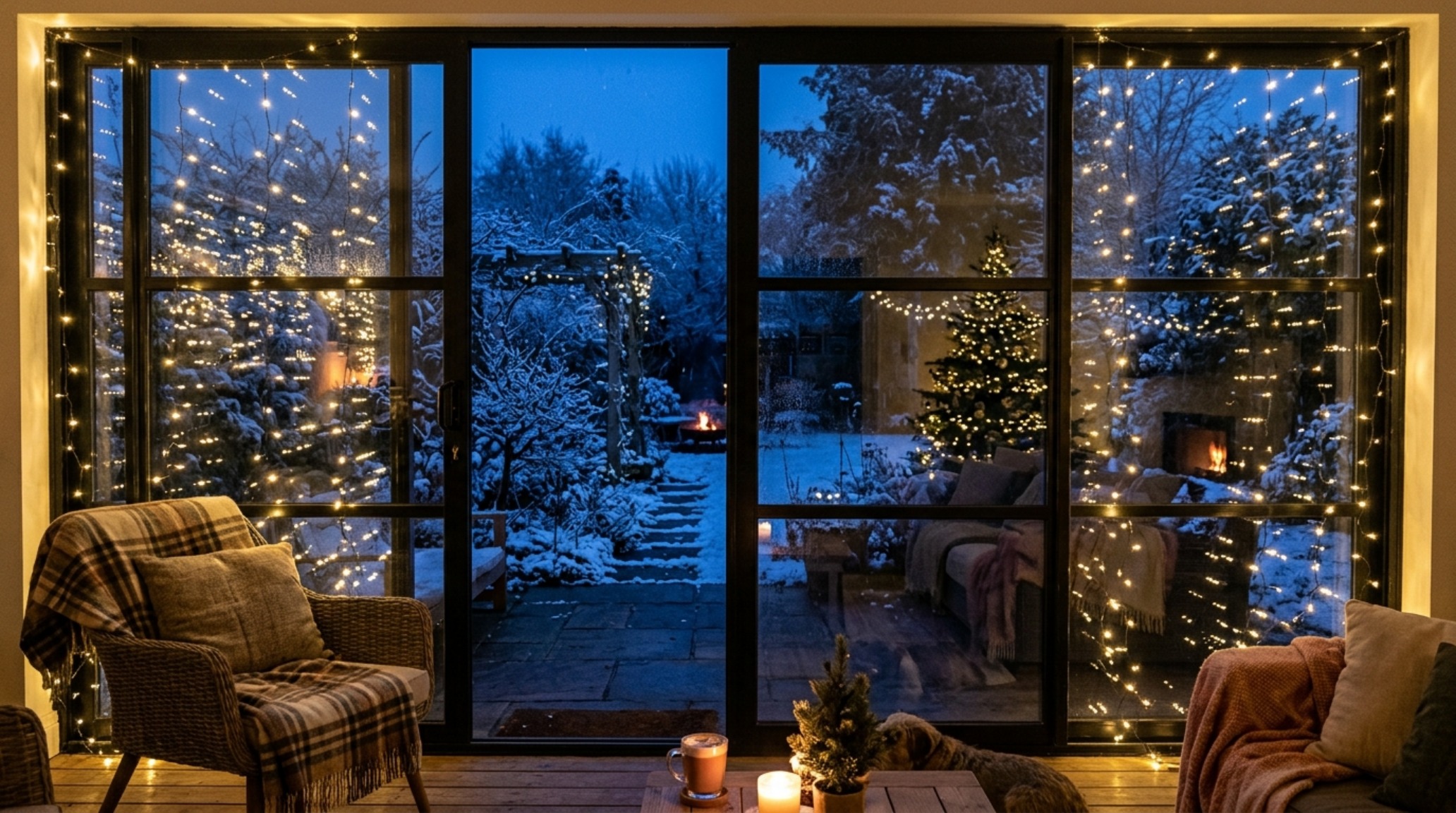
Lighting is the invisible architecture of a room. During the holidays, the temptation is to string lights everywhere, but this often flattens the room’s depth. To maintain structural integrity, use lighting to highlight architectural ‘reveals.’ Place up-lights behind large floor plants or at the base of a structural column to create dramatic height. If you are integrating smart holiday lighting solutions, use apps to create ‘scenes’ that dim the overhead recessed lights while boosting the warm glow of the tree and mantel. This layered approach creates ‘pockets’ of light that define different zones within an open-concept floor plan.
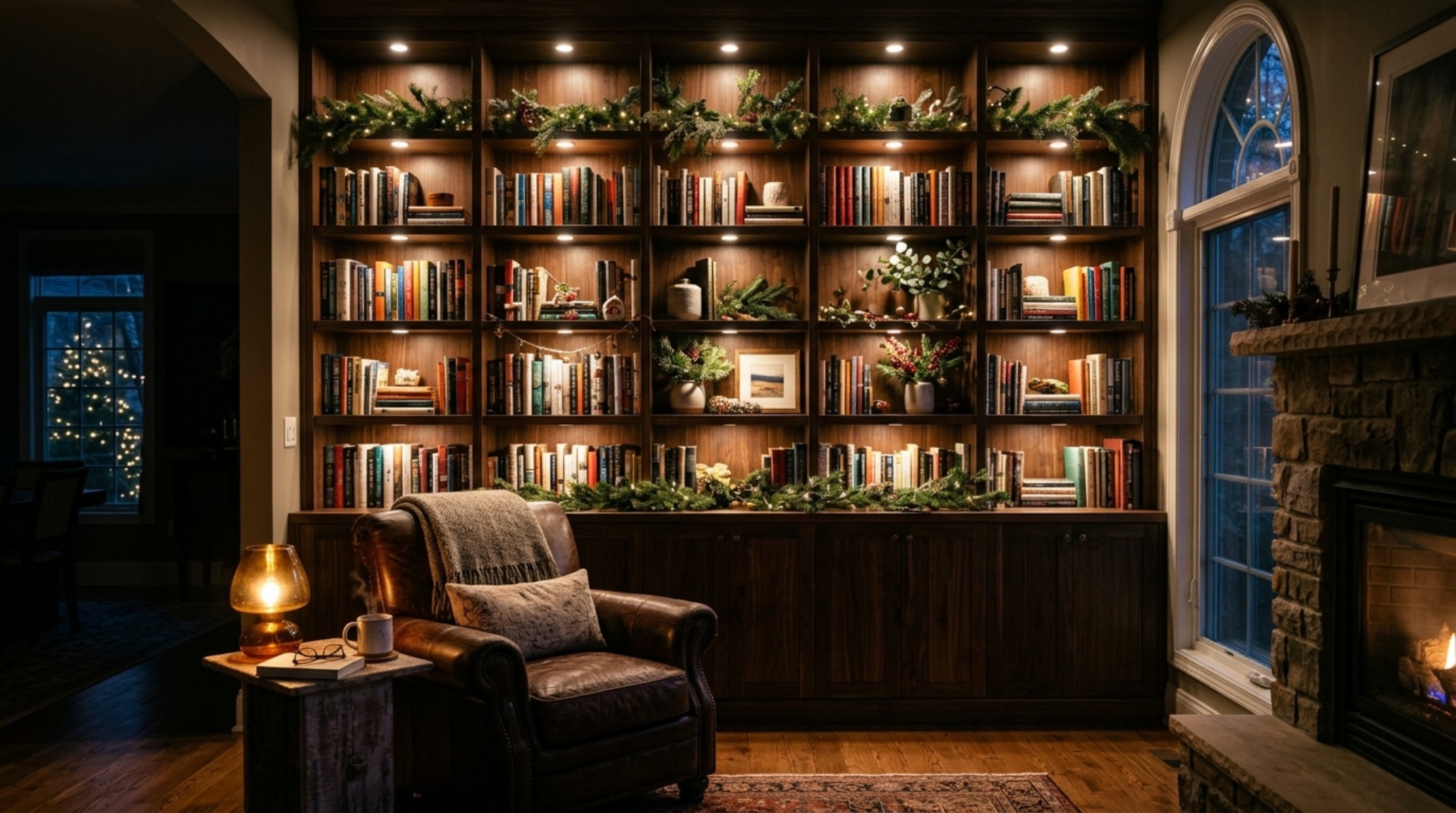
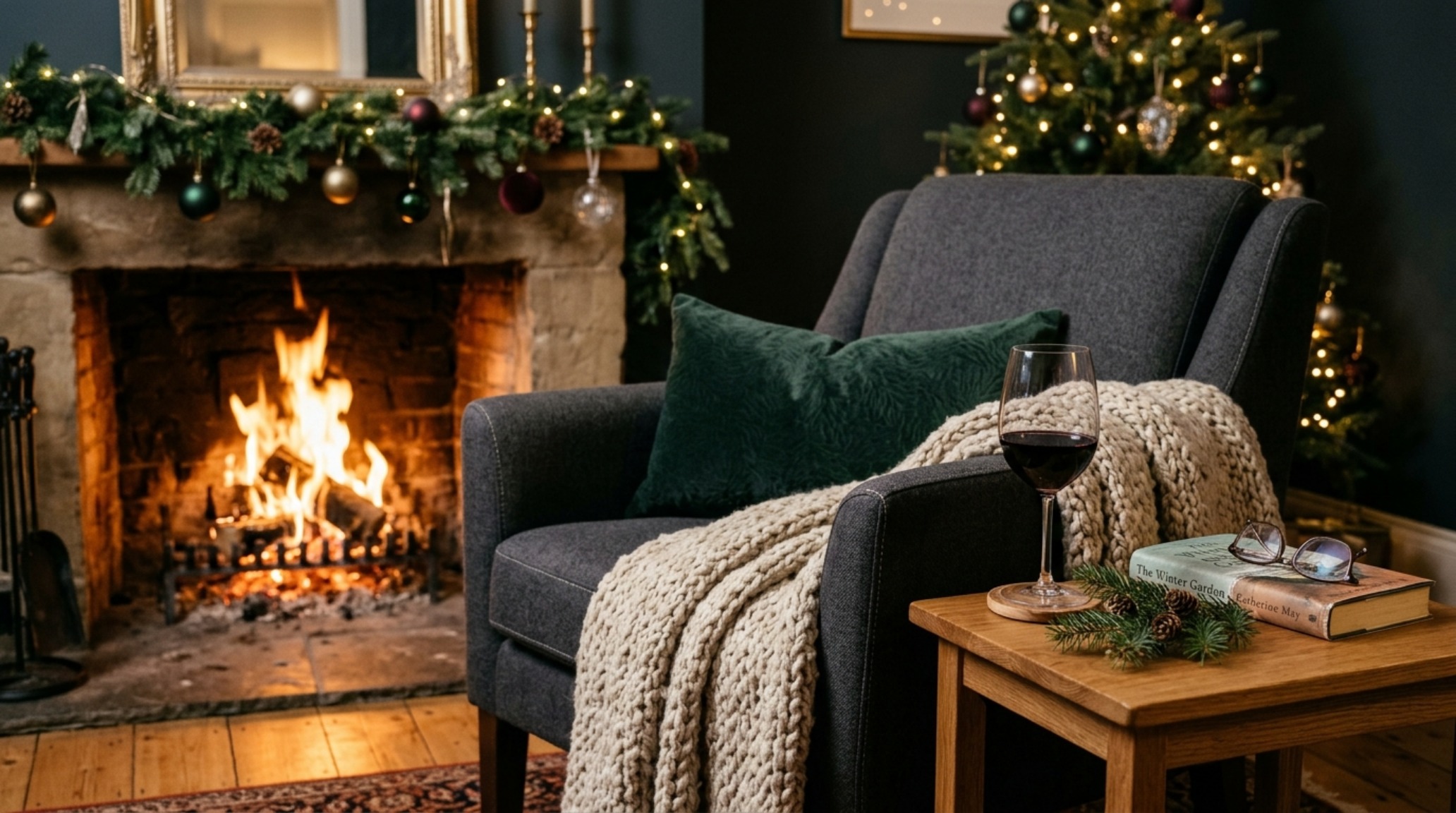
The 2026 design landscape focuses heavily on ‘Smart Warmth.’ This means utilizing flicker-flame LED candles that have the weight and scent of real wax, placed in groupings of three or five to create a staggered visual height. This repetition reinforces the linear flow of sideboards and consoles. When lighting a tree, aim for ‘Internal Depth’—place some strands deeper toward the trunk to illuminate the tree from within, creating a three-dimensional sculptural effect rather than a flat surface of pinprick lights.
Modern Farmhouse Christmas Trends & Structural Honesty
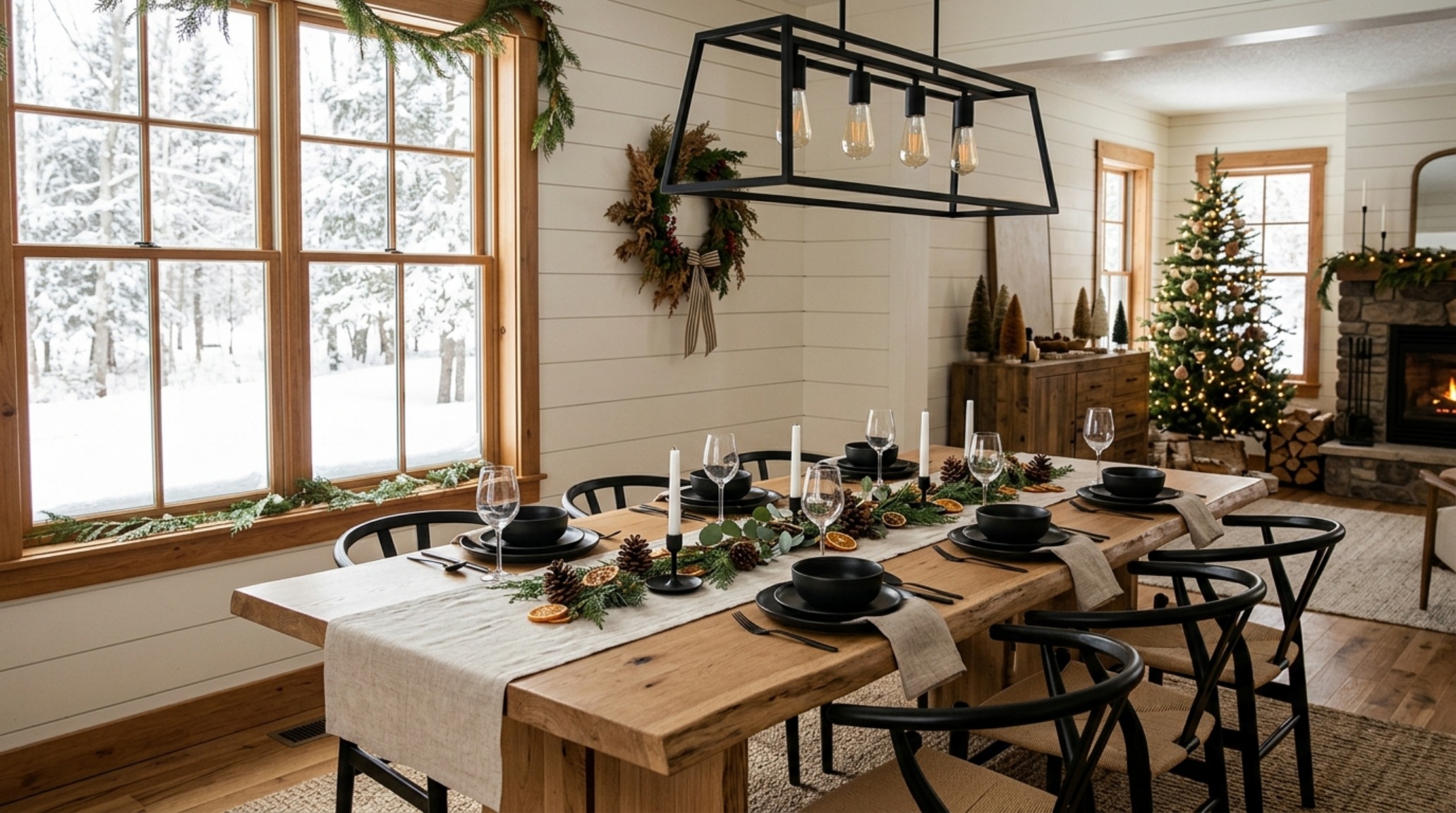
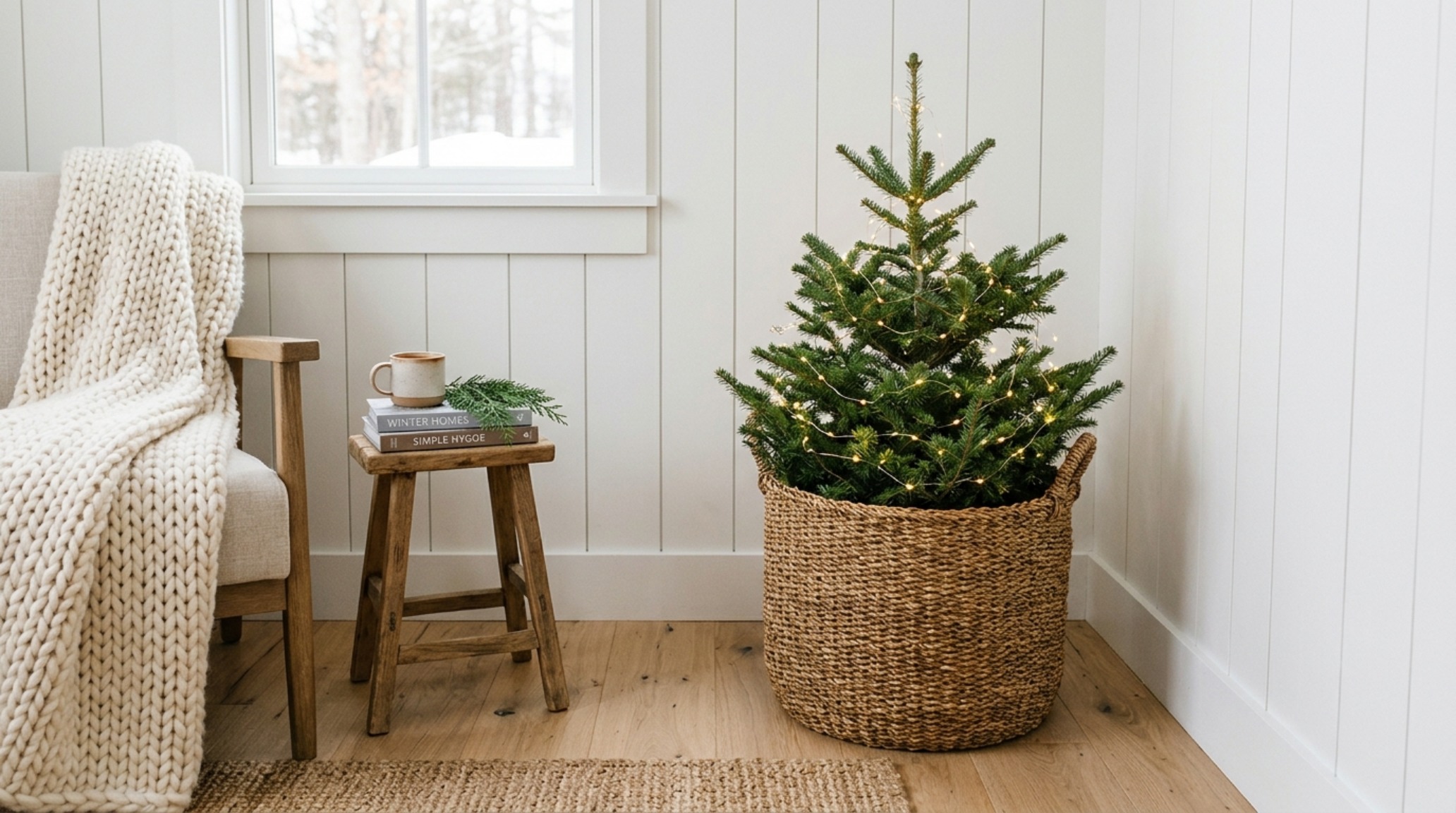
The modern farmhouse christmas trends of recent years have shifted away from the ‘shabby chic’ excess toward a more refined, ‘structural’ rusticity. This involves using reclaimed wood elements and oversized knit textures that speak to the home’s bones. In a room with exposed Douglas Fir beams, your decor should echo that wood tone. Use dried orange slices, oversized pinecones, and heavy linen ribbons. These materials provide a ‘tactile luxury’ that feels grounded and authentic. Avoid plastic sheen; instead, look for the ‘patina’ of aged brass or the matte finish of ceramic ornaments.
Sustainable Holiday Styling: The Ethics of Materiality
As we become more conscious of our environmental footprint, sustainable holiday styling has moved from a niche interest to a primary design pillar. Scaling here means choosing fewer, higher-quality pieces that can be reused for decades. Look for FSC-certified wood, organic cotton, and hand-forged metals. The goal is to create a ‘Visual Anthology’ of your home’s history. A heavy, hand-cast bronze bell has a ‘spatial presence’ that a dozen plastic baubles lack. It carries weight—literally and figuratively—and anchors a room with its permanence.
Curated Materiality & Technical Dimensions Guide
Detailed specifications outlining core tactile materials, lighting temperature, and room clearances.
Ultimately, the most successful ideas for decorating for christmas are those that treat the home with the same reverence in December as they do in June. By respecting the structural profile of our rooms, we allow the festive season to breathe. We create spaces that aren’t just decorated, but are architecturally transformed—where every ornament feels like it was always meant to be there, and the home’s geometry is celebrated through the warm, evocative glow of a winter’s evening.
Editorial Silo • Recommended Architecture Studies
- Beds That Save Space: The Architectural Blueprint & Spatial Flow Guide — Archival Design Case Study
- The Closed-Loop Life: Mastering the Functional Ergonomics of Self Sustaining Homes — Archival Design Case Study
Editorial Design Lookbook
An editorial exhibition documenting finishes, architectural lighting, and bespoke spatial detailing.

Curated Visual Lookbook
Design Gallery & Spatial Studies
A visual curation of architectural arrangements, lighting concepts, and material palettes featured in this space.