The Perimeter Secret of French Parquet
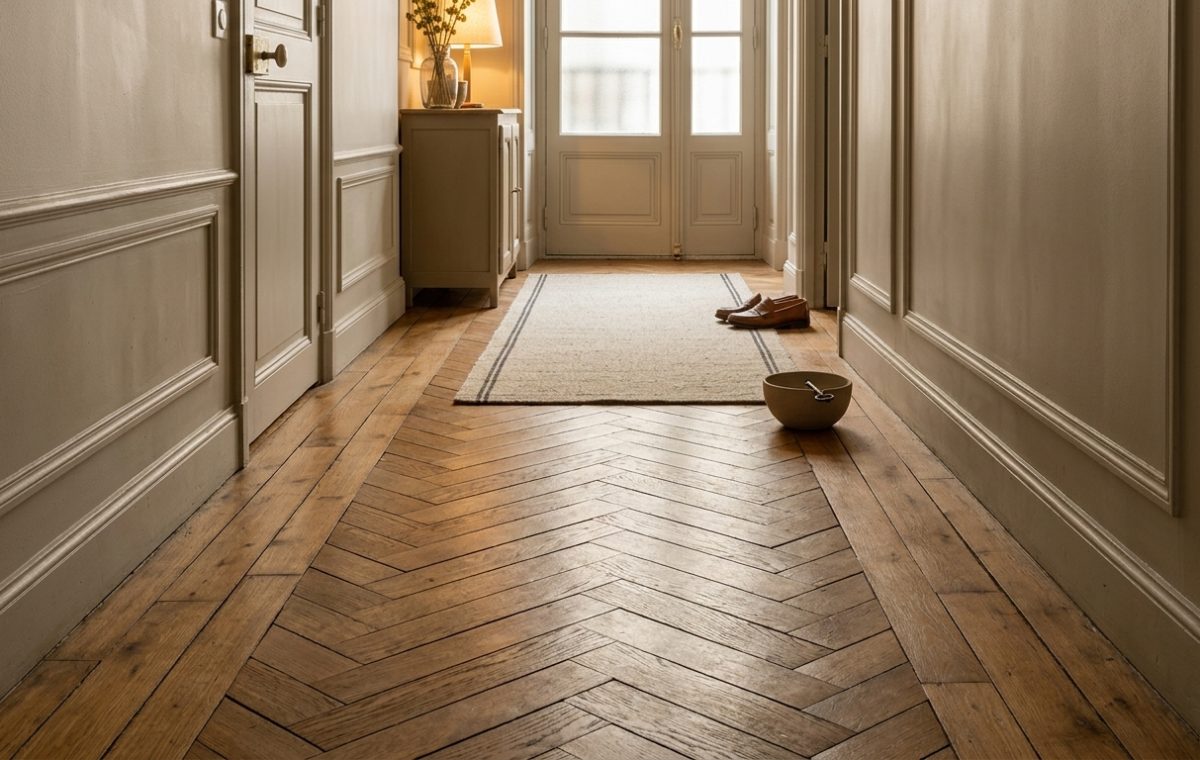
Notice the single plank border running flush alongside the skirting board before the angles begin? That border is doing all the heavy lifting. Long hallways are rarely square. Older homes settle, plaster bows, and walls drift out of true by an inch or two over twenty feet. If you run angled blocks straight into the skirting, every uneven taper shows instantly. Cutting chevron parquet flooring into a parallel perimeter board hides wall eccentricities while giving the chevron points a clean frame to push off from.
It looks effortless here. Achieving that balance takes ruthless geometry on day one.
Aligning the Spine in Narrow Corridors
A hallway is essentially an arrow. Every time someone walks through, their eye follows the central line straight to the doorway at the far end. That means your pattern’s central spine must align dead-on with the visual destination, not necessarily the exact mathematical center between two crooked walls.
Get this wrong, and the entire room feels like it leans left. Installers often snap chalk lines down the room’s axis, dry-lay three runs of blocks, and check sightlines from both entry points. Pair this with traditional picture frame moulding on the walls, and any misalignment becomes glaringly obvious. The wall panels echo the floor grid; symmetry needs to feel intentional, even when the underlying structure fights you.
Never start laying chevron against an exterior wall hoping it lands neatly in the center. Build your central spine out first, then cut your borders to fit the room’s inevitable flaws.
Real-World Wear in High-Traffic Paths
Corridors take a beating. Dirt travels straight from the front door into the grain, grinding down finishes faster than anywhere else in the house. A heavy hallway runner rug protects high-friction paths, but nobody wants to hide sixty percent of an expensive timber installation under wool.
The solution comes down to the finish:
- Matte hardwax oils: They penetrate deep and allow spot-repairing high-wear tracks without sanding down the entire hall.
- Water-based polyurethanes: Exceptional surface resilience against grit, but when scratches inevitably happen, you are stripping the entire corridor to fix them.
- Beveled edges versus square edges: Micro-bevels define each parquet block beautifully, though they trap dust if you skip regular sweeping.
Footwear creates friction. Notice the neat ceramic tray and loafers resting off to the side? High-traffic entryways demand intentional drop zones. Without a dedicated resting spot for keys and damp shoes, pristine white oak turns grey around the doorway thresholds within two seasons.
Managing Proportion and Echo
Long corridors with bare timber and classic boiserie can turn into echo chambers. The crisp click of heels against solid oak sounds dramatic for five minutes, but it gets exhausting during a busy morning routine. Softening the perimeter with wall mouldings helps break up sound waves slightly, yet the real acoustic dampener remains thoughtful staging: low-profile side tables, a textured runner placed far enough down to let the entrance breathe, and muted wall paint that keeps the hallway from feeling like a sterile museum runway.
Are you tackling an old hallway where nothing is level, or starting fresh on a crisp subfloor? Let the site tell you where the center belongs before laying that first point.
Editorial Lookbook & Photo Collection