Mastering Console Table Styling Like an Interior Designer
Key Points
The Anatomy of a Well-Dressed Surface Most flat surfaces in a home instantly attract clutter.
Mail piles up, loose keys gather, and random knick-knacks…
The Anatomy of a Well-Dressed Surface
Most flat surfaces in a home instantly attract clutter. Mail piles up, loose keys gather, and random knick-knacks form messy stacks. Fixing this isn’t about buying more bins. It is about understanding spatial balance. A thoughtfully composed console table relies on deliberate weight distribution rather than symmetrical perfection.
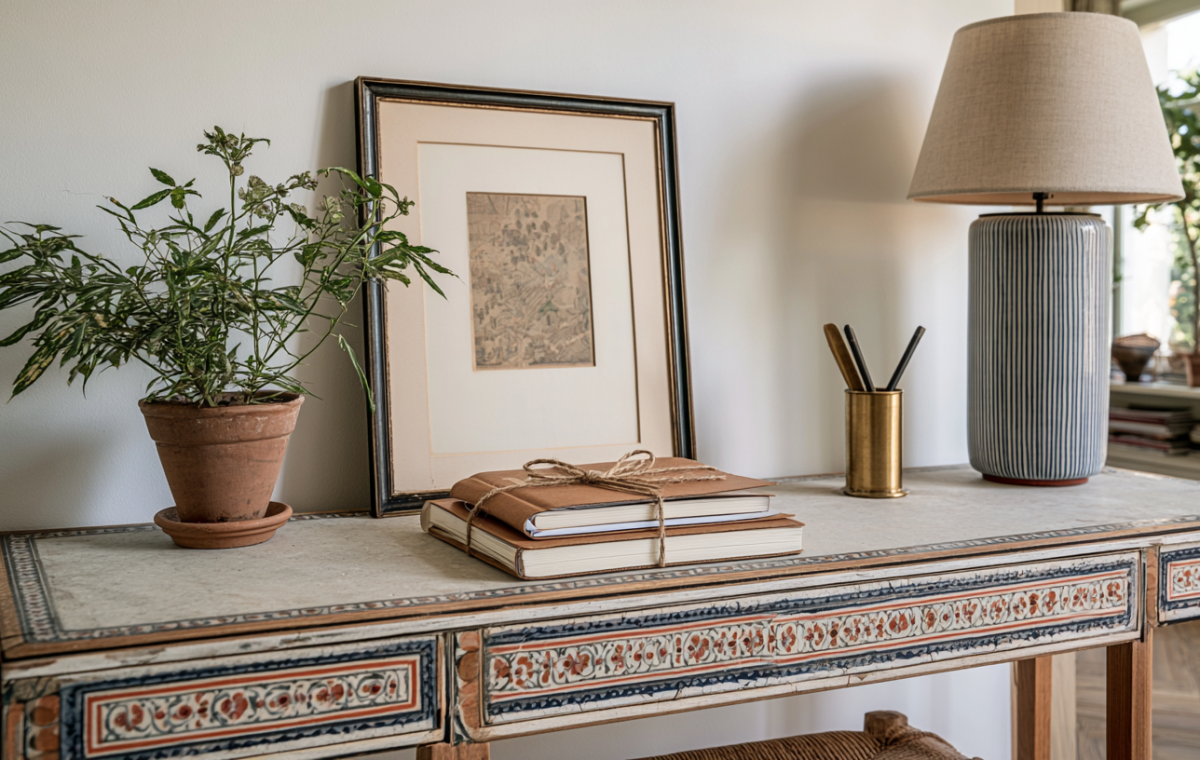
Notice the rustic painted console in the photo. It features intricate, muted hand-painted patterns along its drawers. Because the furniture base already carries heavy visual detail, the items placed on top need breathing room. Too many objects would compete with the craftsmanship of the wood.
Building Visual Height and Depth
Every flat surface needs vertical interruption. Without varying heights, a display looks entirely flat and lifeless. A tall table lamp with a patterned ceramic base anchors one side of the arrangement, casting warm light while creating an immediate vertical anchor. Balance is achieved on the opposite flank using a potted green plant in a weathered terracotta pot, bringing organic asymmetry into the mix.
Pair tall elements like lamps with low, grounded objects like stacked books.
Vary textures between smooth ceramics, rough clay, and raw paper.
Leave intentional negative space so the eye can rest between focal points.
The Power of Negative Space
Restraint remains the hardest part of styling. Leaving an area completely empty feels uncomfortable to many homeowners. Yet, negative space prevents visual fatigue. The framed art piece resting against the wall behind a bundle of tied notebooks serves as a quiet backdrop. It adds depth without adding physical clutter.
Brass accents, such as the small pencil cup holding writing instruments, introduce a subtle metallic sheen. They catch light without overwhelming the muted color palette. These minor details turn a bare walkway into a curated destination within the room.
How do you usually handle the surface clutter that builds up near your main entryways or living spaces?
Editorial Lookbook & Photo Collection
Photo Archive: Mastering Console Table Styling Like an Interior Designer
36 Photos
Written by
JayhawkRent Editorial Team
Culinary Critic exploring visual stories and modern design based in Paris, France.
Editorial review fields are available through custom fields: jayhawk_reviewer_name and jayhawk_reviewer_note.
Cold weather changes how we interact with our living spaces. Hard surfaces suddenly feel uninviting, and minimalist rooms can quickly turn sterile. The shift…
The Anatomy of Parisian Flooring Walk across authentic French herringbone wood flooring and you immediately notice the acoustic difference. Solid oak blocks installed in…