The Shelter of the Pitch
Angled ceilings make builders nervous. Most people see an awkward knee wall and surrender it to dusty plastic bins or dead storage. That is a mistake. When you slide a slender walnut desk beneath a steep structural pitch, the atmosphere shifts instantly. You feel protected. The compressed height cuts peripheral distractions, creating an instinctive cocoon for writing, reading, or deep administrative work.
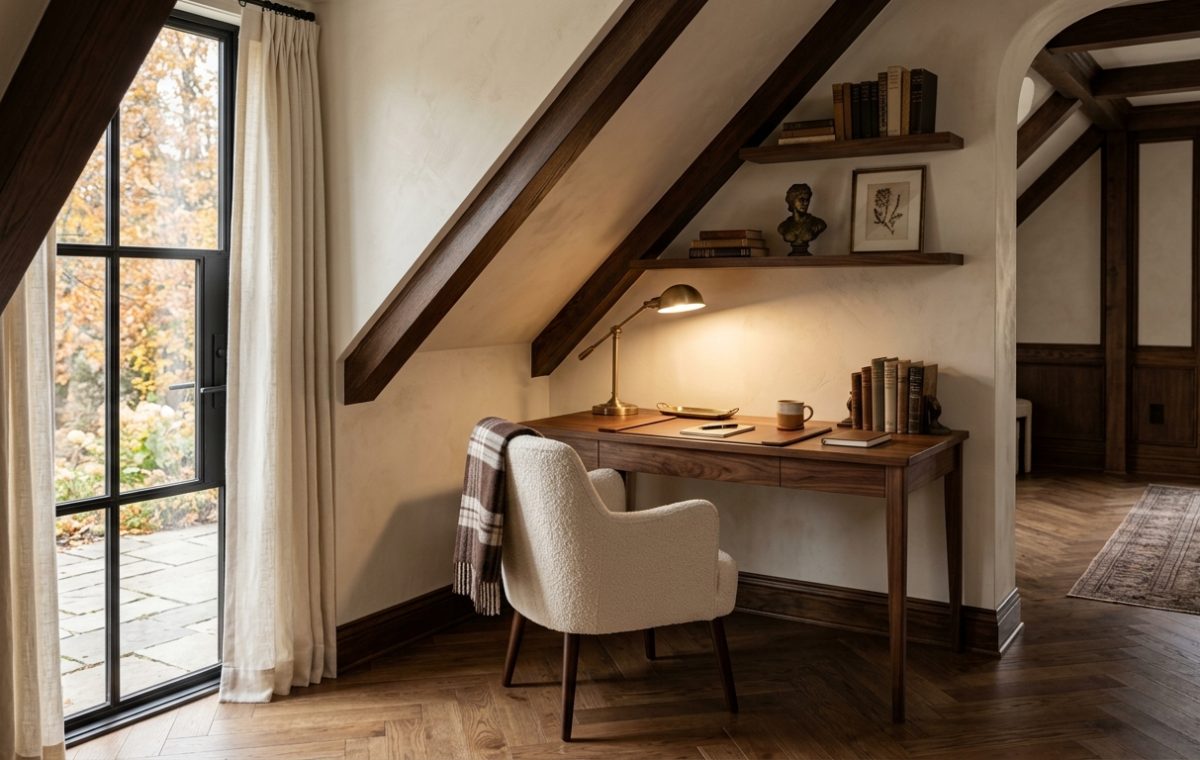
Look at the timber pitch in this room. The rafter does not fight the desk; it frames it. Scale is everything here. Bring in a massive executive pedestal desk and the room feels suffocated. Pick a leggy writing table with shallow drawers instead. You gain legroom, maintain an airy floor profile, and preserve sightlines across the herringbone wood floor.
Building Up Without Crowding In
The biggest challenge under eaves is vertical storage. Standard bookcases do not fit triangular margins. Custom casework costs a fortune. The workaround is surprisingly simple: floating timber shelves cut to follow the ceiling rake.
Notice how two staggered planks maximize what would otherwise be wasted vertical plaster. They carry just enough weight—a handful of hardcovers, a small bronze bust, a quiet print—without protruding into your forehead when you stand up. Keep these shelves no deeper than ten inches. Anything deeper casts heavy shadows onto your blotter and turns an airy niche into a claustrophobic tunnel.
A good workspace under eaves doesn’t try to hide the ceiling angle. It aligns with it.
Solving the Lighting Conundrum
Sloped ceilings devour ambient overhead light. Recessed cans look harsh punched into angled drywall, and chandeliers drop right into your line of sight. Natural daylight from an adjacent French window helps, but directional task lighting does the heavy lifting after dusk.
A low-slung, weighted brass desk lamp provides warm, pooled illumination where your hands rest. It bounces soft amber warmth off textured plaster walls rather than flattening the room with sterile lumens. Pair that with tactile materials to soften hard architectural lines. A textured bouclé chair softens the sharp rake of the ceiling, while a wool throw introduces subtle pattern without visual noise.
Keep in mind that attic knee walls run hot in August and cold in January. Check your perimeter insulation before bolting shelves into exterior rafters, and leave a two-inch gap behind the desktop for airflow and cable drops. Have you ever tried carving a workspace out of an under-eaves dead zone, or did the low clearance scare you away?
Editorial Lookbook & Photo Collection