The Two-Second Friction Test
Watch what happens the moment someone crosses your threshold. They carry mail, car keys, groceries, a damp trench coat, and a brain fried from traffic. If shedding those items demands more than two seconds of physical effort, the system collapses. Bags hit the nearest armchair. Mail scatters over the kitchen island. Keys wander off into jacket pockets never to be seen again.
A well-planned entryway drop zone is not an aesthetic indulgence. It is behavioral architecture. It accepts human laziness as an immutable law and designs around it rather than against it.
The Catchall Bowl: Depth Matters
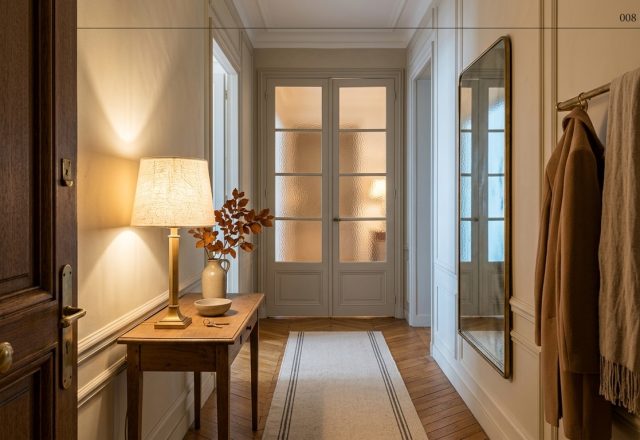
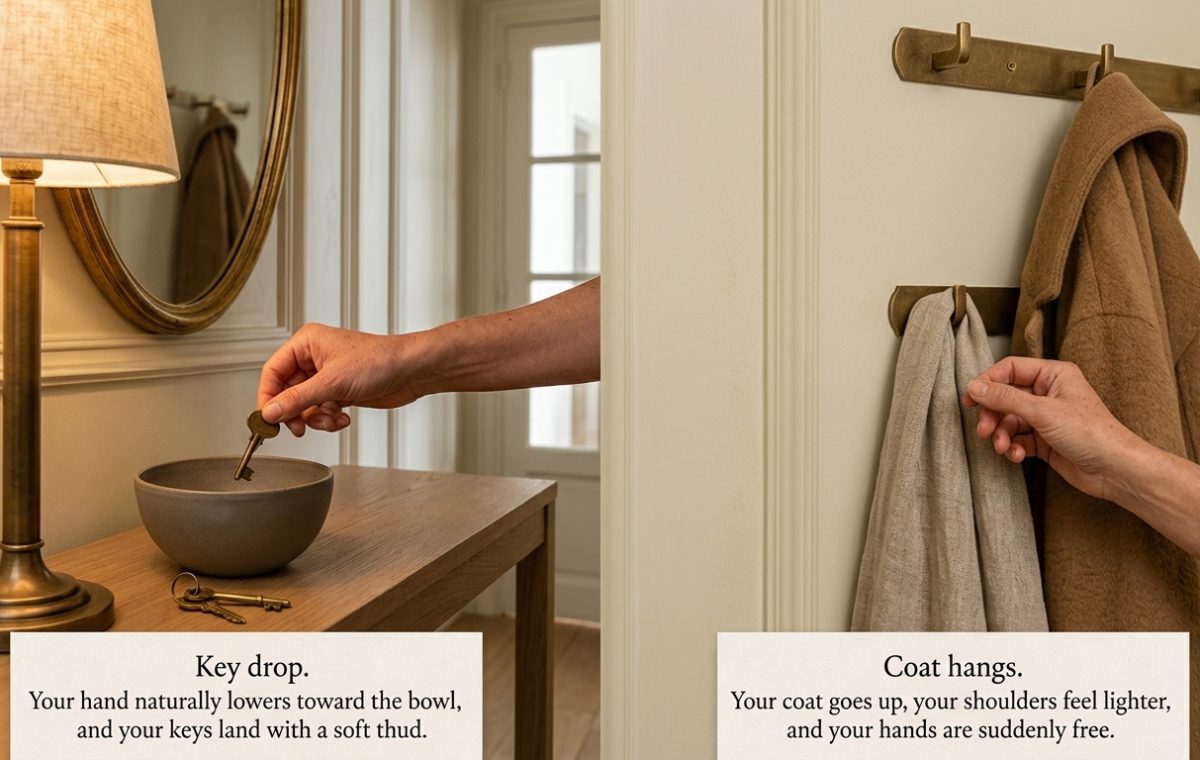
Most decorative trays fail immediately. They are too flat. You toss a heavy key ring onto a flat marble slab, and it skitters off the edge onto the hardwood floor with a startling clatter. Look closely at the ceramic vessel pictured on the console: it has high, inward-curving walls and substantial weight.
That soft, muffled thud when keys land inside a stoneware bowl gives subtle sensory feedback. It tells your subconscious, you are done for the day. Keep the bowl within arm’s reach of the door handle. Pair it with a dimmable table lamp with a linen shade. When you walk in late at night, that single warm pool of light guides your hand straight to the bowl without needing to blast blinding overhead spotlights.
The best organizational systems require zero willpower at the end of an exhausting workday.
Why Brass Hooks Beat Closets Every Single Day
Architects love tucking entryway closets behind paneled doors. Real people hate using them daily. Opening a closet door, digging out a wooden hanger, shimmying a coat onto the shoulders, and sliding the door shut represents four distinct actions. Almost nobody does that on a Tuesday evening.
Wall-mounted hardware wins the practicality test every time. The double-tiered brass rail shown here proves why open hanging works so seamlessly:
- Instant release: Coats hang by their collar loops in half a second.
- Air circulation: Damp outerwear dries naturally rather than smelling musty inside a dark cupboard.
- Tiered verticality: Lower hooks catch linen scarves or tote bags, while upper pegs hold heavy winter woolens.
Opt for solid, patinated brass or cast iron over flimsy adhesive hooks. Winter wool coats are surprisingly heavy, and nothing breaks a serene arrival quite like the sound of mounting tape tearing your drywall away.
Dialing In Your Own Threshold
You do not need a grand center hall foyer to pull this off. Even an eighteen-inch strip of bare drywall behind an apartment door can host a sturdy rail and a shallow floating shelf. The goal is simply to engineer a physical off-ramp between the external world and personal retreat. How many pieces of clutter currently linger on your dining table that simply need a designated hook by the front door?
Editorial Lookbook & Photo Collection