The Art of Repeating Elements
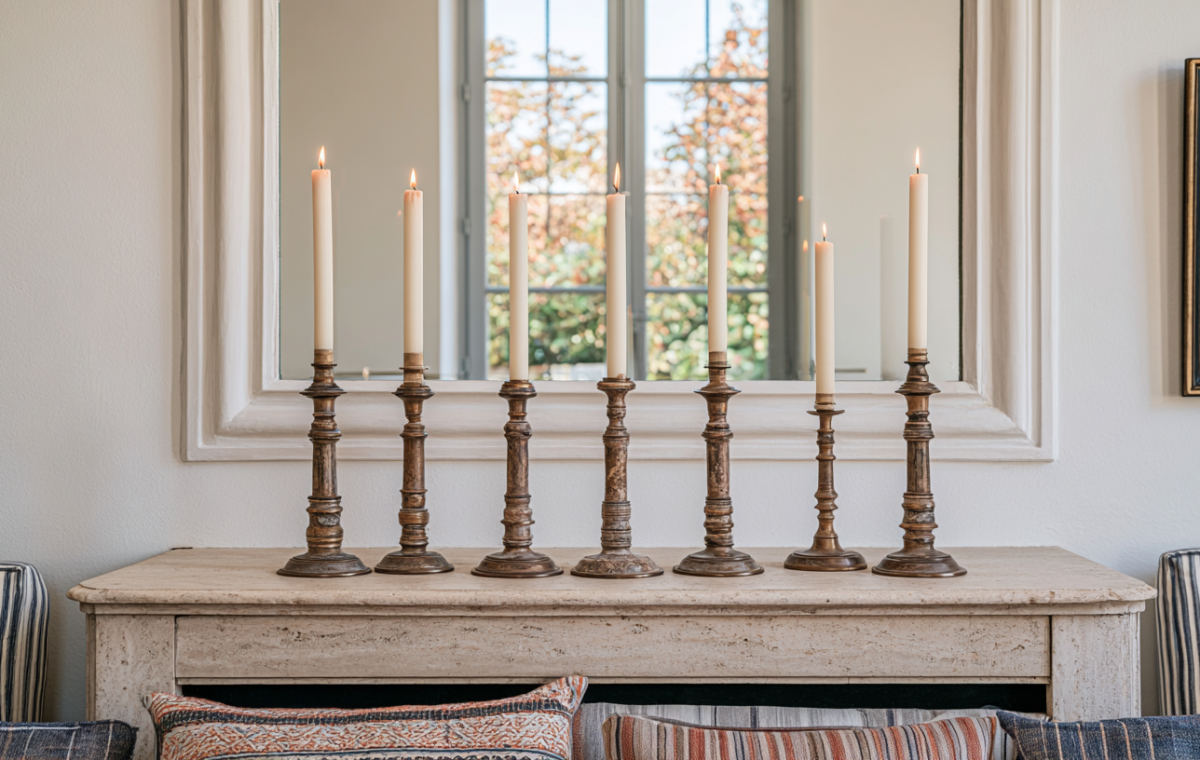
Symmetry feels stiff. Asymmetry feels messy. But repetition? Repetition creates an immediate sense of rhythm that anchors a heavy architectural feature like a stone fireplace. When you line up a row of mismatched or graduated candle holders across a mantel, you stop fighting the room’s geometry and start working with it. The trick lies in the spacing. If objects sit too far apart, the composition evaporates. If they crowd together, the mantel looks cluttered instead of curated.
Metals matter immensely here. Polished brass screams hotel lobby, but aged bronze and tarnished brass absorb light rather than throwing cheap glares. Look at how these warm metallic tones pick up the afternoon light reflecting off the mirror glass behind them. It creates depth without needing dozens of competing knickknacks or seasonal plastic greenery.
Managing Real Fire Hazards
Let us talk about the practical reality of burning actual wax inches below a large decorative mirror. Wax drips. Soot accumulates. If you use real taper candles, you need to accept maintenance as part of the aesthetic. Clean out the drip trays weekly, or switch to high-end LED tapers if your mantel sits directly beneath delicate artwork or a valuable antique looking glass. Real fire adds undeniable atmosphere, but it also ruins vintage finishes if left unsupervised.
Height variation is another subtle trap. Too many people pick candle holders of identical height, turning their fireplace ledge into a picket fence. Graduating the sizes from the center outward or creating rolling waves of elevation keeps the eye moving across the room. Notice the subtle frame hanging to the right, balancing the heavy architectural mirror without overpowering the primary focal point.
Curating Your Own Fireplace Ledge
Building a successful arrangement rarely happens on the first try. Move the pieces around. Step back six feet. squint your eyes to check the weight distribution. Sometimes removing a single element transforms a chaotic display into a striking centerpiece. How often do you switch up your living room styling, or do you prefer to find a single working formula and leave it untouched for months?
Editorial Silo • Recommended Architecture Studies
- Performance Modularity: Modular Shelf System & Engineering Seamless Living in the Modern Compact Home — Archival Design Case Study
- The Physics of the Curve: Structural Secrets of Earth-Sheltered Hobbit Home Designs — Archival Design Case Study
Curated Lookbooks & Architectural Studies
- The Tactile Aesthetic of Loft Bed Ideas: Materials, Moods & Lighting Kelvin
- Sensory Sanctuaries: Mastering Material Haptics and the Design Interior of House Atmosphere
- The Ergonomic Optimizer: Solving Compact Living Challenges with a Strategic Home Design Tool Free
- Mastering Gray Living Room Design With Classic Paris Style
- The Engineering of Ease: How to Make Contemporary Furniture for High-Performance Urban Living”, description: “Modern living demands a departure from static design; to make contemporary furniture today is to engineer kinetic, multifunctional solutions. This guide introduces the ‘2:1 Rule’ of spatial density—balancing two parts low-profile furniture with one part uninterrupted breathing room. We analyze the ergonomics of ‘cognitive stability,’ integrating hidden power hubs, wireless charging surfaces, and modular footprints that allow a single piece to pivot between a high-focus workspace and a serene sanctuary.
- The Architectural Manifesto: Using the Ultimate Sofa Buying Guide Decor Ideas to Engineer Spatial Harmony
Curated Visual Lookbook
Design Gallery & Spatial Studies
A visual curation of architectural arrangements, lighting concepts, and material palettes featured in this space.