The Anatomy of a Timeless Wall
Most modern display units suffer from a terrible affliction: they are far too clean. Rows of paperbacks facing outward in sterile symmetry yield zero character. Look closer at a genuinely lived-in antique arrangement. It leans into asymmetry, heavy textures, and stories accumulated over decades. Shelves do not exist merely to hold paper; they act as physical backdrops for personal history.
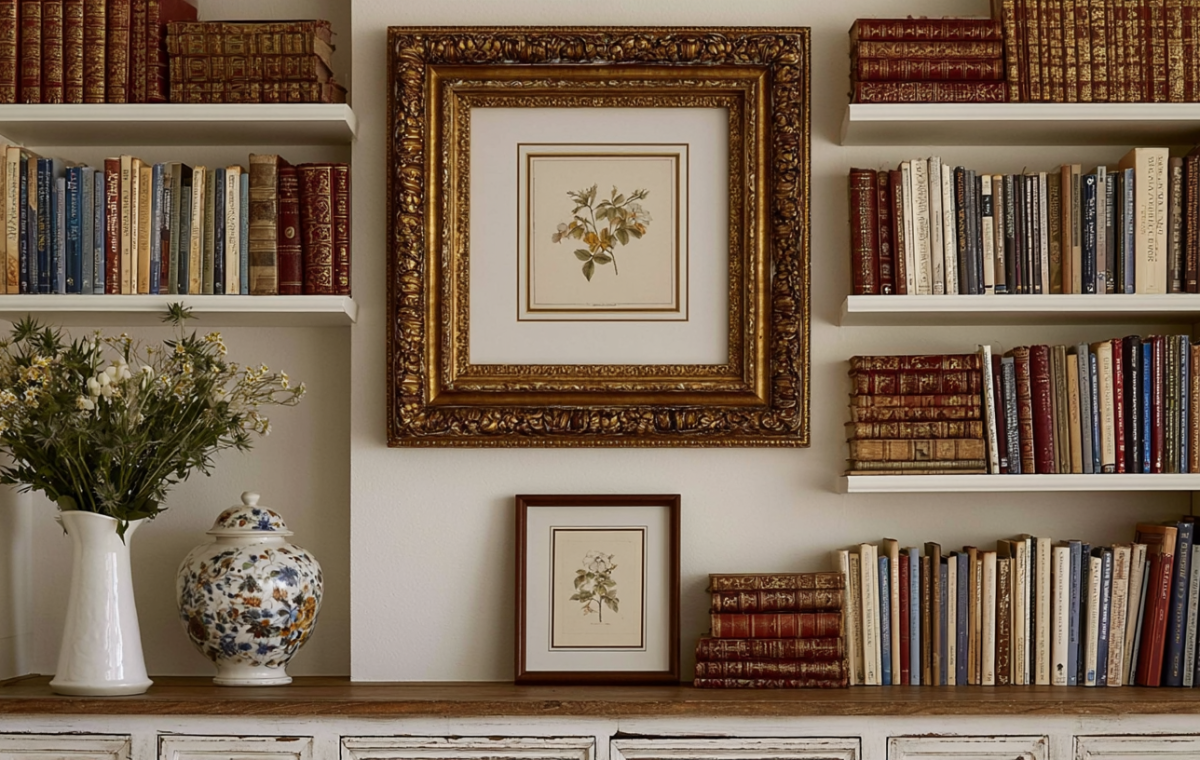
Notice how the dense rows of leather-bound volumes create natural rhythmic blocks. Some stacks sit upright. Others rest flat. That deliberate variation breaks up the monotony instantly. When you stack books horizontally, you create stable staging platforms for smaller decorative objects or fragile vessels.
Layering Art Over Literature
Hanging a gilded, ornate picture frame directly over a central bookshelf divider changes the rules of vertical space. It defies standard minimalist advice. It works because the heavy gold molding contrasts sharply against flat white drywall and simple white shelves. Below it, a smaller secondary frame anchors the lower console table, establishing a visual staircase for the eye.
Textiles and botanicals soften rigid wooden spines. A heavy white ceramic pitcher overflowing with rustic dried wild daisies injects organic movement. Next to it, a lidded blue and white ginger jar introduces historical pattern without overwhelming the muted color palette. These elements require dusting, yes. Perfection is the enemy of charm here.
Executing the Look at Home
Start by clearing every single shelf until completely bare. Group your volumes by height, color family, or physical condition rather than sorting strictly by Dewey decimal order. Mix in vintage curios, framed botanical prints, and family heirlooms gradually. Leave a few small negative spaces empty so the eye can actually rest. What unexpected objects do you have sitting in storage right now that deserve a spot on your primary walls?
Editorial Lookbook & Photo Collection