The Architectural Weight of the Living Room Heartbeat Morning light has a way of exposing the skeletal truth of a room, filtering through sheer…
The Architectural Weight of the Living Room Heartbeat
Morning light has a way of exposing the skeletal truth of a room, filtering through sheer linen drapes and catching the dust motes dancing over a well-worn rug. It is in this quiet, high-contrast hour that we realize the sofa is more than just seating; it is the anchor of a home’s social geography. To truly elevate this anchor, one must treat decorative pillows for couches as structural components rather than mere soft goods. When we approach styling through the lens of spatial volume, we move away from the ‘scattered’ look and toward a curated, gallery-level composition that respects the golden ratio of scale.
The 2-2-1 Blueprint is an editorial strategy born from the need for mathematical precision in high-end residential design. It treats the sofa as a landscape, utilizing varying heights and depths to create a visual cadence that leads the eye across the room. This isn’t about filling a gap; it’s about architecting comfort. By anchoring the perimeter with substantial mass and graduating toward a singular, focused center, we provide the eye with a sense of stability and the body with an ergonomic embrace.
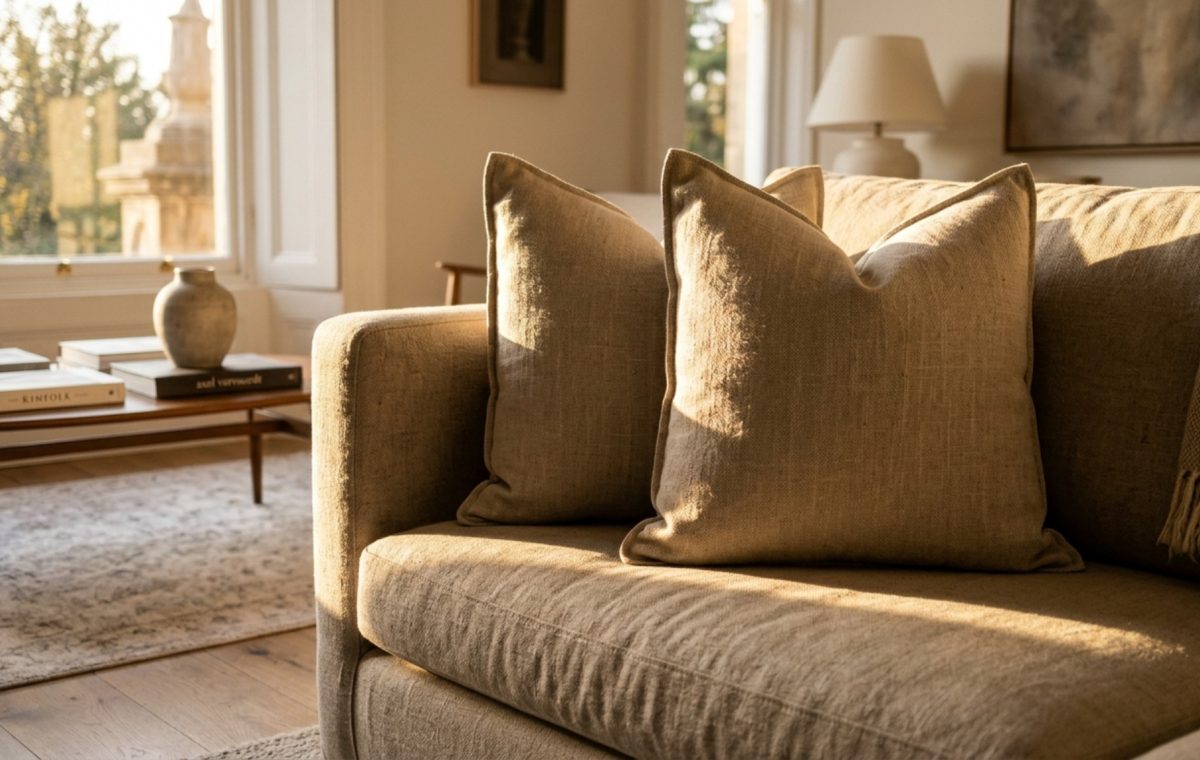
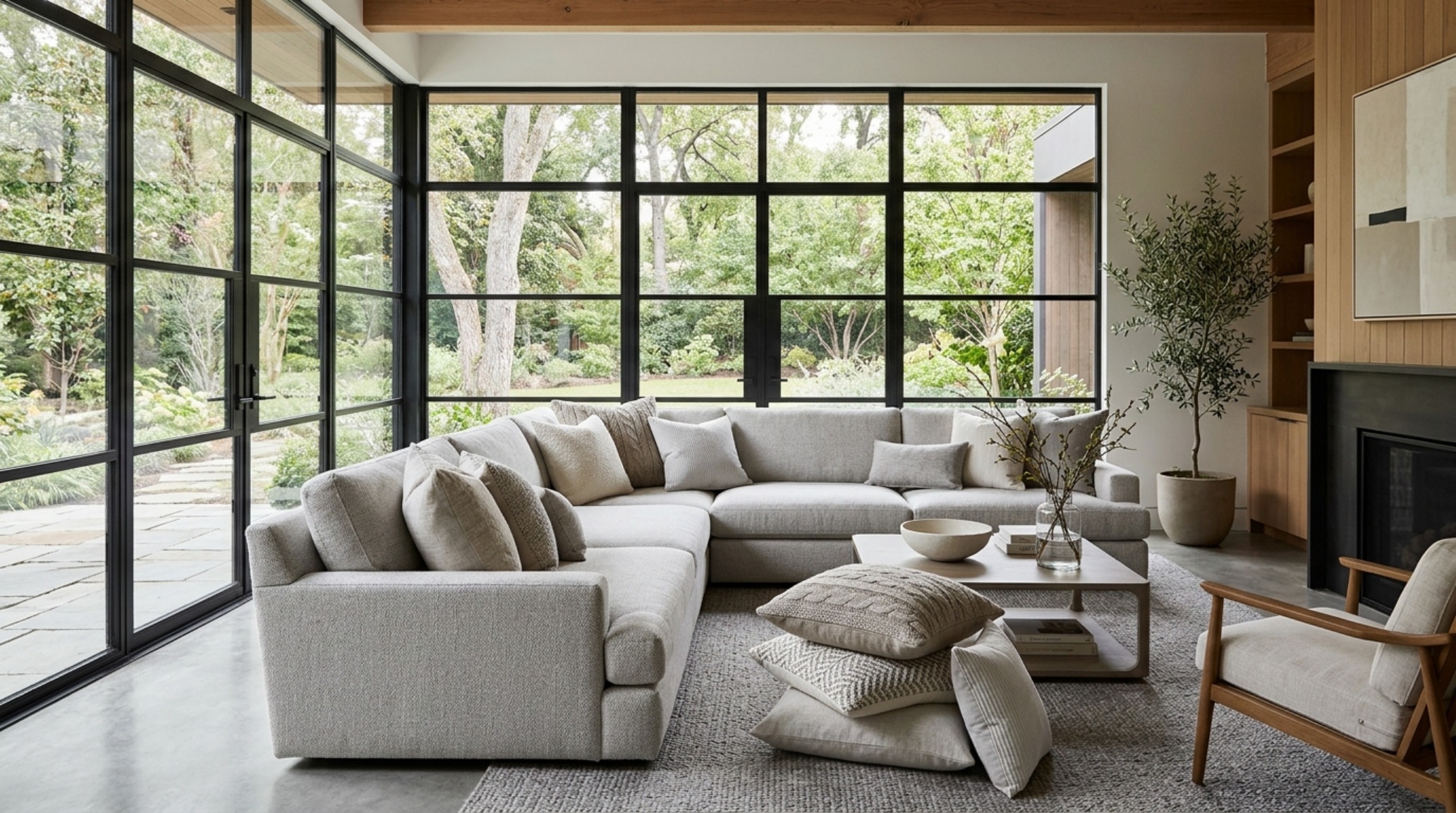
Designer pillow insert sizing guide featuring 24-inch anchor pillows with down inserts on a Belgian linen sofa in a bright living room.
Designer Pillow Insert Sizing Guide: The Structural Foundation
Every architect knows that a structure is only as resilient as its foundation, and in the world of soft styling, that foundation is the 24-inch square. For a standard 84-inch sofa, we begin with the ‘anchor’ layer: two 24×24 inch pillows positioned firmly in the corners. These are the pillars of your arrangement. A common mistake is selecting 18-inch or 20-inch pillows for this role; they lack the verticality needed to stand up against the height of the sofa back, often looking dwarfed by the surrounding architecture.
When consulting a designer pillow insert sizing guide, the industry secret is always to upsize the insert. To achieve that ‘karate-chop’ look favored by designers like Athena Calderone, you must use a high-quality 26×26 inch down-and-feather insert inside a 24×24 inch cover. This 2-inch delta ensures the corners are plump and the center has enough ‘give’ to create a deep, natural crease. Materiality here should be heavy—think high-GSM Belgian linen or a structured wool bouclé—to ground the arrangement.
The Role of Down vs. Synthetic in Volume Management
Weight matters. A synthetic poly-fill insert will fight against the sofa’s form, bouncing back with a rigid, unnatural elasticity that disrupts the room’s flow. Conversely, a 90/10 feather-down blend possesses a tactile gravity. It sits ‘into’ the sofa rather than ‘on’ it. This structural integration is what separates a showroom vignette from a lived-in masterpiece. We want the pillows to feel like they have always been there, fused to the silhouette of the frame.
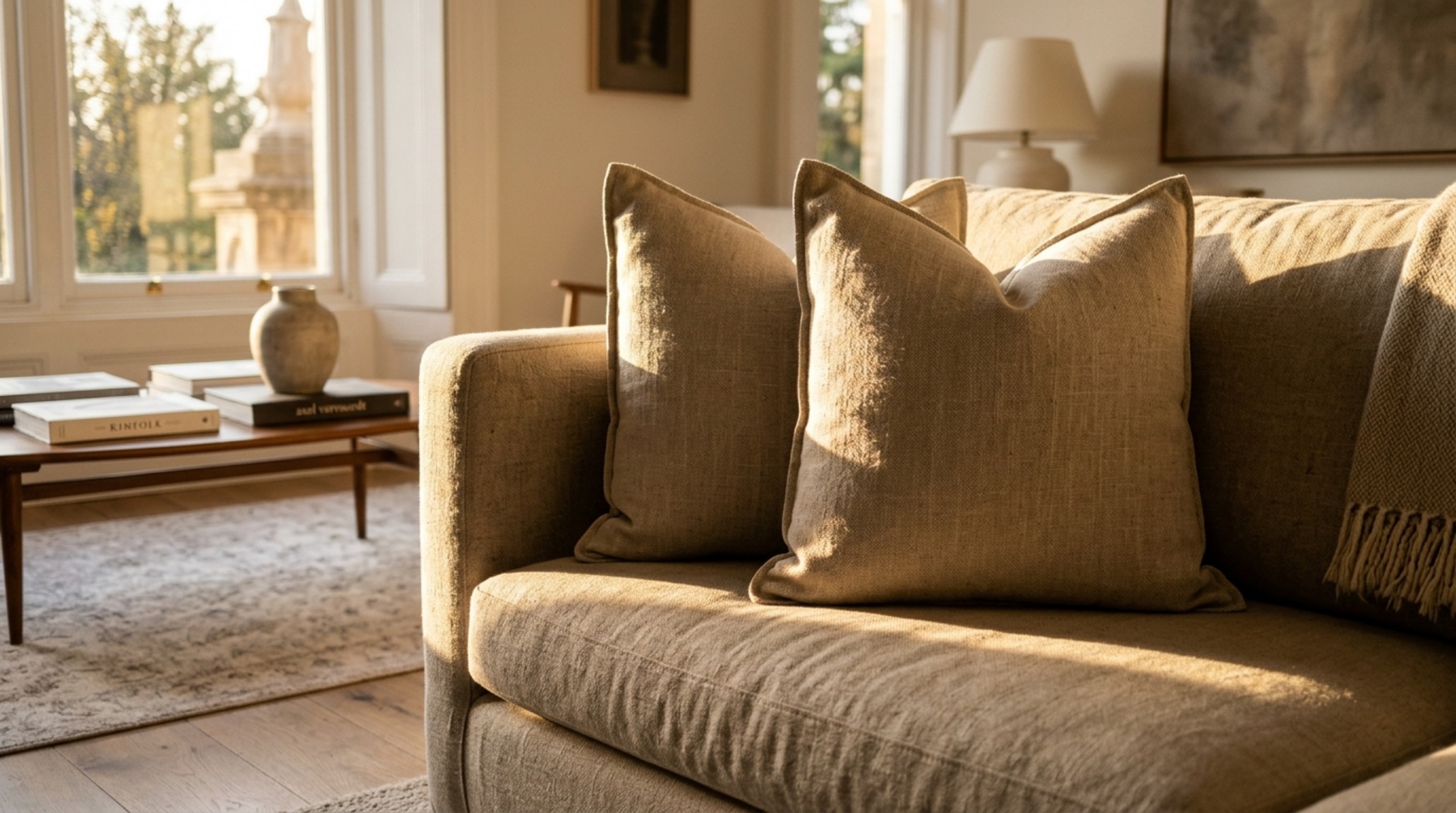
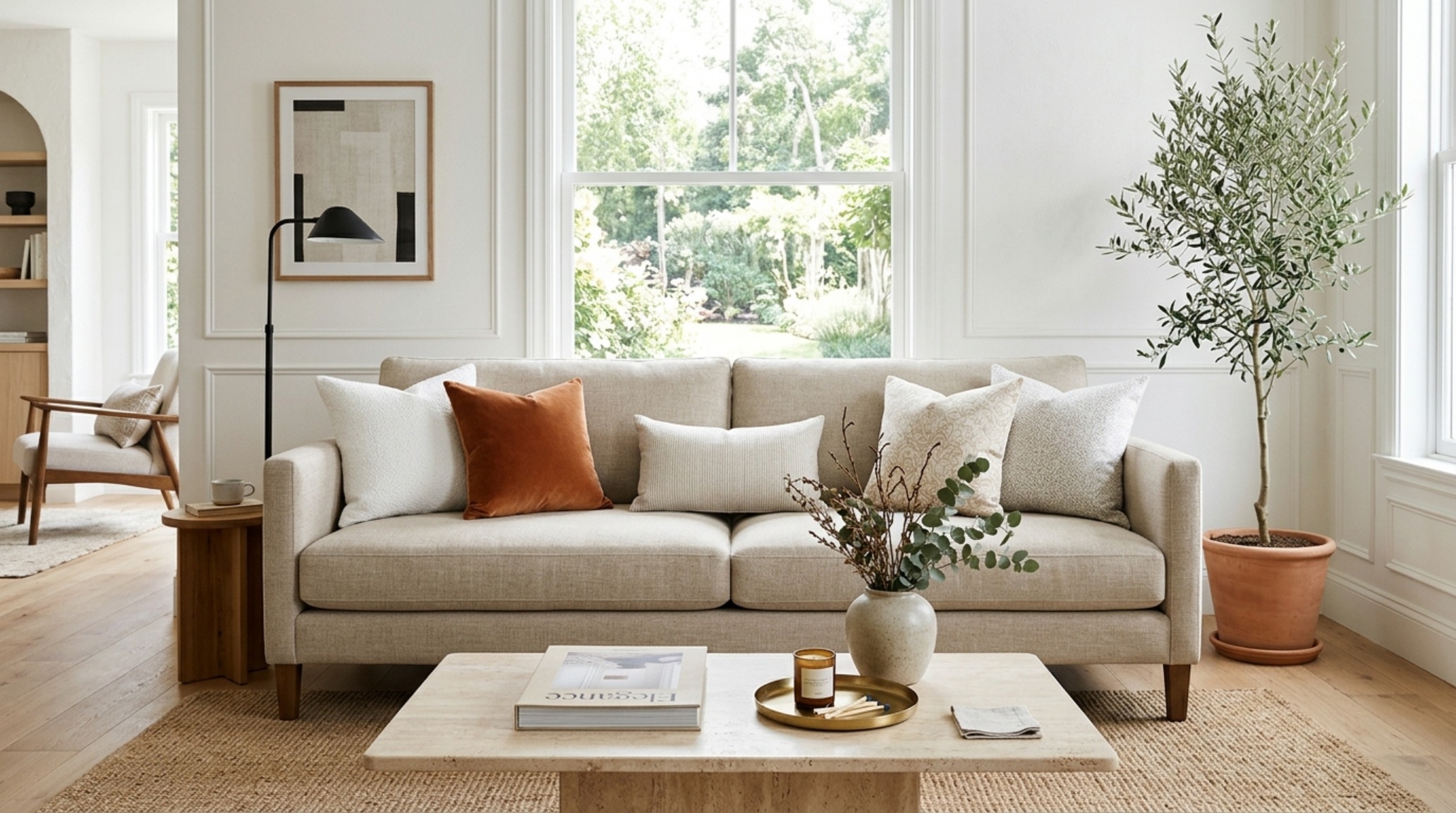
How to layer pillows on a couch using the 2-2-1 method with overlapping 22-inch squares in a soft neutral palette.
The 2-2-1 Architecture of Decorative Pillows for Couches
Once the foundation is set, we move into the second phase of the blueprint: the transitional layer. This involves two 22×22 inch pillows placed slightly overlapping the 24-inch anchors. This layer is where we introduce the first shift in personality. If the foundation is your ‘wall,’ the transitional layer is your ‘art.’ This is the ideal moment to introduce a subtle pattern—perhaps a soft pinstripe or a muted block print—that complements the solid base.
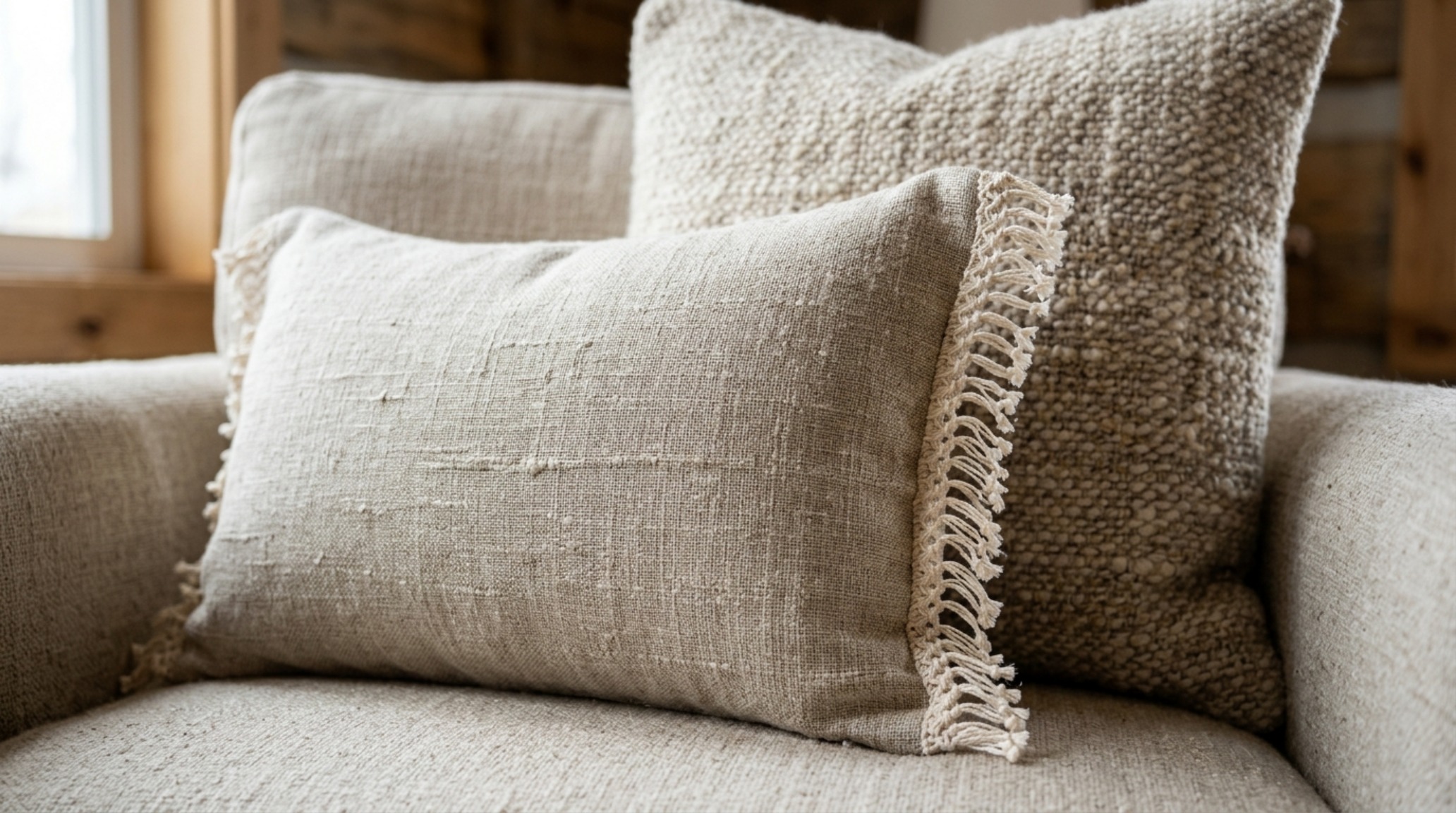
The final ‘1’ in our 2-2-1 formula is the lumbar pillow, the architectural keystone. Placed dead center, the lumbar breaks the symmetry of the squares and introduces a horizontal axis. A long, 14×36 inch lumbar is particularly effective on modern, low-slung sofas, as it emphasizes the width of the piece and draws the eye across the horizon line of the room. This center point acts as the visual gravity, pulling the flanking pairs into a singular, cohesive narrative. When selecting decorative pillows for couches, this lumbar is where you should invest in your most exquisite ‘hero’ fabric—a vintage silk ikat or a hand-knotted textile from an artisanal weaver.
div class=”image-placeholder” data-index=”2″>
How to Layer Pillows on a Couch: Calibrating Visual Depth
Layering is not just about stacking; it is about the manipulation of shadow and negative space. To master how to layer pillows on a couch, you must consider the depth of the seat cushion. On a deep-seated sectional, you have the luxury of creating a three-dimensional landscape. You might pull the 22-inch pillows forward by two inches, allowing a sliver of the 24-inch foundation to peek through, creating a shadow gap that adds perceived value to the arrangement.
Consider the ‘breath’ between the layers. If the pillows are packed too tightly, the sofa loses its inviting quality and becomes a fortress. We aim for ‘nested’ rather than ‘stacked.’ This means each pillow should have a slight angle—leaning toward the center—to create a soft, concave arc. This mimics the natural curvature of the human spine, signaling to the subconscious that this is a space designed for repose. High-end design is as much about the psychology of comfort as it is about the aesthetics of form.
Balancing the Sightlines with Coffee Table Proportions
The height of your pillow arrangement must also respect the surrounding furniture. If your coffee table is a low, honed travertine plinth, your pillows can afford to be taller and more voluminous. However, if you are working with a taller, 18-inch coffee table, keep the lumbar pillow slim to avoid a cluttered ‘mountainous’ look that obstructs the view of the hearth or the garden beyond. Every choice is a dialogue with the rest of the room.
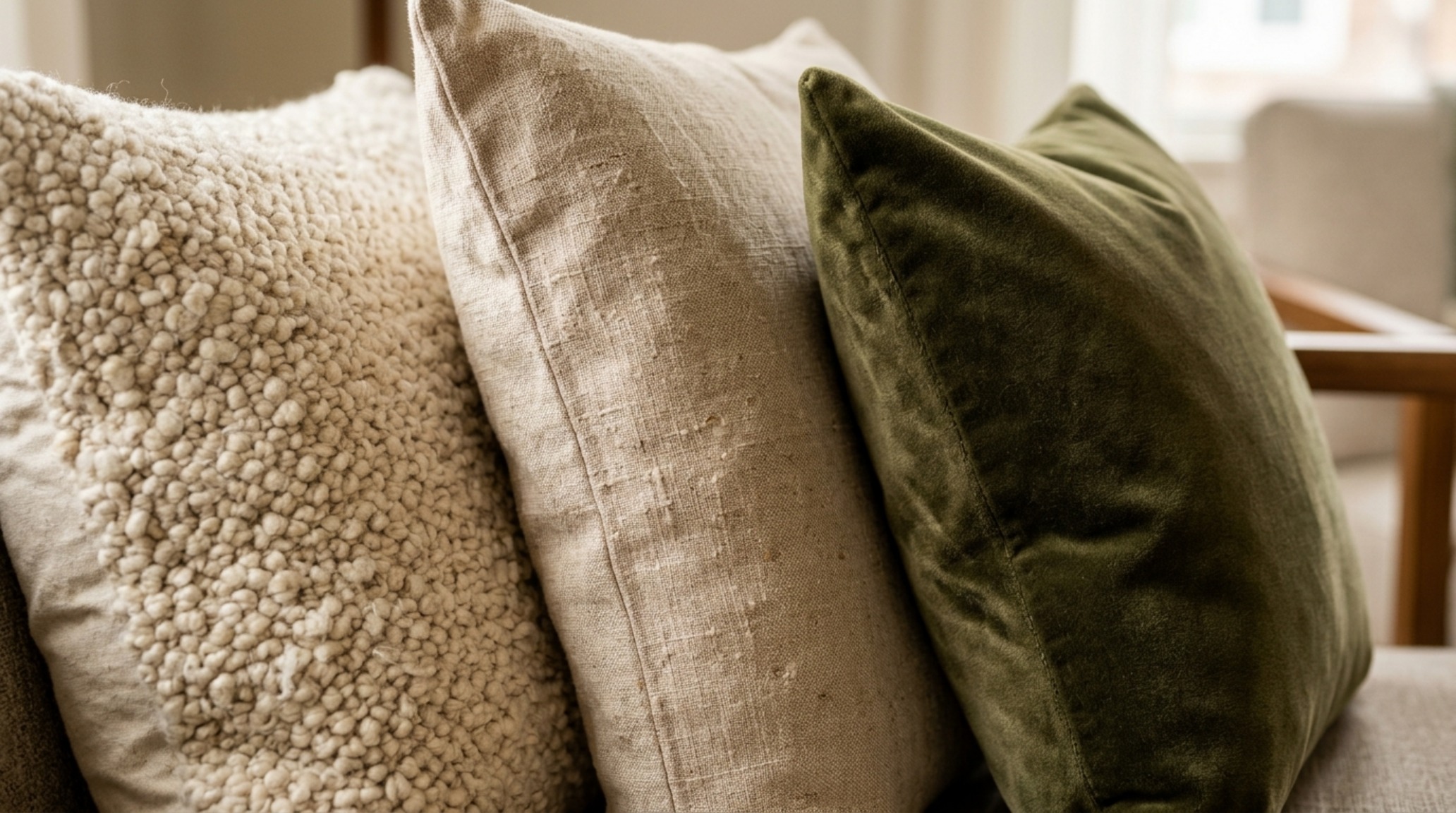
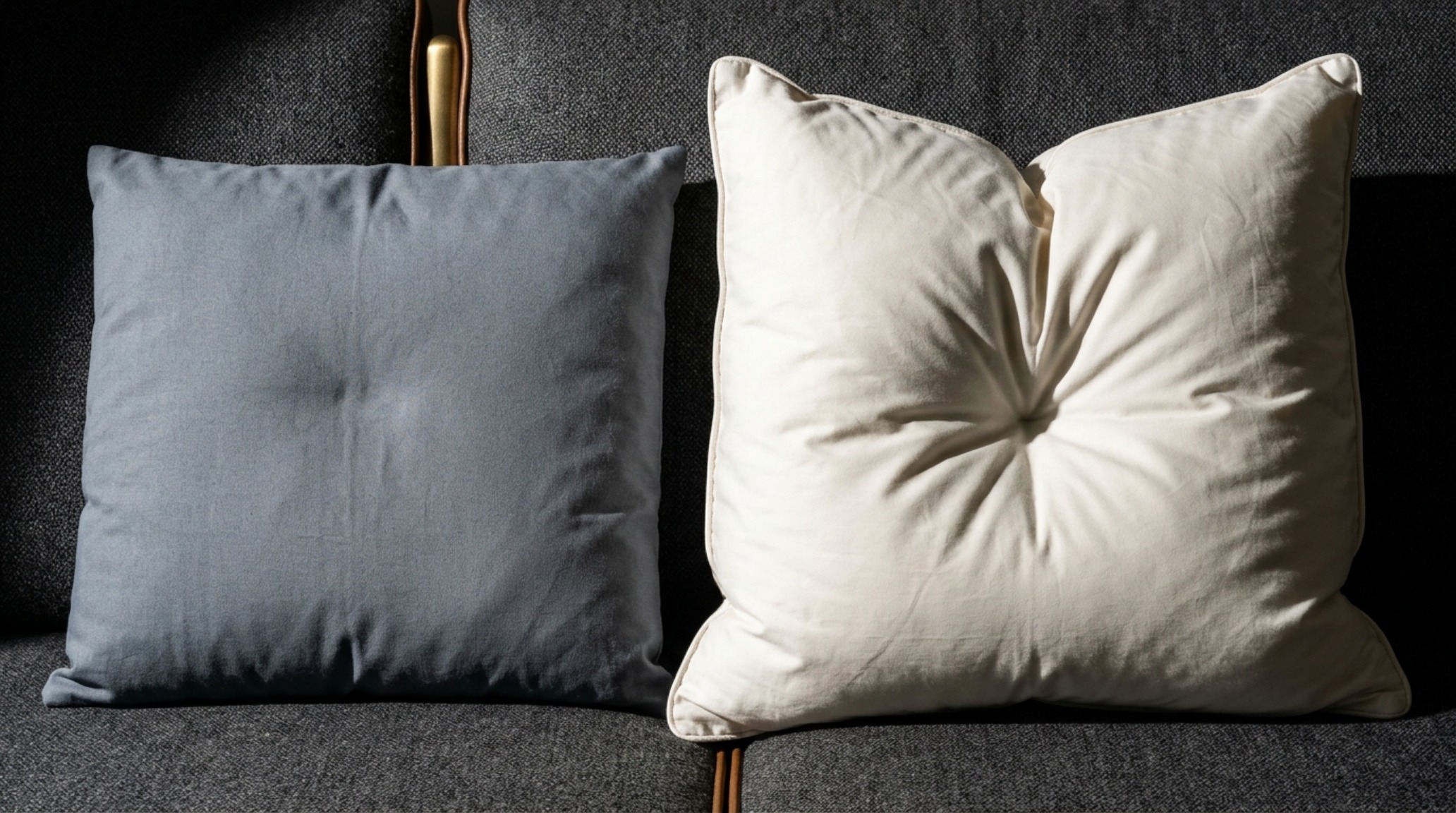
Mixing pillow patterns and textures with a combination of heavy-knit wool, smooth velvet, and pinstripe linen on a modern tuxedo sofa.
Mixing Pillow Patterns and Textures: The Materiality of the 2-2-1 Rule
Texture is the secret language of a neutral palette. When mixing pillow patterns and textures, think in terms of contrast: rough against smooth, matte against sheen. If your anchor pillows are a matte, heavy-weave jute-blend, your transitional pillows might be a shimmering mohair or a buttery velvet. This interplay of light—how the velvet catches the 2700K evening glow while the jute absorbs it—creates a richness that color alone cannot achieve.
The Scale of Pattern: If your 24-inch anchor is a solid, your 22-inch can be a large-scale organic print. The lumbar then functions best as a small-scale geometric or a highly tactile solid.
The Color Thread: Ensure every pillow shares at least one common ‘DNA’ color. Even a wildly different pattern will feel intentional if it shares a thread of Benjamin Moore’s ‘Swiss Coffee’ with its neighbor.
Fringe and Flange: Don’t overlook the edge details. A knife-edge finish feels modern and sharp, while a petite fringe or a leather-piped edge adds a layer of ‘bespoke’ craftsmanship.
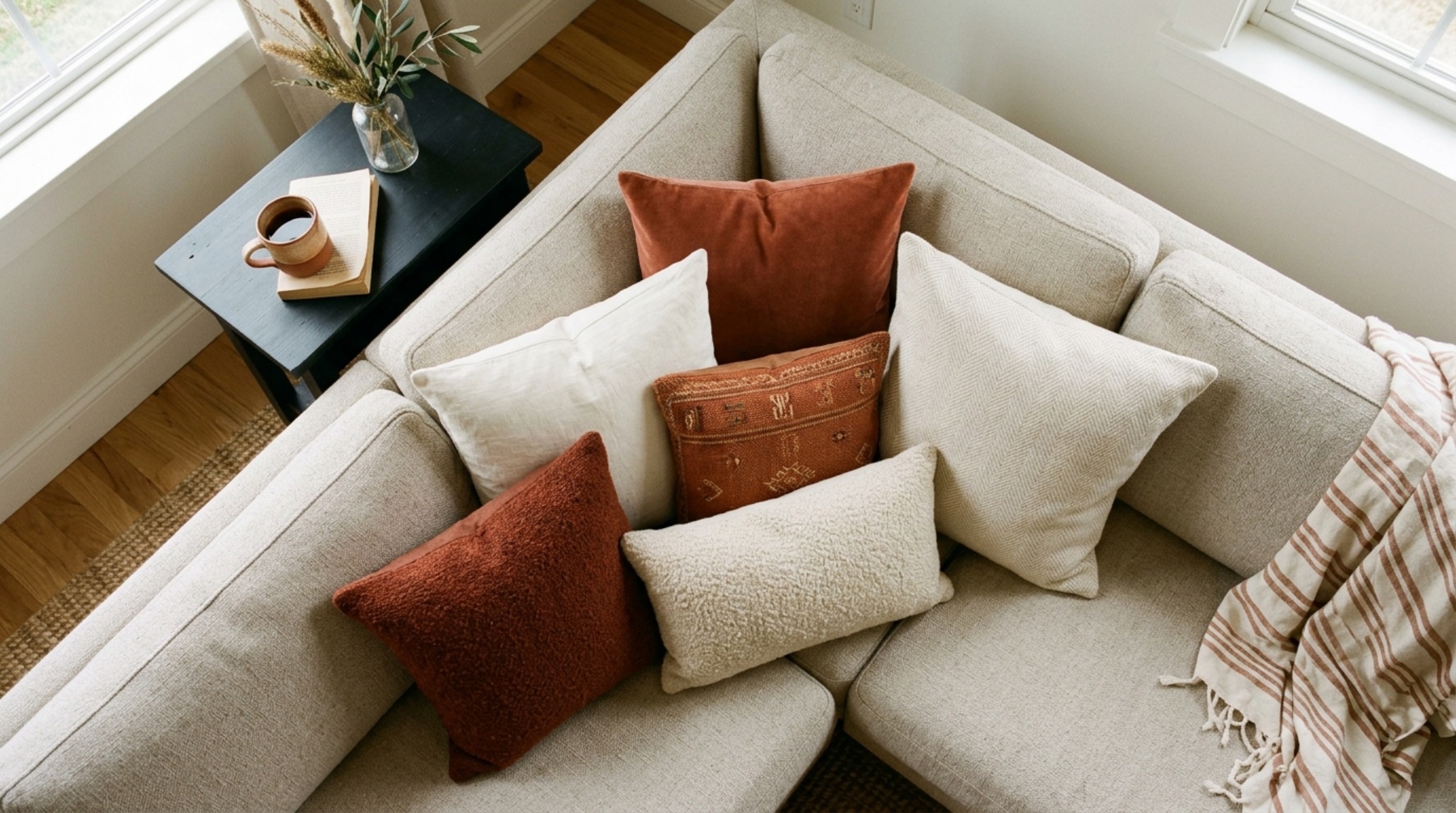
Lumbar pillows for sectionals arranged in a deep corner wedge to create a plush architectural focal point in a contemporary open-plan space.
Lumbar Pillows for Sectionals: Solving the Scale Dilemma
Sectionals present a unique challenge because they offer multiple ‘corners’ and an extended horizontal plane. When deploying lumbar pillows for sectionals, the 2-2-1 rule can be doubled or adapted. In the corner ‘wedge’ of the L-shape, create a cluster of three squares (24″, 22″, 20″) to provide a plush nesting spot. Then, use long, oversized lumbars on the flanking ‘arms’ to ground the long expanses of the seat cushions.
For a large-scale sectional, a single lumbar often feels like an afterthought. Instead, consider two 12×24 inch lumbars placed side-by-side or staggered. This maintains the structural integrity of the sofa’s long lines without breaking the rhythm. The goal is to avoid the ‘scatter-gun’ approach where small pillows are peppered aimlessly across the length of the piece. Grouping them into architectural ‘zones’ provides the eye with resting places, making a large piece of furniture feel intimate rather than imposing.
Best Throw Pillow Arrangements: Beyond the Blueprint
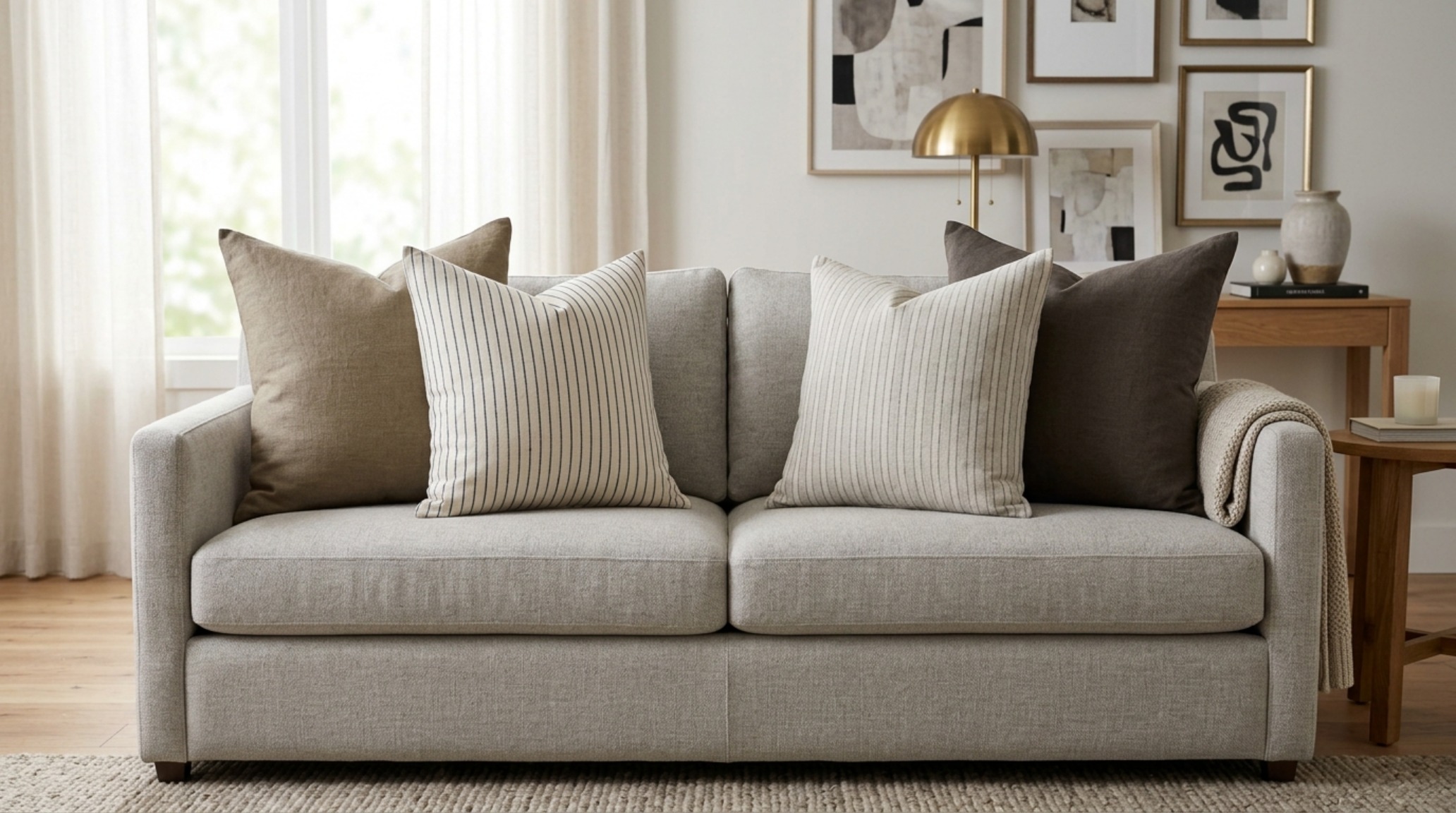
While the 2-2-1 rule is the gold standard, the best throw pillow arrangements often take cues from the specific silhouette of the sofa. A Lawson-style sofa with its soft, rounded back cushions requires a more relaxed approach—perhaps fewer pillows to avoid overwhelming the soft lines. A Tuxedo sofa, with its high, straight arms, is the perfect candidate for the 2-2-1 rule, as the high arms provide a rigid ‘frame’ for the large 24-inch anchors.
“Design is not just what it looks like and feels like. Design is how it works.” — This Steve Jobs adage applies perfectly to the sofa. If you have to move five pillows just to sit down, the design has failed. The 2-2-1 rule is efficient; it provides maximum visual impact with five well-chosen pieces that are easily shifted or leaned against.
Best throw pillow arrangements for a high-end gallery look, emphasizing spatial volume and symmetrical balance on a custom upholstered sofa.
Tactile Finishes, Color Codes & Spatial Ledger
Architectural breakdown detailing authentic surfaces, paint references, and standard circulation clearances.
Color Swatches & Hex
#F2F0EB Swiss Coffee, #D9D2C5 Setting Plaster, #3C3B39 Iron Ore
Core Tactile Materials
Washed Belgian Linen, Silk Mohair, Honed Silver Travertine
Atmospheric Lighting
2700K Warm Ambient, High CRI 95+, Dimmable Cove Lighting
Spatial living is about more than just square footage; it’s about the cadence of the objects we choose to surround ourselves with. When we apply the 2-2-1 blueprint, we are doing more than just choosing decorative pillows for couches; we are acknowledging that the smallest details carry the most architectural weight. By respecting scale, volume, and materiality, we transform a simple piece of upholstery into a masterclass in balanced, intentional living. As the light shifts through the room and the shadows lengthen across the linen and velvet, the sofa remains a perfectly composed testament to the beauty of precision.
Jack Rodriguez is a Minimalist Interior Architect with over 7 years of hands-on experience in negative space balance, clean architectural lines, and decluttered living environments. Jack approaches each space as a tailored sculptural canvas designed for human ease. An avid contributor to architectural and design dialogues, Jack writes extensively on creating elevated residential sanctuaries.
CURATORIAL CRITIQUE & DESIGN ANTHOLOGY: The Tectonic Shift Walking through a contemporary Athenian residence today, one isn’t greeted by the high-contrast, often-jarring juxtaposition of…
The Architecture of Arrival: A Curatorial Critique of the Transitional Threshold Observe the modern residential sanctuary and you will find that the most successful…
The Evolution of Precision: From Static Architecture to High-Performance Living Historically, homes were a series of disconnected boxes, partitioned by heavy oak doors and…