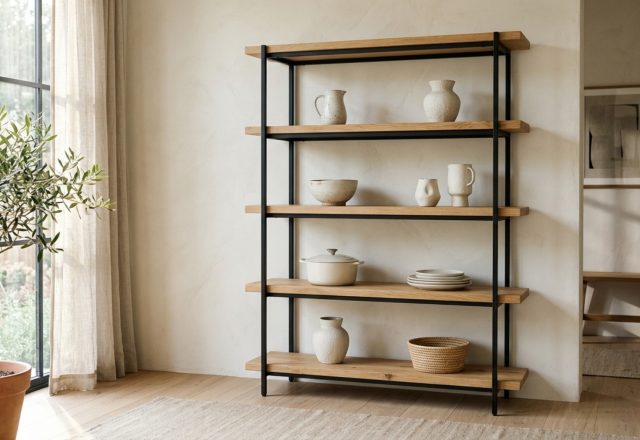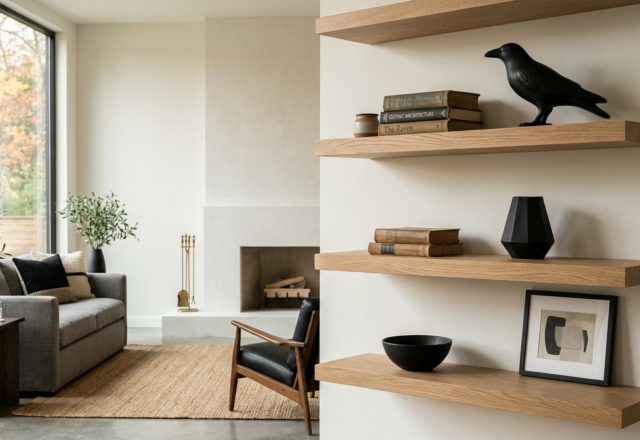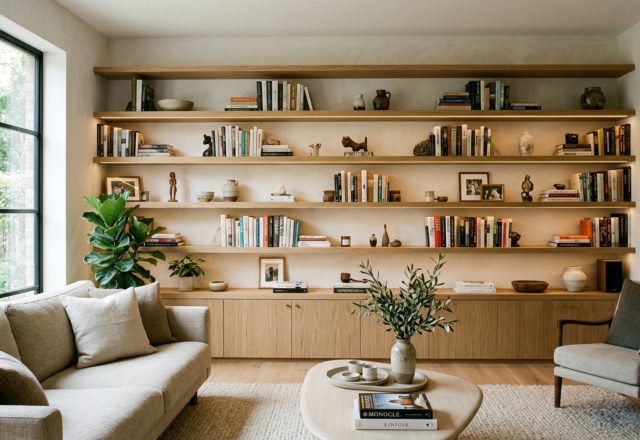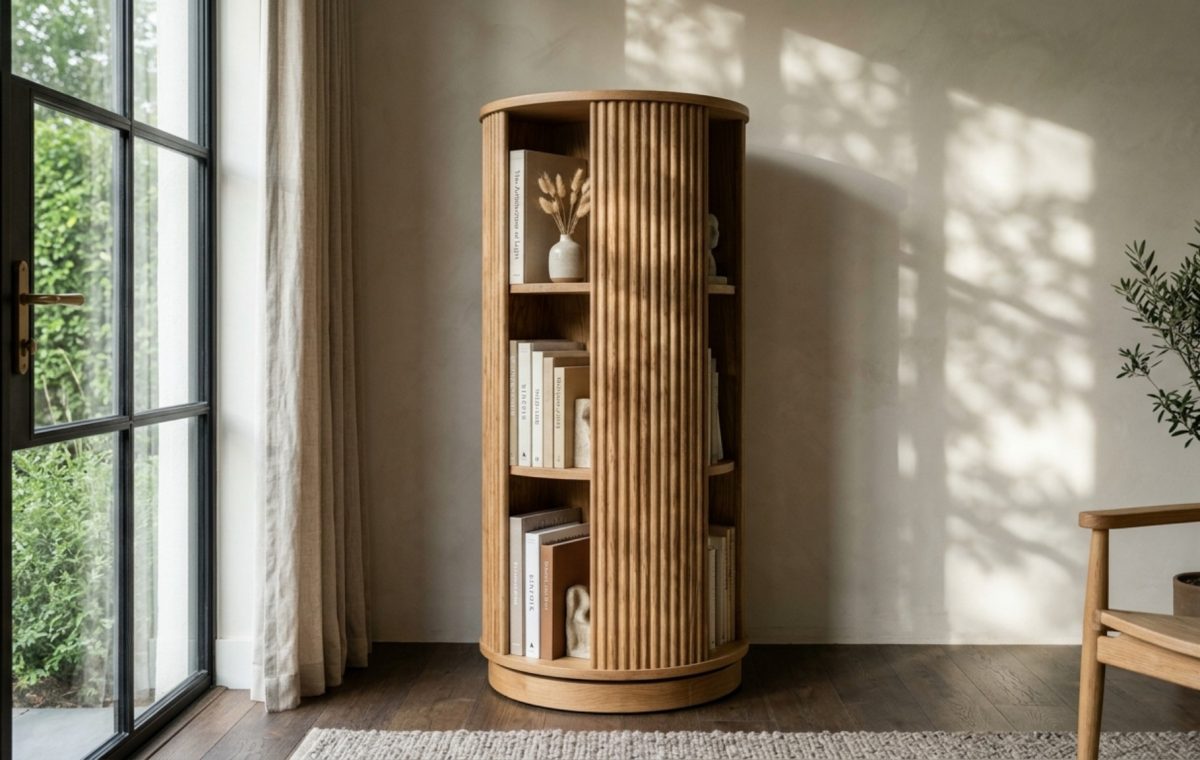
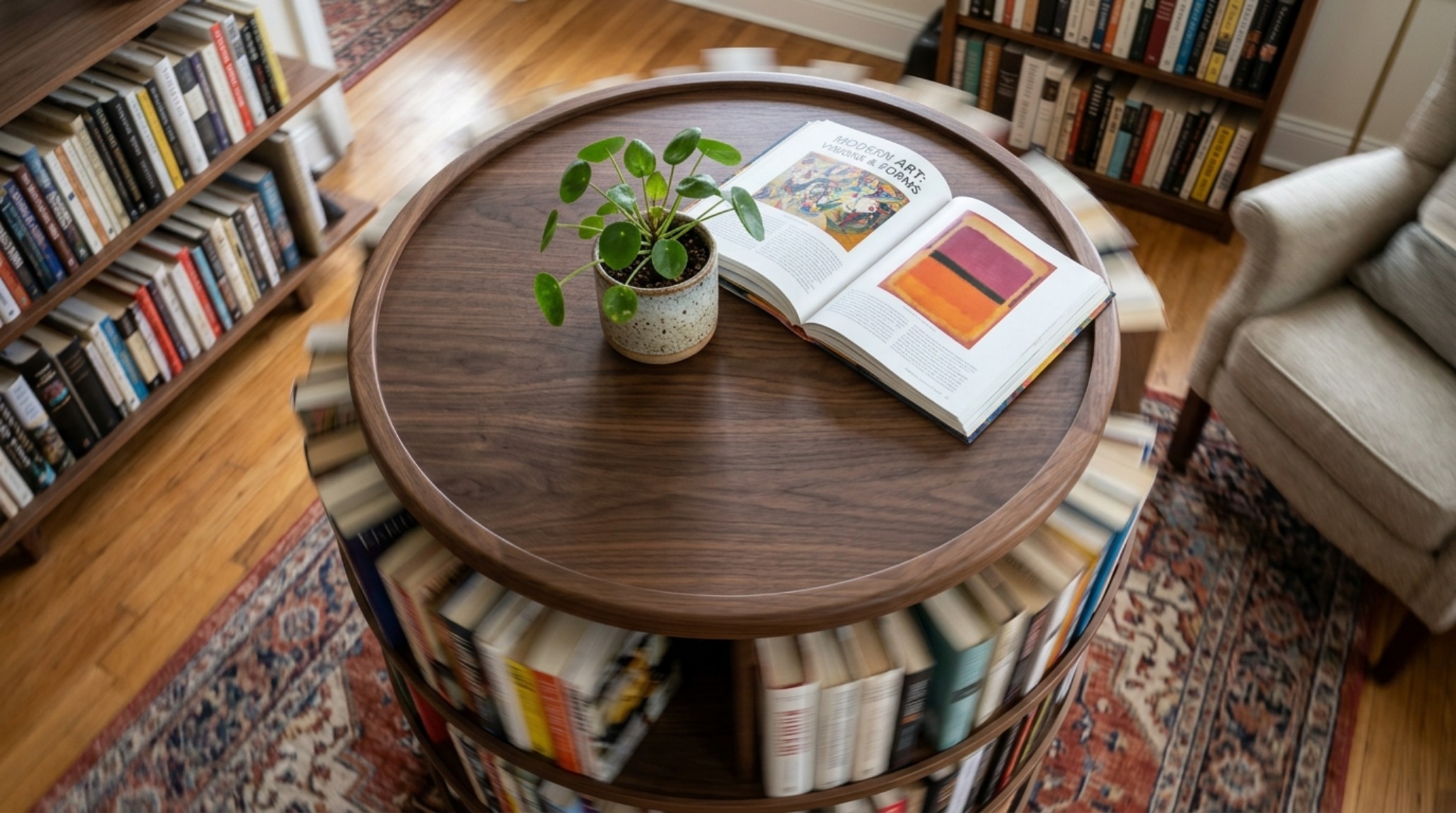
There is a specific kind of heartbreak known only to the urban bibliophile: the moment you realize your collection has outpaced your floor plan. We have all been there, standing in a sun-drenched but spatially challenged living room, measuring the distance between the sofa and the wall with the desperation of a surveyor. In the traditional architectural canon, a library requires a dedicated room—or at least a dedicated wall. But in the era of high-density metropolitan living, we are seeing a radical shift toward kinetic furniture that defies the static constraints of the past. Enter the 360-degree kinetic sculpture that has recently taken the design world by storm. While many are exploring living room floating shelves ideas to lift their collections off the floor, the viral rotating bookshelf represents a pivot—literally—toward a more frictionless, high-density future.
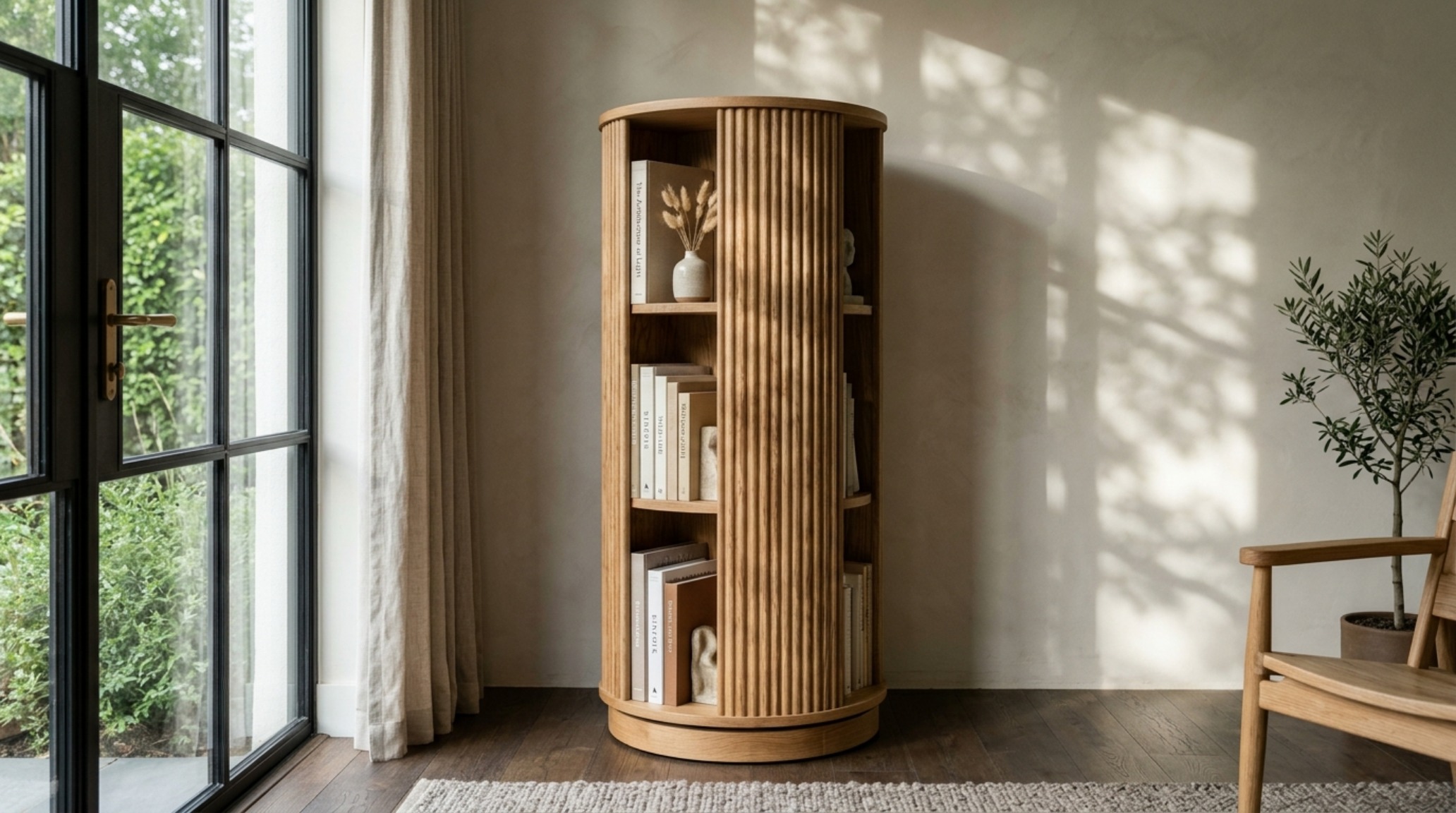
The brilliance of this furniture typology lies in its refusal to adhere to the traditional ‘wall-bound’ logic of interior design. In a standard setup, a bookshelf is a monolithic presence that consumes linear wall space. When we analyze the ergonomics of a small apartment, every inch of that perimeter is precious real estate for seating, art, or windows. The rotating book tower, however, operates on a central axis, reclaiming the ‘dead corner’—that awkward 24-inch vacuum where shadows go to die. By utilizing a vertical, rotating footprint, you are essentially tripling your storage capacity without increasing the square footage required. It is an exercise in spatial efficiency that feels less like a storage unit and more like an architectural installation.
The Ergonomics of Motion: Beyond Traditional Living Room Floating Shelves Ideas
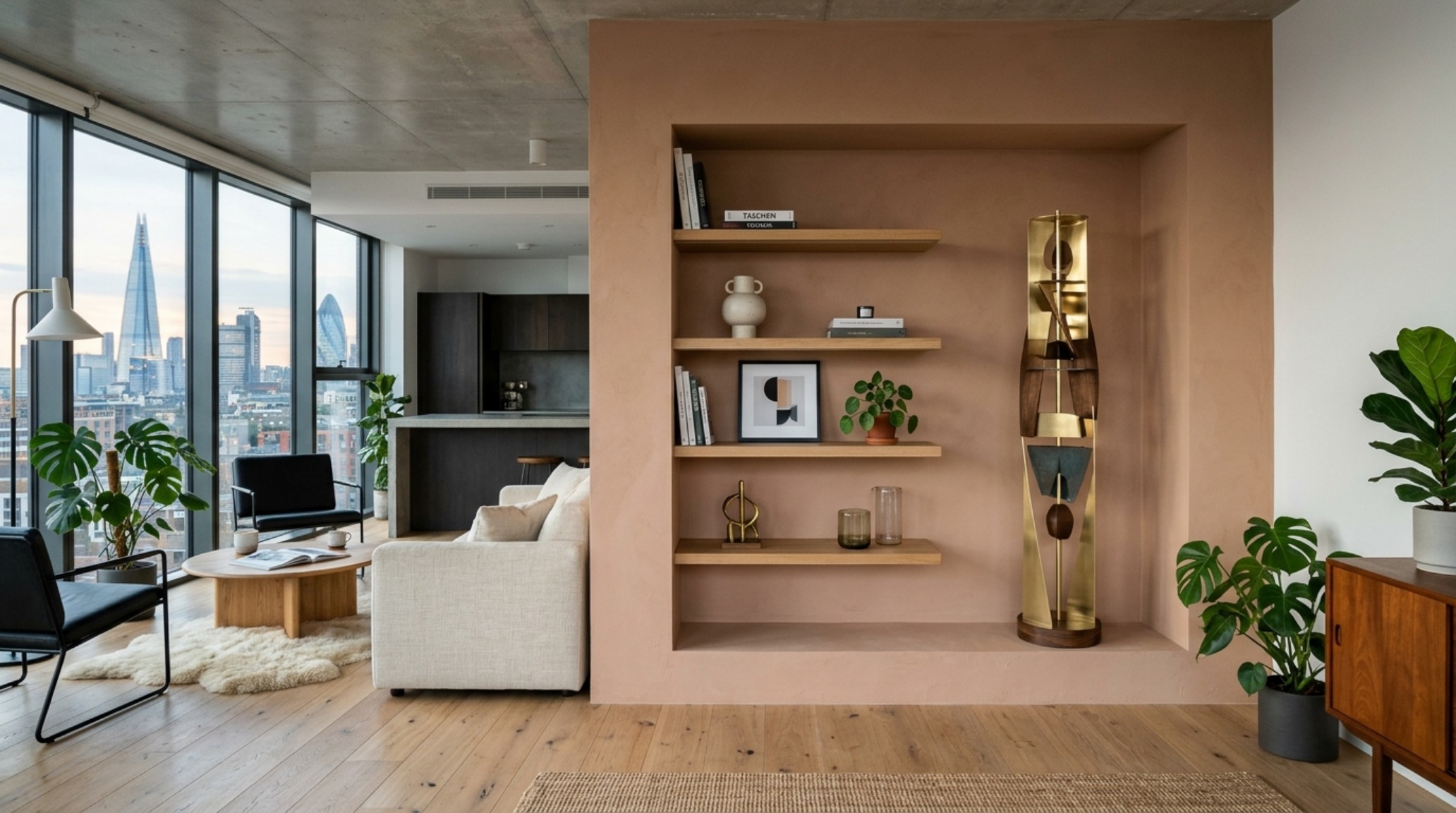
When we discuss living room floating shelves ideas, we are usually solving for visual lightness. Floating shelves are marvelous for creating horizontal sightlines and allowing the wall color—perhaps a soft, breathable shade like Benjamin Moore’s Swiss Coffee—to peek through. However, floating shelves have a weight-bearing limit and a fixed depth that can sometimes crowd a narrow walkway. The rotating bookshelf solves the depth crisis. Because the unit spins, you only need to access one face at a time. This allows for a tighter integration into corners that would otherwise be inaccessible.
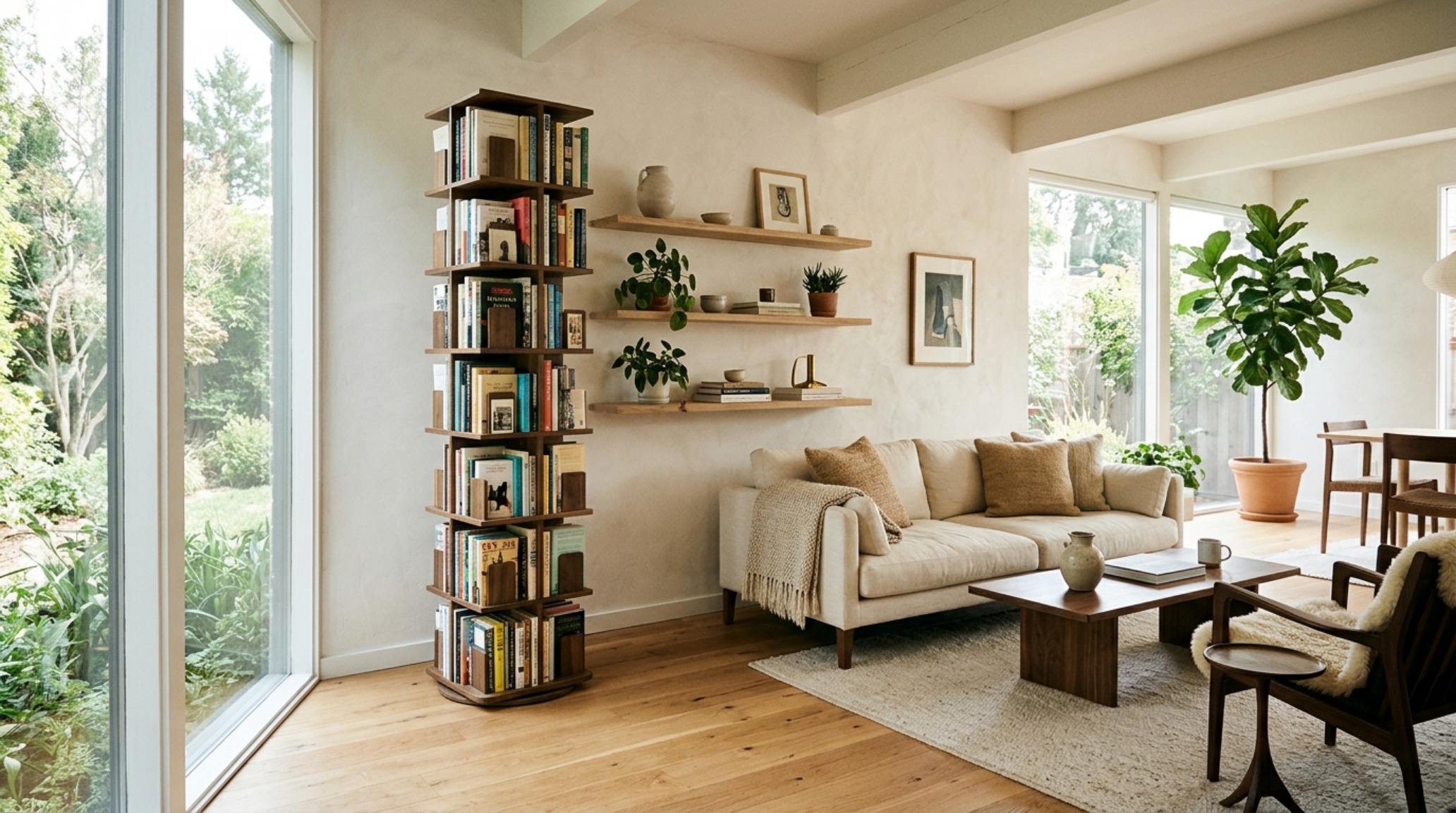
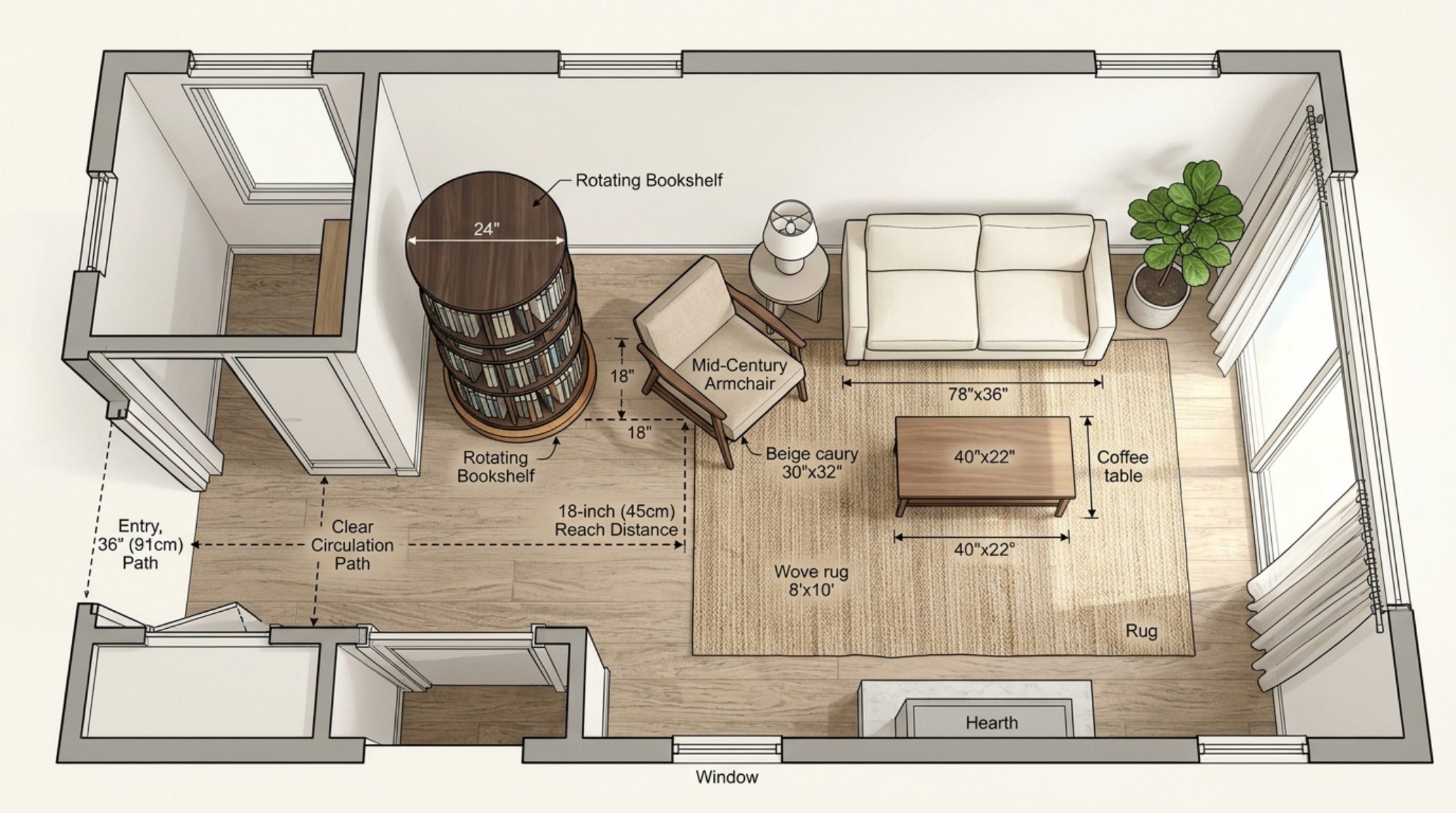
Architecturally, we must respect the 36-inch primary circulation rule. In a compact living room, a standard 12-inch deep bookshelf can quickly turn a comfortable passage into a claustrophobic gauntlet. A rotating tower, strategically placed at the terminus of a seating arrangement, requires only its own diameter to function. This kinetic approach allows the dweller to maintain that crucial 36-inch clearance while still housing a library of 200+ volumes. It’s about the cadence of the room; the furniture adapts to the person, rather than the person maneuvering around the furniture.
The Hybrid Strategy: Blending Kinetic and Static Storage
The most successful ‘Quiet Luxury’ interiors aren’t built on a single gimmick. They are built on layers. I often advise clients to pair a primary rotating tower with asymmetrical living room floating shelves ideas to create a sense of architectural permanence. Imagine a corner anchored by a fluted white oak rotating column, flanked by two or three long, slim floating shelves in a matching timber. This creates a ‘Z’ pattern for the eye to follow, breaking up the verticality of the tower and grounding it into the room’s broader geometry.
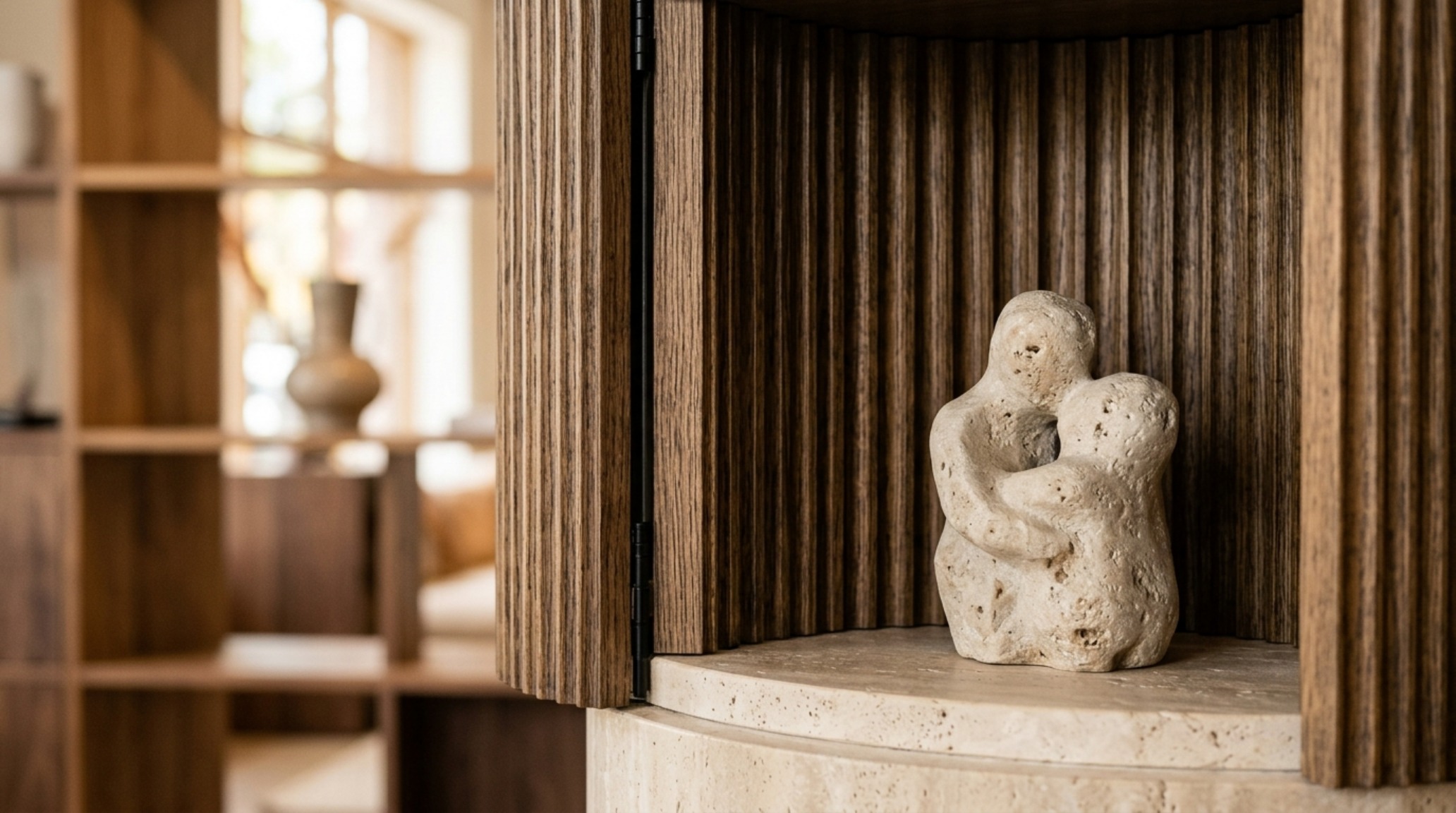
In this hybrid configuration, the rotating shelf handles the bulk—the heavy hardcovers and the dense reference texts—while the floating shelves provide the negative space breathing room. This is where you place your tactile ‘moments’: a single piece of honed travertine, a vintage brass taper holder, or a small ceramic vessel. This interplay between high-density storage and curated minimalism is what elevates an apartment from ‘cluttered’ to ‘collected.’
Materiality and the 2700K Glow: Setting the Atmospheric Index
We cannot discuss modern shelving without addressing the sensory experience. The viral appeal of these units isn’t just their function; it’s their Organic Modern aesthetic. We are seeing a move away from the sterile, high-gloss whites of the 2010s toward materials that offer tactile grounding. Think fluted oak, blackened steel with visible weld marks, and matte-lacquered finishes. When these materials interact with light, the room transforms.

For a library nook to feel like a sanctuary rather than a warehouse, lighting is non-negotiable. I recommend a dedicated 2700K warm ambient light source nearby. This color temperature mimics the golden hour, softening the edges of the books and making the wood grain pop. If you are integrating living room floating shelves ideas into this scheme, consider recessed LED strips with a high CRI (Color Rendering Index) of 90+. This ensures that the spine of that first-edition Steinbeck looks as rich and saturated as the designer intended. Avoid 3000K or higher in these zones; you want an inviting glow, not the sterile hum of a pharmacy.
The Physics of Style: Weight Distribution and Visual Balance
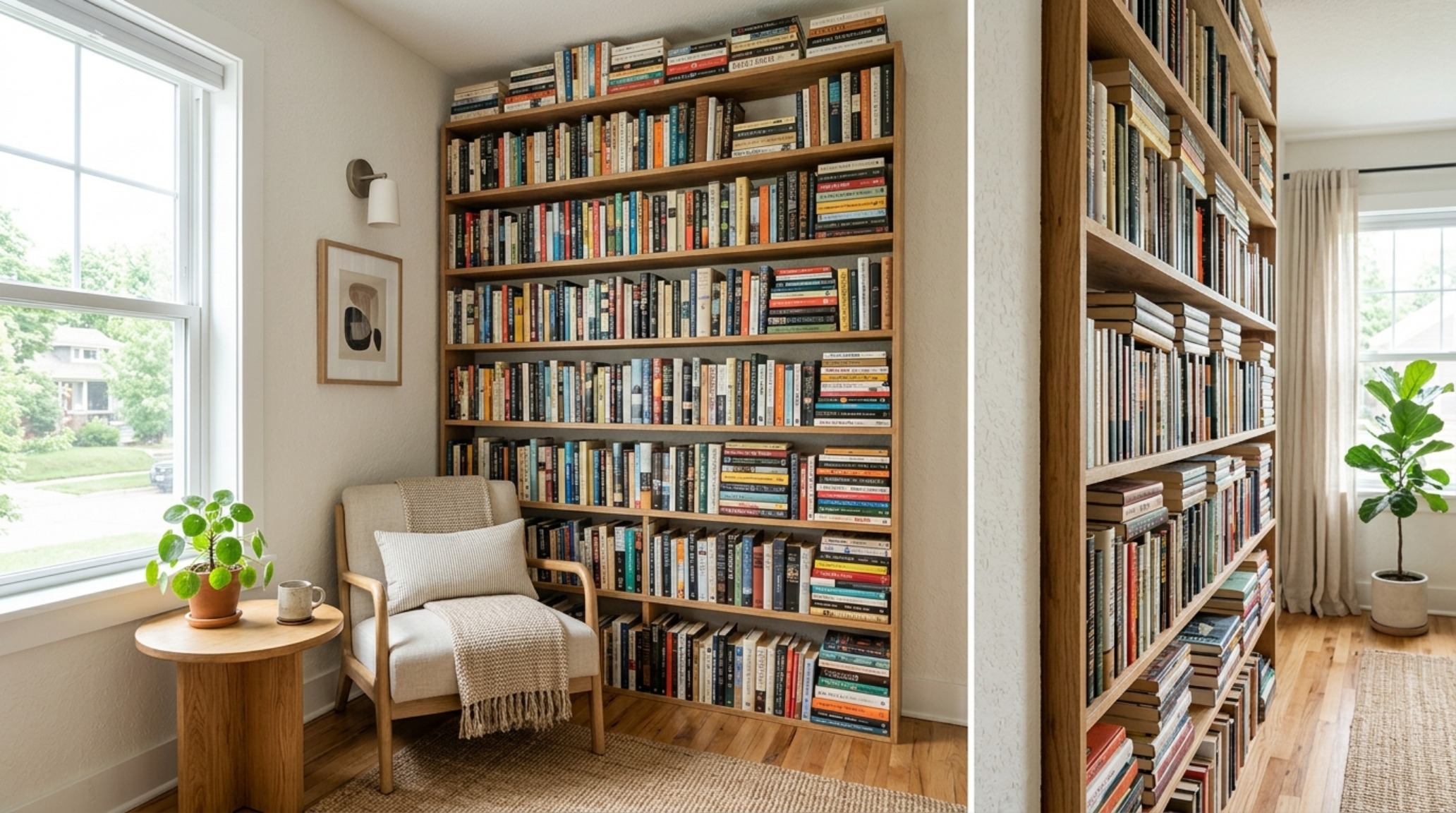
One of the most common mistakes in small-space styling is ‘visual dumping’—filling every available inch until the eye has nowhere to rest. Even with a high-density rotating unit, the principles of spatial cadence apply. Group books by height or by tonal palette to create a sense of order. Use the 360-degree nature of the shelf to your advantage; perhaps one side is dedicated to your most-read fiction, while another side is a rotating gallery of oversized art books.
When aligning these units with living room floating shelves ideas, maintain a sense of sightline alignment. The top of your rotating tower should ideally align with a window frame or the highest floating shelf to create a cohesive ‘horizon line’ in the room. This prevents the furniture from feeling like a series of disconnected islands. It’s about creating a unified architectural gesture that feels intentional and custom-built, even if it’s an off-the-shelf solution.
Tactile Mastery: Reclaiming the Corner with Kinetic Sculpture
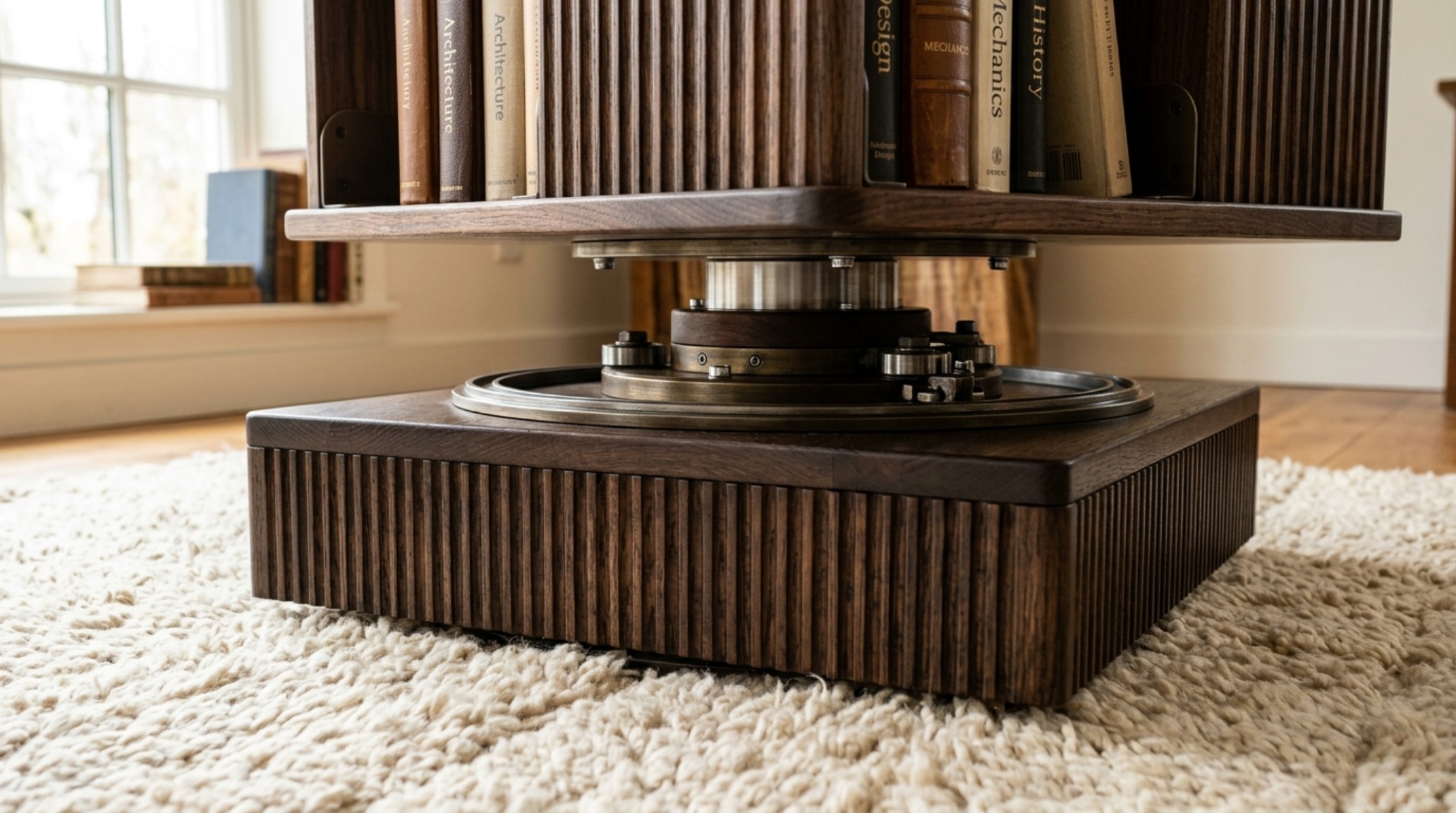
The true luxury of the rotating bookshelf is the friction-less access. There is something deeply satisfying about a silent, ball-bearing-smooth rotation that brings your entire library to your fingertips. It turns the act of choosing a book into a tactile ritual. In an era where everything is digital and ethereal, the physical weight of a rotating library provides a necessary anchor. It is furniture that invites touch, much like a fluted wall panel or a velvet-upholstered chair.
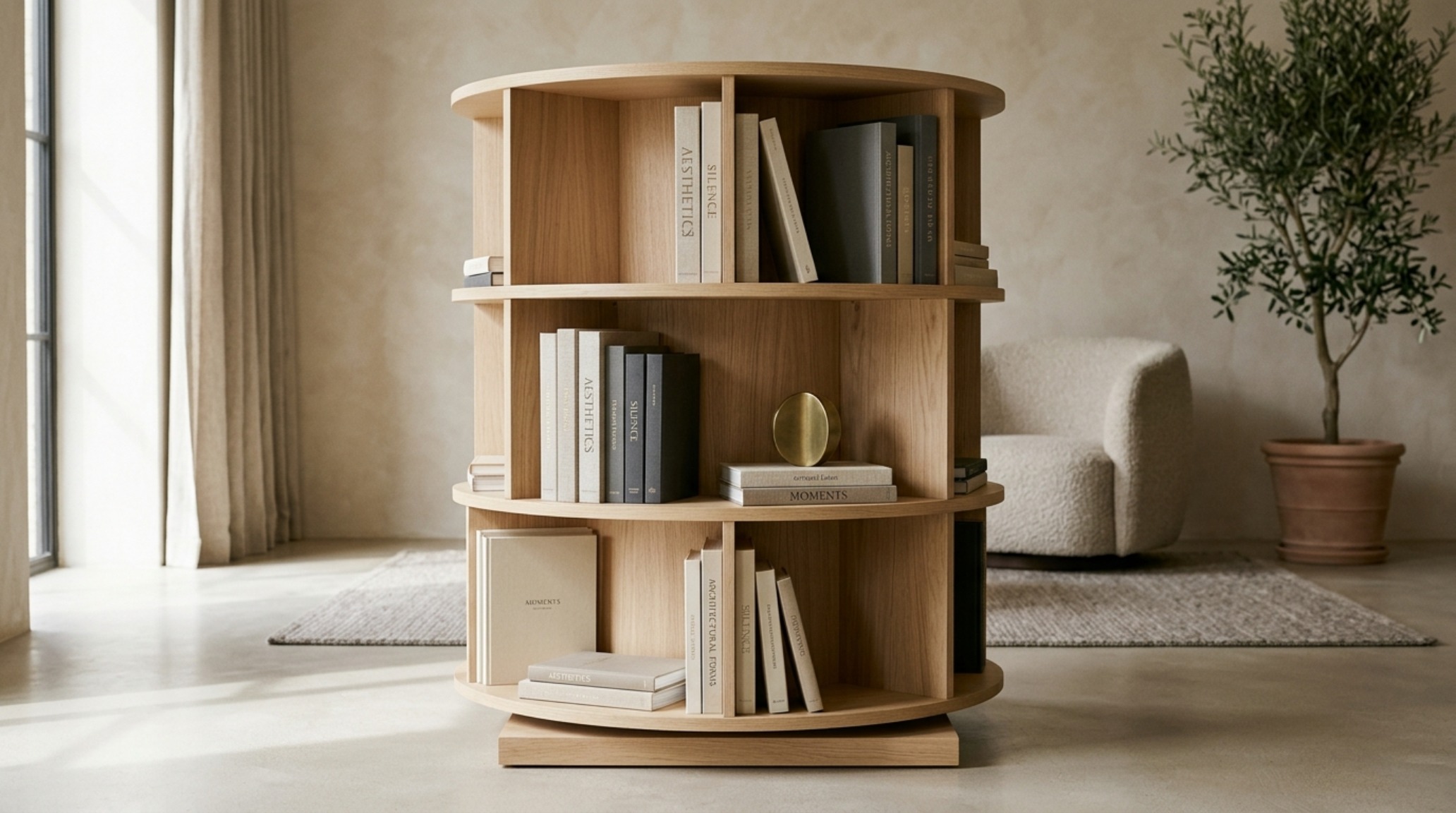
As we look at the evolution of the urban apartment, the ‘Zero-Square-Foot’ library isn’t just a trend; it’s a necessity. It’s a response to the compression of our living spaces and the expansion of our personal identities. By combining the high-efficiency engineering of kinetic units with the aesthetic grace of living room floating shelves ideas, we are no longer choosing between our books and our breathing room. We are designing a space that accommodates both with effortless, architectural precision.
Architectural Specification & Material Matrix
Curated tactile palette, spatial dimensions, and atmospheric lighting index for this design scheme.
In the final analysis, the integration of kinetic furniture and thoughtful living room floating shelves ideas represents more than just a storage solution—it is a sophisticated dialogue between motion and stillness. As we continue to inhabit denser urban environments, our furniture must become as dynamic as our lives. The rotating library is a quiet reminder that even in the smallest footprint, there is room for an infinite world of stories, provided we are willing to view our space from every possible angle.
Editorial Silo • Recommended Architecture Studies
- Ikea Hyllis Shelves Hacks: The Architectural Blueprint & Spatial Flow Guide — Archival Design Case Study
- The Invisible Haunt: Multi-Functional Living Room Floating Shelves Ideas for Seasonal Sophistication — Archival Design Case Study
Architectural Inspiration Lookbook
A high-resolution study in spatial proportions, tactile materiality, and light choreography curated for enduring modern living.
Curated Visual Lookbook
Design Gallery & Spatial Studies
A visual curation of architectural arrangements, lighting concepts, and material palettes featured in this space.